Wednesday, July 27, 2011
Bastion: A Review and Some Further Thoughts on Choice and Inevitability
Firstly, I wrote a review of Bastion for Paste Magazine. You can read it here, and perhaps you should before you read the rest of this post so I don't have to repeat myself. But if you don't feel like it, here is a run down: Bastion is an utterly beautiful and melancholy game that makes you care for a world that no longer exists. There. That should be all you need for the rest of this post. Also, the rest of this post will contain spoilers for both Bastion and Grand Theft Auto IV so perhaps don't read on if you are yet to complete Bastion at least once.
At the end of Bastion you have to make a couple of choices. The first one is potentially heartbreaking, but not relevant to what I want to say here so I won't go into any details. The second one is what I am concerned with here. At the end of Bastion you can choose to do two things: either rewind time to before the Calamity ripped the world to shreds, or use the Bastion as some kind of airship to fly off and find new lands. However, both have consequences. If you rewind time and 'unbreak' the world, 'you' will cease to exist anymore. The Kid, Rucks, and Zia will have no memory of the post-Calamity world--something that would be hard enough to give up if Zia did not admit right towards the end that she has only ever known happiness since the Calamity. Further, there is no guarantee that people will not make the same mistake and simply cause the Calamity all over again. The consequences of continuing on, of using the Bastion as an airship to fly off into the sunset is two-fold: firstly, obviously, it means the Calamity will never be undone. Ever. Secondly (and more vaguely), the world around you will be irreversibly damaged as you take off. Or something. The game is not overly clear on this point but it seems to me that all the beasts and Ura in the vicinity will be destroyed by you choosing to fly off on the Bastion to find new lands. Perhaps I misread this, though.
It was a hard choice to make and, ultimately, I did not feel as though I had 'completed' the game until I played through it twice and made each choice. The first time I decided to turn back time. At that point, it was the obvious choice. Having heard so many stories about the pre-Calamity world from Rucks's tales, I needed to save it--or rather, to give it a second chance to save itself.
The second time through, when I played "New Game Plus" (which is essentially a new game where you keep you experience and weapons and the enemies get more difficult to reflect this), it was clear that this was not a distinct, 'other' game. The continuation of my character as well as some slight, clever changes in the narration made it clear to me that the Calamity had happened again. So on this playthrough, it made sense to make the other choice, to move forward into the future and not to stagnate in the past. It was bittersweet, of course, as it meant saying goodbye to the world I had wanted to visit for two generations of myself now, but it was filled with a sense of hope and optimism. There was me, Zia, and Rucks, and we were going to explore a brave new world.
The beauty of this was the the utter gravity of my choice to say goodbye to the pre-Calamity world was painfully apparent largely due to my previous playthrough. Because of that playthrough, I knew that turning back time yet again was inevitable. We often say that videogame narratives are about being able to answer the "what if" question. "What if I did this, not that." Bastion answers the question brutally by making you see that what happens is not pretty and then asking you to choose again.
Of course, the flaw of this is that not everyone makes the choice in the order I made them. I feel as though the game is attempting to set up the choices to be made in that order by trying to tie you down to the world with Rucks's sweet, sweet voice, but some players will certainly choose the future their first time through. This, then, destabilises the meta-narrative that, for me, ran through both playthroughs. It's a weakness of the story that i feel Bastion was trying to tell but one that is in no way new to videogames: the player will rarely do what the storyteller wants them to do.
Only one other game felt as incomplete until I played it twice and made the different choice: Grand Theft Auto IV. Rockstar's games always have that inevitability streak, but never has it hit me so hard as it did in Grand Theft Auto IV. Towards the end of the game, Niko makes the choice to either work for a man that previously betrayed him (and make a lot of money) or to kill the man for vengeance (and make no money). His cousin, Roman, wants him to take the money. His girlfriend, Kate... well, she doesn't want him to get revenge, but she doesn't want him to take the money, either. Either way, Niko has promised himself, his cousin, and Kate that this is it, that he will get himself out of this sink-pit of crime once he does this One Last Thing.
So the player makes the choice. Long story short, if you take the money (what Roman wanted you to do), then Roman gets shot dead at his wedding; if you take revenge (what Kate kind of wanted but not really) then Kate gets shot dead at Roman's wedding. The way the narrative progresses, both endings make sense based on the choices you made, and both leave Niko devastated at the end of the game's narrative.
The first time through the game you think "what if". What if you had just taken the money? Kate would still be alive. What if you had walked away? Roman would still be alive. So you play again; you make the other choice; and Niko simply loses someone else he loves. It kind of makes Niko Bellic one of gaming's few tragic characters. The utter helplessness of the situation he gets himself in becomes all the more apparent when you make a different choice and end up at a similarly dark conclusion--if you can call an aimless existence in a foreign city with the specter of a loved one haunting you a conclusion.
Neither of these games do this inevitability-through-choice perfectly. Bastion's hinges on makes choices in a certain order for the full impact to hit the player. Meanwhile, many people had enough trouble getting through one complete game of Grand Theft Auto IV, let alone two. But it is something I would like to see games exploit more often.
Tuesday, July 19, 2011
My Thesis. By Others.
When I uploaded a draft abstract of my thesis back in April, I promised I would continue to write updates about it here. Alas, I have failed to do that. In part this is because I've constantly had other writing obligations and in part it has been because the only times recently that thoughts related to my thesis have been coherent enough to publish is when I am actually writing it. At the moment I am struggling through Chapter One, which I'm hoping will allow me to situate where the player-character relationship sits, stradling the fourth-wall between the actual and virtual worlds (or something like this). Anyway, as I have been failing to write anything coherent about it, I have instead been writing incoherent rambles over at Google+ with which to have conversations with people about my ill-formed ideas.
And conversations I have had! Every post has seen a stack of thoughtful engagement and bouncing of ideas back and fourth and has been really useful for my writing and for forming my ideas. Most surprisingly, these rambles have actually got other people thinking and writing in areas related to the player-character relationship. In particular, Adrian Forest has written a blog post at Three Parts Theory called "Inhabiting Game Spaces" which brings together the relationship between player and character in regards to his primary interest in videogame spaces. Further, Kris Ligman has written a post at Popmatters about videogames, characters, and fourth walls and in doing so has rendered one of my incoherent rambles coherent. Both posts are an excellent read and in a weird, cyclical, nonlinear, new media kinda way, will hopefully end up being cited in my final thesis.
As for my rambles, if you wish to read them yourself, let me know and I will add you to the appropriate circles on Google+.
Thursday, July 7, 2011
Big Concerns about Tiny Towers
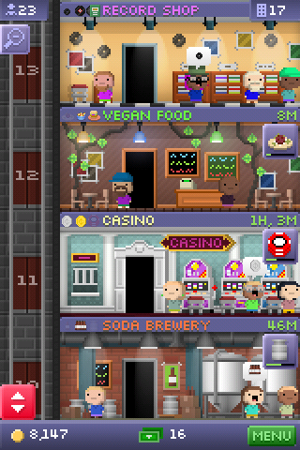
I have been playing the horrifically addictive iOS game Tiny Tower an awful lot lately. To justify the many, many hours the game has taken away from me, I went and wrote a review of it for Paste Magazine that you can read here.
While I was predominately positive in my review and gave the game a good score, the design of the game is potentially problematic and ethically unsound. Jorge Albor wrote a great piece for Popmatters discussing some of the (very valid) criticisms of Tiny Tower that my review just skims over, and follows it up with a few more remarks at Experience Points also worth reading.
Ultimately, Tiny Tower is 'addictive' in the most literal sense of the word, not in the casual 'really fun' sense that we tend to use in writing about videogames. It is designed in such a way that not playing it becomes more and more difficult the more you play it. Truly, it is like a drug: an unarguably enjoyable experience that probably isn't really good for you to do too often.
Anyway, I won't waste more words repeating Jorge or myself here. I find it interesting (and perhaps worrying) that I am enjoying a game so much despite the flaws that I am completely aware of.
Monday, June 27, 2011
Child of Rez
Rez had no right to be a good game. Its level of interactivity is down there with point-and-click adventures, Heavy Rain, and shopping mall directories. You move along on automatic rails, merely moving a crosshair over targets that appear in the same place every time you play. You point at things and they die. This is all there is to it. To get away with such minimal interaction most games would require an extensive narrative, but Rez has about as little story as it does interactivity. There is an artificial intelligence trapped in a computer network and you are trying to free it. That is pretty much it. Yet, despite this lack of interaction and story, Rez manages to be an utterly engaging experience.
So when Twitter assured me I could still enjoy Child of Eden without a Kinect, picking it up was a no-brainer. I tried not to get too excited; I tried not to expect too much, but the very fact that I had no idea what to expect probably, contrarily, made me more excited. When I first played Rez on an Official Playstation Magazine demo disc (that I had purchased for the metal Gear Solid 2 demo) I had no idea what it was I was experiencing. Rez was the most unique gaming experience I had ever encountered when I first played it and, despite knowing better, I was hoping for something just as new this time around.
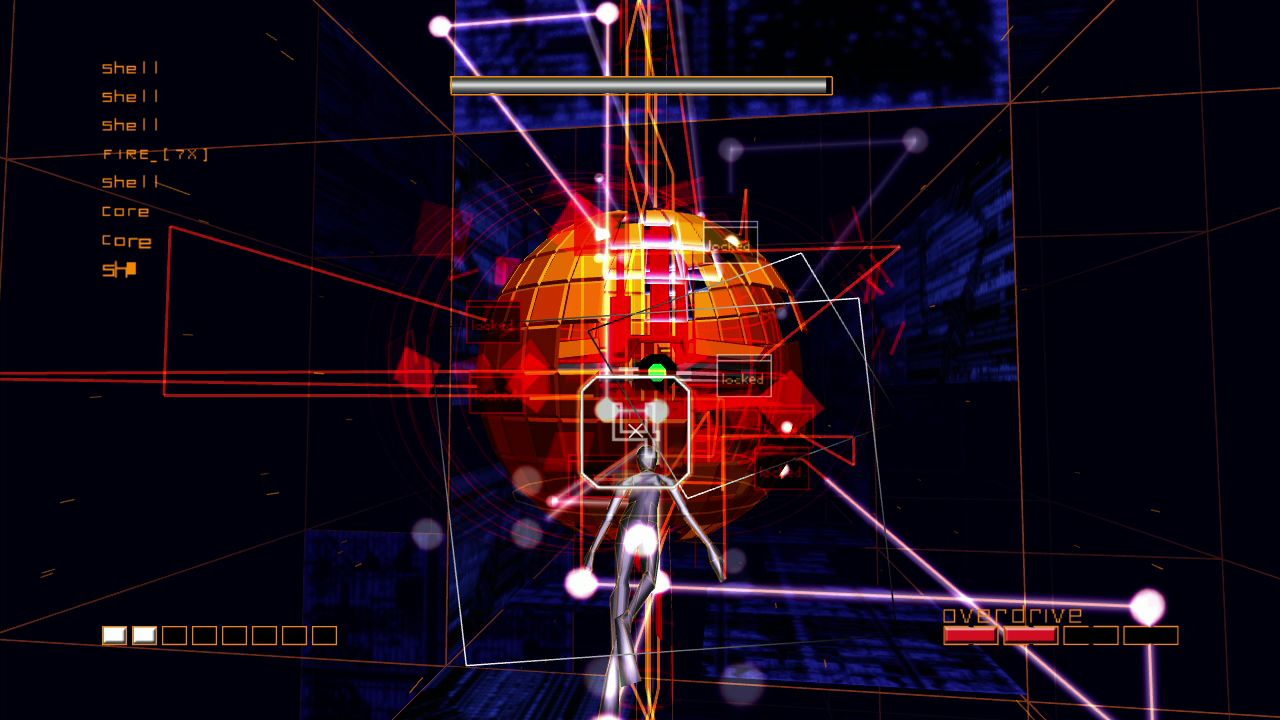
Sadly, though, the first thing you notice about Child of Eden is that it is not so much a spiritual successor of Rez as it is a direct sequel. Mechanically, very little has changed. You hold down a button while moving a crosshair around the screen, lock onto a maximum of eight targets, then release the button to fire and watch those targets explode into dazzling displays of light and sound. It relies on the same music/visual/haptic synthesis (though, I would argue not synesthesia) with the bass-thud vibrating through the controller, the handclapping of the crosshair when no target it locked, the psychotic and nonsensical worlds pulsing along to the beat. It's all there. The only mechanical difference is the baffling need to hold down a different button to fire the tracer at purple projectiles. I understand that with a Kinect, the tracer and the normal laser can be fired simultaneously, but with a controller you can only fire one or the other, which means many targets will escape as you try to control the fiddly crosshair to destroy the fifty missiles hurtling towards you with all the speed of a drifting continent. It's Child of Eden's only real mechanical innovation and also its weakest element.
Yet, despite the mechanical overlap, Rez and Child of Eden differ greatly in terms of thematic, aesthetic content. Just like Rez, every element of Child of Eden complements and build towards a central, consistent theme, and it is interesting to look at how the two games differ in this regard. Both games explore (in their own very abstract ways) the relationship between humans and technology, between consciousness and artificial intelligence, between the 'real' world and the virtual world. In Rez, you are trying to liberate an artificial intelligence construct from within a computer network (interestingly, the a.i.'s name is Eden). In Child of Eden, you are trying to rescue a real human's consciousness from within the internet (the internet now being known as Eden). Or something like that. The stories are not very coherent--or important, for that matter. Still, the little synopses for each game highlight the intertwined themes both games deal with and the subtly different perspectives and nuances of each.
As Rez's Eden is a fundamentally technological being, so too are Rez's aesthetics. All the game's visuals and sounds reflect themes of technology, science, computers, artificial intelligence, etc. The visuals are all rigid wireframes and flat polygons; the music is all techno beeps and industrial thuds. The playable character's health, too, is portrayed literally in its technological/visual layers. At lowest health, the character's model is a simple sphere, representative perhaps of a single vertices. As the player obtains more health, the character evolves first to a wireframe model before obtaining a mesh, polygons, textures, and, at the final stage, seems to become a living human child. Perhaps, ultimately, Rez is about technology aspiring to become 'actual' life.
Child of Eden's girl-that-requires-saving, on the other hand, is fundamentally human and the game's aesthetics are all about technological invasions on organic life. The jagged wireframe edges and flat polygons have been replaced with curving, twisting, sparkling tentacles and petals and waves. The robotic, rigid, Tron-like enemies are now bubbles and birds and cells and flowers. The music is less industrial electronic and more trancey pop complete with vocal tracks and chimes. Even the fact that the game is intended to be played with Kinect--with the player's own limbs--rather than the traditional controller shows the emphasis shift from the technological to the organic, with a complete absence of any playable character from the screen.
Yet, despite the emphasis on organic life, Child of Eden just feels stagnant next to Rez. Rez had a sense of motion to it, of constant progression and evolution that Child of Eden failed to instill. In Rez you were always moving forward, moving deeper into the virtual world as you got closer to the central mainframe where the girl was trapped. The music, too, evolved and built as each level progressed from complete silence to a multi-layered harmony. Everything synthesised like clockwork. The visuals and audio always felt like they were working together to the extent that it was often hard to tell if something was a sound effect or part of the music.
In Child of Eden, often that sense of progress is not there. Much of the game plays out like Rez's boss stages: just you floating in one spot as an enemy evolved and unwraps before you. The music doesn't build so much as just shift from one pop cacophony to another. I don't feel like I am moving forward or progressing at all; I am just sitting in the one spot waiting for the pretty lights to appear so I can shoot them. In Rez I was trying to get somewhere; in Child of Eden I was just trying to survive.
But then again, that's life, isn't it? Life is messy, chaotic, unruly, unfair. Rez is uniform, neat, and clockwork like computer systems tend to be, but Child of Eden's messy unfolding is far more indicative of organic life. Things sprawl around you like some crazy collage, not like the well-organised components of a machine.
When I started writing this post, I was planning on examining why I don't think Child of Eden is as good as Rez, but I think now a far more interesting observation is how the two games themselves intertwine and relate in similar ways as technological and organic life do within each game. I undoubtedly enjoyed Child of Eden less than Rez, and one of the first things I did after playing Child of Eden for a few hours was go back and play Rez again. Yet what is more interesting here than just saying Child of Eden is 'not good' is how different each game felt despite being nearly identical as far as mechanics go. Child of Eden is not so much a bad Rez as an anti-Rez. It does not have the same clear progression and tidiness as Rez because organic life is never clear nor tidy. If Child of Eden is a worse game than Rez, it is only because it sticks so determinedly and consistently to its central themes.
Such is life, I guess.
Thursday, May 5, 2011
Anti-Game: The Minimalist Style, Elegant Puzzles, and Mindfucked Space of Hazard
Speaking as part of IGDA Brisbane’s Game On lecture series, Melbourne-based independent games developer Alexander Bruce presented a talk on his current project, the mind-boggling, space-twisting, eyeball-burning Hazard: The Journey of Life. He discussed the game’s history, going back to 2006 and the many iterations that led from a failed Snake clone, to a multiplayer arena combat game, to a single player puzzle game, to the space-warping experience it is today. It was an interesting insight into how such a bizarre game comes into being along with many interesting asides into broader design concepts. There was a video camera present so hopefully a video of the entire talk appears somewhere on the internet in the near future for me to link too [EDIT: Here it is]. In the meantime, though, I’ll try to do sections of the talk justice with this post by focusing on the historical section of Bruce’s talk which explored how he settled on the game’s unique aesthetic style, its puzzle design, and its unique depiction of space, and how the three aspects all intertwine.
The Journey of The Journey of Life
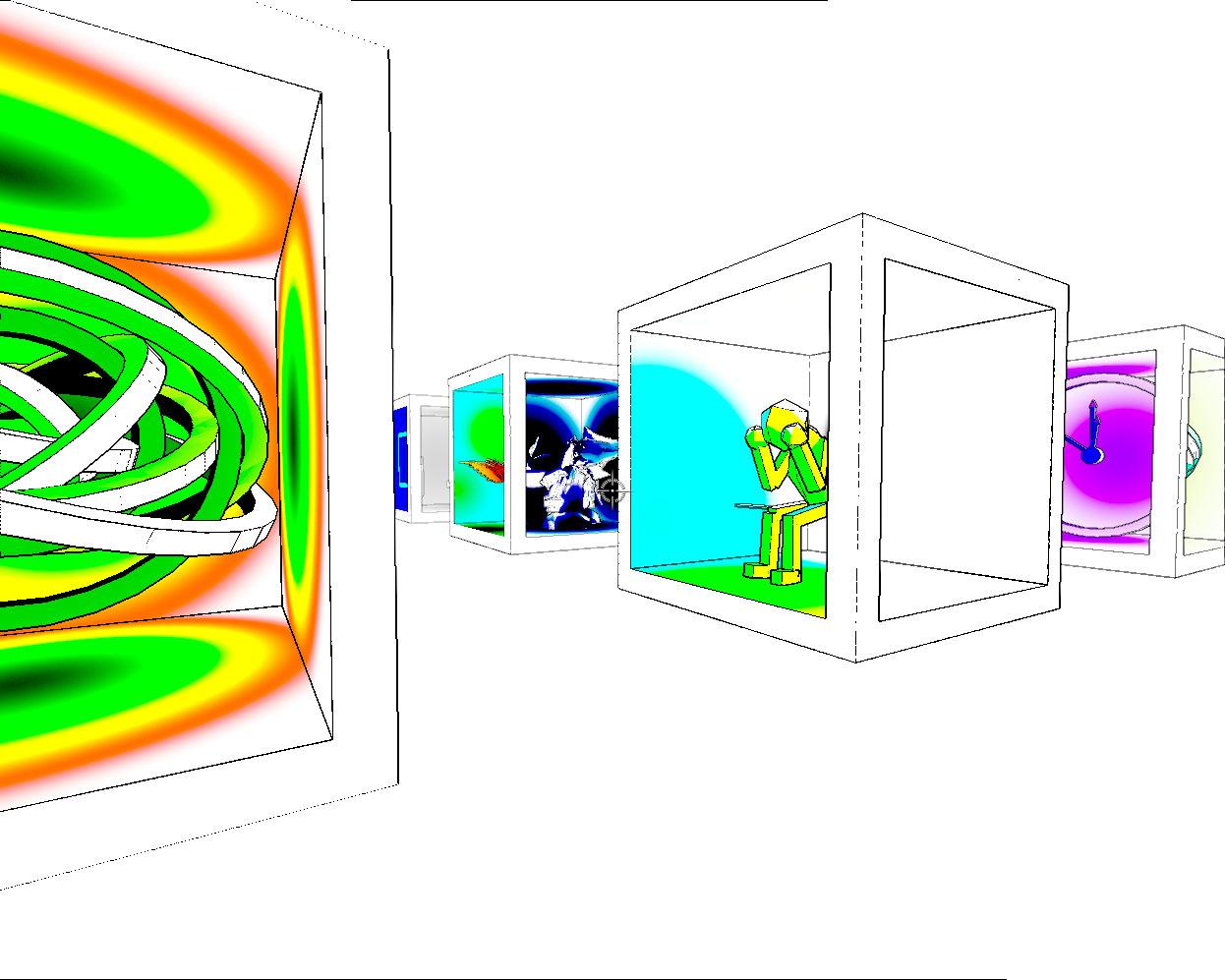
Hazard is a difficult game to describe in words. Even watching a trailer can hardly impress the nauseating sensation that is playing it. Space—or perhaps more specifically how you navigate space—does not work in Hazard like it does in most games or, indeed, like reality. Movement is untrustworthy. You may be standing on the third floor of a tower, looking up and down through a central hole at the other floors above and below you. Meanwhile, in the room to your left is the second floor of the tower, to your right is the fourth floor, simultaneously below you and beside you. Or perhaps you stand before a forked stairwell—red stairs going up, blue stairs going down; take the wrong path and, somehow, you are back before both stairwells again.
The earliest roots of Hazard came into being in 2006 when Bruce started to look at geometry and space. Curiously, this came about when he tried to make a clone of Snake… badly.
“I was trying to create Snake, and I implemented it in a very stupid way.”
Bruce was still learning how to program and didn’t want to have to figure out how to build the game from scratch in Java but neither did he want to “cheat” by using a tutorial. As he had just completed a mod on the Unreal engine, he decided to use the Unreal engine to make his Snake game.
He used what he described as a “brute force method”. He created a floorboard of elevators that would open and close behind the player, leaving a trailing gap in the player's wake. The further the player would get, the longer the trail of depressed elevators would get. “But,” said Bruce. “My game of Snake was fairly flawed as my character could jump and had a gun.”
Rather than remove these elements, Bruce gave up on creating a Snake clone and grew more curious in how these elements would work with his floorboard design. What would happen if he shot the elevators, for instance? “Maybe I could start linking them together so I shoot one and create a rippling effect.”
This led to an abstract combat arena game where players would shoot the tiles that made up levels to cause domino effects that would knock opponents out of the arena. Bruce showed videos of outer-space arenas, constructed out of neon green bathroom tiles shattering in mesmeric displays before binding back together.
Eventually, though, Bruce had to put this project aside as his AI was not performing adequately, and his “brute force” coding made multiplayer next to impossible to run over a network. Instead, he moved on to other prototypes including what he called “recursive space”. Bruce described it as “like Asteroid, where you go off one side and back on the other. I wanted to see what this would look like in 3D.”
The video Bruce showed this time was of an Unreal Tournament-esque map, except with the effect of being enclosed in a cube of mirrors. Copies of the same map stretched ad infinitum above and below the level. The player could fall and land on the roof of the same map, or fire a rocket launcher and be hit in the back by the rocket.
Then, in early 2009, he decided it was time to begin work on something bigger than a prototype. “Of all the things I’d created thus far,” said Bruce. “I was most interesting in trying to do something with my geometry system.” Since multiplayer wasn’t working, he shifted his focus onto a single-player puzzle game.
As with his experimental, abstract prototypes, Bruce explained how “for the most part, all of the good ideas I got for this game came from my mindset of actively working against the grain, because that is what I do best.” This meant trying to create what he described as “the anti-game”, which “flew in the face of whatever anyone else said was good design.” Bruce’s reasoning for this what that he knew that whatever he ended up creating would be different. “If somehow I could make that good enough then I would be onto something special because people hadn’t seen it before.”
Visual Design
What was to become a key feature of Bruce’s anti-game was the art style. Hazard’s world is predominately a flat white with a thin, black outline, and an occasional flash of bright colour or intricate pattern. It is fairly hard to mistake it for any other game.
Bruce recollected how at E3, 2010, a person observing Hazard said that the distinct, minimalist art direction was “obviously a budget decision.” At E3, where every other game was mapped in high-quality (and predominately grey) textures, Bruce could see how someone could think that. However, “what the person didn’t realise when he made that comment was that despite looking like an unfinished colouring book, he had been standing there watching it for fifteen minutes. Everything around him was louder, in booths that were flashier, on screens that were bigger, by companies that were better, but for fifteen minutes at E3 he couldn’t stop watching this little indie game made of lines and colours.”
For Bruce, the observer’s actions meant more than his words, especially in contrast to other accolades the game received, such as people calling it “the most creative thing at E3. “This kind of thing doesn’t happen by accident,” stated Bruce.
Bruce explained that “in the world of 3D, low budget games stand out as bad because they aren’t keeping up with technical advances. People can tell when something is limited by hardware constraints.” So how was his game able to be compelling? When one can’t compete on technological grounds, one must make up for it with style. “I needed to come up with something that no one else was doing,” Bruce said.
Bruce then showed two games that heavily inspired his own unique visual style. At first, he showed still images of the games as he described them. Curiously, one was simply a blank white screen, and the other was pitch black.
Eventually, he revealed that the white game was Giant Sparrow’s The Unfinished Swan—a first-person game in a pure white world where the player must throw blobs of paint to gauge the shape and depth of the world. Through The Unfinished Swan, Bruce explained “the simplest things we take for granted in games suddenly becomes wonderful again. Simply exploring an environment is magical.”
The black game was Wraughk Audio Design’s Deep Sea—a game that literally has no graphics. The player wears a sense deprivation mask that blinds them, affects their breathing, and works with sound to give the sense of being submerged deep underwater.
Bruce explained that “the design of both these games is interesting, but magnified by the graphical style chosen (or not chosen).” Once Hazard had a similarly extreme graphical style, “it suddenly seemed remarkable again” when compared to other Unreal games.
A side effect of this visual design, Bruce explained, was how it effected the puzzles design of the game—it made the environments readable.
Puzzle Design
Bruce highlighted Portal as a game that uses readable environments well. In Portal, it is clear where you can and can’t put a puzzle. “The minimalist aesthetic got out of the way of the puzzle design and allowed for elegance, not complexity.”
Similarly, Bruce was able to use details and colours to attract the player’s attention in his otherwise white world. “Much like The Unfinished Swan, I could create a game where the emphasis was on discovery.
Bruce contrasted how this was executed perfectly in Portal with how he feels it doesn’t work so well in Portal 2, and in the process managed to find the words to describe the sequel’s shortcomings that I had struggled with myself.
“Every room in Portal 2 feels epic. They contain massive spaces, moving parts, and far more detail than was ever seen in the original game, and as much as all that sounds like a step in the right direction, for me it felt like it flew in the face of their original design. To add all these extra details, they removed the freedom to place portals absolutely anywhere in the game. Many puzzles went from ‘where can I put a portal to solve this puzzle correctly?’ to ‘where can I put a portal at all?’”
While Portal allowed a vast array of choice, Portal 2 restricted freedom: “Every chamber in Portal had room for the original solution, an advanced solution, solving it with the fewest portals, the least number of steps, or the least amount of time. In other words, the rooms were flexible enough to allow many different play styles.” However, in Portal 2, argued Bruce, the only options were success, death, getting stuck, or quitting.
“Limiting the design like this was a real shame as the first game got it all so right.”
(Personally, I wondered if this is why I enjoyed the level design of Portal 2’s co-op campaign far more than the single player, as it more closely resembled the first Portal.)
For Bruce, then, Portal—as shown in the contrast with Portal 2—is a fine example of elegant design, that less is more.
Bruce explained how when he first began designing his puzzles, he too fell in the trap of trying to make everything epic and complex. Though, he soon came to realise that creating a game like that isn’t fun for the player and perhaps not even for the designer.
“The more time I spent thinking about puzzles, the more I realised that truly great design was found when the designer could show you the fewest elements but figuring out how to integrates them all together was the real problem to solve.”
He used Braid to demonstrate this point. Every world in Braid begins with a simple level: obtain the key from the pit and unlock the door. In each world, the player must use the unique ability of that world to get the key, thus learning how that ability worked before moving on to more challenging levels. Bruce explained that, “If I was to give you a single lock and key, but there was something unusual in how they work together, that creates a far better puzzle than me giving you a lock and a hundred keys and saying ‘figure out which one opens it.’”
Bruce stressed that when designing a game that the player isn’t familiar with, “you need to get as much out of the way of the player’s enjoyment as possible.”
To drive the point home, Bruce showed a video of Polytron's upcoming 3D/2D hybrid game, Fez. “Fez is a game that would lend itself to being one of the most frustrating and confusing things ever if executed incorrectly. It would be very easy to overload the design with things like enemies, time pressures, and stress, and lose sight of what makes it special in the first place.”
Twisted Space
So Bruce now had his single player puzzle game with elegantly designed puzzles and a minimalist, eye-catching art style, but something was still missing. While playtesting the game, players were regularly getting stuck or lost, suggesting to Bruce that he removed dead-ends, or made the game more linear, or add clealer way pointing. But Bruce was wary of following the feedback too literally. He quoted Team Meat to say, “Players can only tell you what they are used to.” Or, as he put it more bluntly: “Players don’t know what they want.”
For Bruce, that people got stuck on puzzle 40 did not mean there was an issue with puzzle 40, but perhaps there was an issue with how puzzle 38 was communicating the skills that puzzle 40 required.
He boiled down all the negative feedback he was receiving down to the fact that “it wasn’t that people wanted more, or that there were dead ends everywhere, but rather because of the way the game was structured, in a few key points of the game, I was teaching players a piece of information at one point and it was too much of a leap for them to apply that at another point.”
The only way Bruce could solve this would be too significantly reconstruct the game so that some puzzles could be physically linked differently. However, this was impossible without skewing the design that Bruce envisioned for the game. Instead, he tried something else: “Enter Mind Fuck.”
“One of the most important decisions that happened when designing the game happened by not doing what everyone was suggesting,” Bruce said.
“What saved me in this case was doing something that no one ever suggested because it was weird and other games didn’t do it. Something I nearly cut from the game entirely. The answer to making the game special was breaking space. If I could make a maze that keeps throwing players back to the start of it, then it wasn’t too much of a leap to arbitrarily connect one puzzle to another.”
By twisting space, Bruce was able to open up the game to different play styles while also preventing players from getting stuck. Much like Braid, with its reversal of time, failure is never an end in Hazard, but will just send the player somewhere else.
“The game gets out of the player’s way and lets them enjoy the space.”
The feedback from playtesting was instantly different, said Bruce. “Rather than being caught up on guidance, or knowing what they could or could not solve, players just kept running through the game, solving problems in what seemed like a coherent order. It didn’t always make sense, but they didn’t care because the game kept moving.”
Finally, Bruce explained how while Hazard certainly has its thematic content of psychology threaded through its aesthetics and design, it neither has or requires a story. He feels like people miss the point when they ask if it should have a story. “Rather than letting players run around where half of the fun was trying to figure out why it existed, or what it was, if I added a story that explained all of this stuff, they would know they were just going through the motions to get to some contrived plot twist.”
Bruce put it most succinctly, I think, when he said that Hazard is about discovery for discovery’s sake. Just like The Unfinished Swan, exploring and comprehending the world through its aesthetics, its design, and its twisting of space is its own reward.

The Journey of The Journey of Life
Hazard is a difficult game to describe in words. Even watching a trailer can hardly impress the nauseating sensation that is playing it. Space—or perhaps more specifically how you navigate space—does not work in Hazard like it does in most games or, indeed, like reality. Movement is untrustworthy. You may be standing on the third floor of a tower, looking up and down through a central hole at the other floors above and below you. Meanwhile, in the room to your left is the second floor of the tower, to your right is the fourth floor, simultaneously below you and beside you. Or perhaps you stand before a forked stairwell—red stairs going up, blue stairs going down; take the wrong path and, somehow, you are back before both stairwells again.
The earliest roots of Hazard came into being in 2006 when Bruce started to look at geometry and space. Curiously, this came about when he tried to make a clone of Snake… badly.
“I was trying to create Snake, and I implemented it in a very stupid way.”
Bruce was still learning how to program and didn’t want to have to figure out how to build the game from scratch in Java but neither did he want to “cheat” by using a tutorial. As he had just completed a mod on the Unreal engine, he decided to use the Unreal engine to make his Snake game.
He used what he described as a “brute force method”. He created a floorboard of elevators that would open and close behind the player, leaving a trailing gap in the player's wake. The further the player would get, the longer the trail of depressed elevators would get. “But,” said Bruce. “My game of Snake was fairly flawed as my character could jump and had a gun.”
Rather than remove these elements, Bruce gave up on creating a Snake clone and grew more curious in how these elements would work with his floorboard design. What would happen if he shot the elevators, for instance? “Maybe I could start linking them together so I shoot one and create a rippling effect.”
This led to an abstract combat arena game where players would shoot the tiles that made up levels to cause domino effects that would knock opponents out of the arena. Bruce showed videos of outer-space arenas, constructed out of neon green bathroom tiles shattering in mesmeric displays before binding back together.
Eventually, though, Bruce had to put this project aside as his AI was not performing adequately, and his “brute force” coding made multiplayer next to impossible to run over a network. Instead, he moved on to other prototypes including what he called “recursive space”. Bruce described it as “like Asteroid, where you go off one side and back on the other. I wanted to see what this would look like in 3D.”
The video Bruce showed this time was of an Unreal Tournament-esque map, except with the effect of being enclosed in a cube of mirrors. Copies of the same map stretched ad infinitum above and below the level. The player could fall and land on the roof of the same map, or fire a rocket launcher and be hit in the back by the rocket.
Then, in early 2009, he decided it was time to begin work on something bigger than a prototype. “Of all the things I’d created thus far,” said Bruce. “I was most interesting in trying to do something with my geometry system.” Since multiplayer wasn’t working, he shifted his focus onto a single-player puzzle game.
As with his experimental, abstract prototypes, Bruce explained how “for the most part, all of the good ideas I got for this game came from my mindset of actively working against the grain, because that is what I do best.” This meant trying to create what he described as “the anti-game”, which “flew in the face of whatever anyone else said was good design.” Bruce’s reasoning for this what that he knew that whatever he ended up creating would be different. “If somehow I could make that good enough then I would be onto something special because people hadn’t seen it before.”
Visual Design
| The Unfinished Swan |
What was to become a key feature of Bruce’s anti-game was the art style. Hazard’s world is predominately a flat white with a thin, black outline, and an occasional flash of bright colour or intricate pattern. It is fairly hard to mistake it for any other game.
Bruce recollected how at E3, 2010, a person observing Hazard said that the distinct, minimalist art direction was “obviously a budget decision.” At E3, where every other game was mapped in high-quality (and predominately grey) textures, Bruce could see how someone could think that. However, “what the person didn’t realise when he made that comment was that despite looking like an unfinished colouring book, he had been standing there watching it for fifteen minutes. Everything around him was louder, in booths that were flashier, on screens that were bigger, by companies that were better, but for fifteen minutes at E3 he couldn’t stop watching this little indie game made of lines and colours.”
For Bruce, the observer’s actions meant more than his words, especially in contrast to other accolades the game received, such as people calling it “the most creative thing at E3. “This kind of thing doesn’t happen by accident,” stated Bruce.
Bruce explained that “in the world of 3D, low budget games stand out as bad because they aren’t keeping up with technical advances. People can tell when something is limited by hardware constraints.” So how was his game able to be compelling? When one can’t compete on technological grounds, one must make up for it with style. “I needed to come up with something that no one else was doing,” Bruce said.
Bruce then showed two games that heavily inspired his own unique visual style. At first, he showed still images of the games as he described them. Curiously, one was simply a blank white screen, and the other was pitch black.
Eventually, he revealed that the white game was Giant Sparrow’s The Unfinished Swan—a first-person game in a pure white world where the player must throw blobs of paint to gauge the shape and depth of the world. Through The Unfinished Swan, Bruce explained “the simplest things we take for granted in games suddenly becomes wonderful again. Simply exploring an environment is magical.”
The black game was Wraughk Audio Design’s Deep Sea—a game that literally has no graphics. The player wears a sense deprivation mask that blinds them, affects their breathing, and works with sound to give the sense of being submerged deep underwater.
Bruce explained that “the design of both these games is interesting, but magnified by the graphical style chosen (or not chosen).” Once Hazard had a similarly extreme graphical style, “it suddenly seemed remarkable again” when compared to other Unreal games.
A side effect of this visual design, Bruce explained, was how it effected the puzzles design of the game—it made the environments readable.
Puzzle Design
Bruce highlighted Portal as a game that uses readable environments well. In Portal, it is clear where you can and can’t put a puzzle. “The minimalist aesthetic got out of the way of the puzzle design and allowed for elegance, not complexity.”
Similarly, Bruce was able to use details and colours to attract the player’s attention in his otherwise white world. “Much like The Unfinished Swan, I could create a game where the emphasis was on discovery.
Bruce contrasted how this was executed perfectly in Portal with how he feels it doesn’t work so well in Portal 2, and in the process managed to find the words to describe the sequel’s shortcomings that I had struggled with myself.
“Every room in Portal 2 feels epic. They contain massive spaces, moving parts, and far more detail than was ever seen in the original game, and as much as all that sounds like a step in the right direction, for me it felt like it flew in the face of their original design. To add all these extra details, they removed the freedom to place portals absolutely anywhere in the game. Many puzzles went from ‘where can I put a portal to solve this puzzle correctly?’ to ‘where can I put a portal at all?’”
While Portal allowed a vast array of choice, Portal 2 restricted freedom: “Every chamber in Portal had room for the original solution, an advanced solution, solving it with the fewest portals, the least number of steps, or the least amount of time. In other words, the rooms were flexible enough to allow many different play styles.” However, in Portal 2, argued Bruce, the only options were success, death, getting stuck, or quitting.
“Limiting the design like this was a real shame as the first game got it all so right.”
(Personally, I wondered if this is why I enjoyed the level design of Portal 2’s co-op campaign far more than the single player, as it more closely resembled the first Portal.)
For Bruce, then, Portal—as shown in the contrast with Portal 2—is a fine example of elegant design, that less is more.
Bruce explained how when he first began designing his puzzles, he too fell in the trap of trying to make everything epic and complex. Though, he soon came to realise that creating a game like that isn’t fun for the player and perhaps not even for the designer.
“The more time I spent thinking about puzzles, the more I realised that truly great design was found when the designer could show you the fewest elements but figuring out how to integrates them all together was the real problem to solve.”
He used Braid to demonstrate this point. Every world in Braid begins with a simple level: obtain the key from the pit and unlock the door. In each world, the player must use the unique ability of that world to get the key, thus learning how that ability worked before moving on to more challenging levels. Bruce explained that, “If I was to give you a single lock and key, but there was something unusual in how they work together, that creates a far better puzzle than me giving you a lock and a hundred keys and saying ‘figure out which one opens it.’”
Bruce stressed that when designing a game that the player isn’t familiar with, “you need to get as much out of the way of the player’s enjoyment as possible.”
To drive the point home, Bruce showed a video of Polytron's upcoming 3D/2D hybrid game, Fez. “Fez is a game that would lend itself to being one of the most frustrating and confusing things ever if executed incorrectly. It would be very easy to overload the design with things like enemies, time pressures, and stress, and lose sight of what makes it special in the first place.”
Twisted Space
So Bruce now had his single player puzzle game with elegantly designed puzzles and a minimalist, eye-catching art style, but something was still missing. While playtesting the game, players were regularly getting stuck or lost, suggesting to Bruce that he removed dead-ends, or made the game more linear, or add clealer way pointing. But Bruce was wary of following the feedback too literally. He quoted Team Meat to say, “Players can only tell you what they are used to.” Or, as he put it more bluntly: “Players don’t know what they want.”
For Bruce, that people got stuck on puzzle 40 did not mean there was an issue with puzzle 40, but perhaps there was an issue with how puzzle 38 was communicating the skills that puzzle 40 required.
He boiled down all the negative feedback he was receiving down to the fact that “it wasn’t that people wanted more, or that there were dead ends everywhere, but rather because of the way the game was structured, in a few key points of the game, I was teaching players a piece of information at one point and it was too much of a leap for them to apply that at another point.”
The only way Bruce could solve this would be too significantly reconstruct the game so that some puzzles could be physically linked differently. However, this was impossible without skewing the design that Bruce envisioned for the game. Instead, he tried something else: “Enter Mind Fuck.”
“One of the most important decisions that happened when designing the game happened by not doing what everyone was suggesting,” Bruce said.
“What saved me in this case was doing something that no one ever suggested because it was weird and other games didn’t do it. Something I nearly cut from the game entirely. The answer to making the game special was breaking space. If I could make a maze that keeps throwing players back to the start of it, then it wasn’t too much of a leap to arbitrarily connect one puzzle to another.”
By twisting space, Bruce was able to open up the game to different play styles while also preventing players from getting stuck. Much like Braid, with its reversal of time, failure is never an end in Hazard, but will just send the player somewhere else.
“The game gets out of the player’s way and lets them enjoy the space.”
The feedback from playtesting was instantly different, said Bruce. “Rather than being caught up on guidance, or knowing what they could or could not solve, players just kept running through the game, solving problems in what seemed like a coherent order. It didn’t always make sense, but they didn’t care because the game kept moving.”
Finally, Bruce explained how while Hazard certainly has its thematic content of psychology threaded through its aesthetics and design, it neither has or requires a story. He feels like people miss the point when they ask if it should have a story. “Rather than letting players run around where half of the fun was trying to figure out why it existed, or what it was, if I added a story that explained all of this stuff, they would know they were just going through the motions to get to some contrived plot twist.”
Bruce put it most succinctly, I think, when he said that Hazard is about discovery for discovery’s sake. Just like The Unfinished Swan, exploring and comprehending the world through its aesthetics, its design, and its twisting of space is its own reward.
Monday, April 11, 2011
A Draft of a Thesis Abstract
[This year I am completing a Communication and Cultural Studies Honours as both a capstone of my undergraduate studies and, most probably, a stepping stone into several more years of postgraduate study. In addition to some coursework, Honours largely consists of writing a 15,000 word dissertation by the end of Semester 2 (late October). As such, I will be doing less freelance writing and even less blogging this year as I work on my thesis. However, to make up for this, I might try to update here with my thesis-in-progress, both to keep the blog alive and to get some valuable feedback. While the academics in my school (in particularly my supervisor) are able to give me excellent structural and theoretical advice, few of them play videogames and even fewer engage with videogame academia. By placing my work-in-progress here, perhaps my arguments will become a little more watertight.
For now, here is an early draft of an abstract of my thesis. It gives a decent oversight about what I plan to write about this year. Needless to say, there is a very high chance that this will change in the coming months as I do more research, get more feedback, and actually start writing. But for now, this is my topic as it currently stands:]
Partners in Crime: The Mediating Effects of the Playable Character on the Videogame Player
Through a textual analysis of Grand Theft Auto IV (Rockstar North 2007), this thesis aims to complicate and complement videogame studies’ current understanding of the playable character’s role in shaping the player’s experience. Just as the player may define certain actions and characteristics of the character, so too do the character’s actions and characteristics helps to shape the player’s experience.
The videogame player interacts with the videogame text as a hybrid of navigable spaces: a procedural space defined by processes that the player must comprehend; a possibility space defined by affordances that the player must act within the confines of; a fictional space defined as an audiovisual world that the player must interpret and exist in. While most videogame scholars acknowledge the role of the playable character as a vessel through which the player navigates these spaces, rarely is its mediating effect on the player fully recognised. Many texts will use the terms ‘player’ and ‘character’ interchangeably when discussing the agent that acts within the videogame space. This uncertainty as to just who is acting highlights a gap in the existing literature on playable characters and their role in mediating the player’s experience.
Engaging with actor-network theory and cyborg theory to account for the existence of the playable character’s nonhuman agency independent of the player, this thesis explores how the agencies of both actors—player and character—intertwine and mediate each other to form a hybrid actor, the player-character, which is the actual actor that navigates the videogame space.
Grand Theft Auto IV and its episodic expansions “The Lost and the Damned” and “The Ballad of Gay Tony” engage the player with three distinct playable characters while the game’s spaces and mechanics remain more-or-less unchanged. An analysis of these titles will thus allow this thesis to explore the effects of the playable character’s agency on the player-character hybrid and, subsequently, on the player’s experience.
For now, here is an early draft of an abstract of my thesis. It gives a decent oversight about what I plan to write about this year. Needless to say, there is a very high chance that this will change in the coming months as I do more research, get more feedback, and actually start writing. But for now, this is my topic as it currently stands:]
Partners in Crime: The Mediating Effects of the Playable Character on the Videogame Player
Through a textual analysis of Grand Theft Auto IV (Rockstar North 2007), this thesis aims to complicate and complement videogame studies’ current understanding of the playable character’s role in shaping the player’s experience. Just as the player may define certain actions and characteristics of the character, so too do the character’s actions and characteristics helps to shape the player’s experience.
The videogame player interacts with the videogame text as a hybrid of navigable spaces: a procedural space defined by processes that the player must comprehend; a possibility space defined by affordances that the player must act within the confines of; a fictional space defined as an audiovisual world that the player must interpret and exist in. While most videogame scholars acknowledge the role of the playable character as a vessel through which the player navigates these spaces, rarely is its mediating effect on the player fully recognised. Many texts will use the terms ‘player’ and ‘character’ interchangeably when discussing the agent that acts within the videogame space. This uncertainty as to just who is acting highlights a gap in the existing literature on playable characters and their role in mediating the player’s experience.
Engaging with actor-network theory and cyborg theory to account for the existence of the playable character’s nonhuman agency independent of the player, this thesis explores how the agencies of both actors—player and character—intertwine and mediate each other to form a hybrid actor, the player-character, which is the actual actor that navigates the videogame space.
Grand Theft Auto IV and its episodic expansions “The Lost and the Damned” and “The Ballad of Gay Tony” engage the player with three distinct playable characters while the game’s spaces and mechanics remain more-or-less unchanged. An analysis of these titles will thus allow this thesis to explore the effects of the playable character’s agency on the player-character hybrid and, subsequently, on the player’s experience.
Wednesday, March 16, 2011
New Kill Screen Article: A Sackboy Says No Words
| Awesome art thanks to Josh Holinaty |
Just like last time, many thanks to Ryan Kuo for the awesome editing job. Without his suggestions, I wouldn't be half as happy with this post as I am.
Tuesday, March 15, 2011
The Inevitable Exploitation of Chain World
Today (or possibly yesterday; I am a bit behind on Internet News), Jason Rohrer's entry into this year's GDC's Game Design Contest, Chain World, went up on eBay.
Some quick background information: The theme for this year's contest was 'religion'. That is, the contestants were not to make a game about religion, but a game that could be a religion. Returning champion Jenova Chen created the most disappointing concept, essentially sticking TED talk videos on YouTube with a little bit of gameification. John Romero had an interesting idea for a live-action game that he was able to perform in the room. It was a very western-centric idea of religion, but it worked and was fairly interesting. If I ever get the chance to write up about the actual session, I would like to cover Romero's concept in more detail.
The winning concept, and my personal favourite, however, was Jason Rohrer's. Rohrer's concept was based on his personal feelings of what religion is. In an over-simplified nutshell: religion is the myths we tell ourselves about those that came before us. He used examples such as things his family always say his grandfather used to say (though none of them are actually sure) and the stories and beliefs we form around artifacts such as Stonehenge. Essentially, we craft narratives and reasons around the things we don't know the actual history for.
Rohrer conceptualised this with a modification of Minecraft. One player has one life, and when they die they pass the game on to someone else on a USB stick. Once you play the game, you may never play it again. It was an interesting and inspired concept, and the most grounded in an actual interesting idea of religion. At the talk, Rohrer passed the USB stick onto the second player (himself being the first), and from there the game would continue as player passed it on to player.
Except now, player number two is exploiting it. He is selling the USB on eBay to the highest bidder. I could write a huge rant about how pathetic and despicable I think this is, but as my opinions seem to mirror Darius Kazemi's, I'll just link to his brief thoughts on it. You should read it before carrying on with this piece, just so you know where I stand on the matter.
So yes, the fact that this is happening made me angry. However, unlike several people I have been debating with on Twitter, I don't believe this necessarily implies the game was poorly designed to begin with. On the contrary, I think this exploitation crowns the game an absolute success. Chain World didn't fail. It is we, humans, that failed.
The reasons why others seem to think this exploitation of Chain World implies poor design (and I am not naming these 'others' on the high possibility that I am misquoting them and deforming their arguments, as Twitter is prone to do) can be boiled down to two things: firstly, the game fundamentally relied on players passing the game on, which was a tenuous hope at best; secondly, Rohrer never anticipated the game to be played this way and thus the game fails at achieving the thematic goals intended by its creator.
I agree with both of these statements completely, and I absolutely hate what the current player is doing with the game, yet I still do not believe Chain World failed. Why? Because Chain World is currently being used in the same way religion is used: exploited by the few to obtain money and fame from the many.
No religion starts as an institution. Religion start as faith and belief. It is only when they gather enough popularity that those in charge start exploiting and cashing in on the faith of the many. This isn't a particularly shocking thing to say. You only have to look at the wealth piled up in the Vatican while the preachers of Christianity insist we should give everything to the poor to see it is true. Does this mean religion is essentially 'bad'? No, of course not. Everyone is free to believe in whatever they desire, and nearly all religions are founded on noble, commendable goals. It's the institutionalisation of this faith and the exploitation of the faith of the many by a few that is bad--but also, I would argue, inevitable.
Those who founded Christianity did not do so to gather a huge pile of gold and tell others what to do. They founded it because they thought it was a pretty decent way to live your life and they thought everyone else would gain something from it, too. And then comes the inevitable stage where those in charge find themselves in a position of power over the faith of the many. Sure, it's greedy, but it's human. And I don't mean to pick on Christianity; the same happens in all the world's major religions at some point in history or another.
Now back to Chain World. It started with a belief of Rohrer of what religion 'is' and how that should be conveyed as a game. This belief tapped into similar beliefs of many others, either because he gave a really good presentation (which he did); or because most of those people love Minecraft, or Rohrer's previous work, or both.
And now, those shared beliefs of the many are being exploited by a few. Just like the most popular religions, Chain World is being institutionalised. Chain World is being treated just like a religion.
So was Chain World poorly designed because a) it is no longer conveying the themes Rohrer intended (or arguably it never conveyed those themes as the very first player after Rohrer exploited it), and b) because there was no fail-safe in the game design to prevent this from happening? No. Chain World was exquisitely designed, perhaps even better than Rohrer intended, because it has been able to evolve in the same way major religions tend to evolve: from personal beliefs into the exploitation of many, far beyond the control of the religion's founder.
So while I think what the current player is doing is pathetic, I also think it was inevitable, and perhaps even necessary if Chain World was to succeed at the contests stated thematic goal: make a game that could be a religion. As the bids for Chain World on eBay approach $500, and as Rohrer futilely urges on Twitter that the believers reject this reappropriation and exploitation of his creation*, those currently in power are taking suggestions for a tenth commandment for the game (essentially, putting their own rules over Rohrer's) as they institutionalise Chain World into the religion it had no chance of not becoming.
Chain World succeeded. Humans, on the other hand, have not.
(* Interestingly, I could be reappropriating Rohrer's words in a similar way myself by saying this is what he meant in this tweet, which he quite possibly didn't!)
(** Also, for the sake of full disclosure, and if it wasn't clear from the post, I am an agnostic/athiest (it depends what day you ask me). I apologise if my cynical views on religion offend you and your faith as I mean no disrespect to anyone's personal beliefs.)
Monday, March 7, 2011
God-Damned Crazy: GDC Postmortem
After a ridiculous long long trip home (over 30 hours spent on planes, trains, and in airports), I am back in Brisbane after what was easily the most phenomenally insane and overwhelming and outright amazing week of my life attending the Game Developer's Conference in San Francisco. Lectures were attended, reports were written, hotel rooms were partied in, tacos were eaten. It was one hell of a week.
I won't go too far into my experience partly because I am so jetlagged and mostly because that is a piece I am meant to be writing for Pixel Hunt, so I will surely link that when it is done.
Speaking of links, I was planning on linking to all the reports I wrote for Industry Gamers throughout the week, but they are currently migrating to a new server so I can't get to my articles, I am afraid. Instead, here are my favourite three things to come out of last week:
- The Many Faces of Tim Schafer, Paste Magazine. Double Fine's Tim Schafer hosted this year's Game Developer Choice Awards and did a stellar job. He was entertaining, funny, and even managed to slam Penny Arcade over the whole Dickwolf thing. It was incredible. Unrelated to all of this, Brian Taylor took a lot of photos of Schafer's head during the ceremony and they turned out awesome.
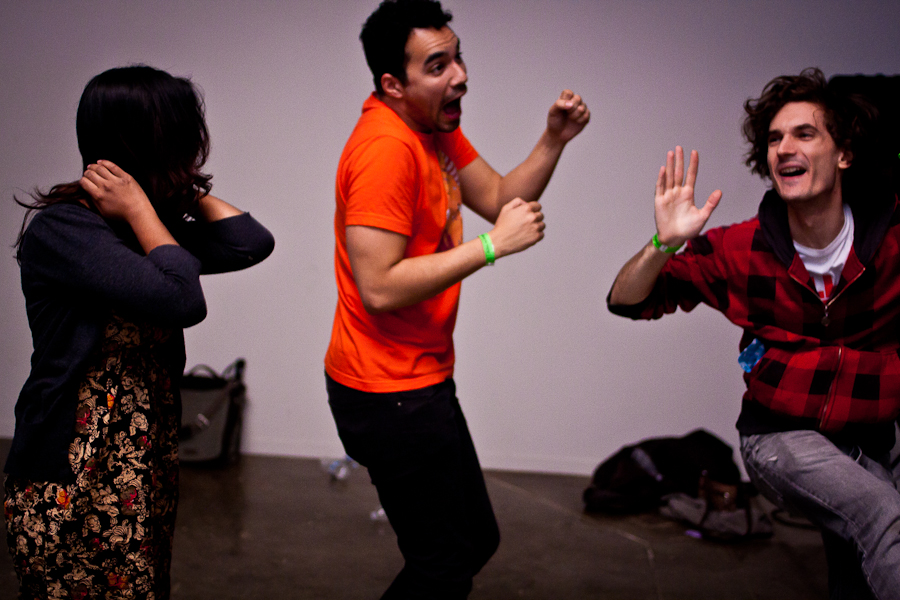
- Kill Screen & Copenhagen Gaming Collective Party. The social highlight of the week for me was partying with the amazing writers from Kill Screen Magazine (and a whole bunch of other people!) Games were played, dances were danced, and a certain Sydney-based blogger got a bit drunk and hugged a lot of people. Brian Taylor, once again, grabbed a whole stack of amazing photos worth checking out.
- Holding the Bag: How I Gamed GDC's Top Social Game Developers. The Social Game Developer's Rant/Debate was a chaotic highlight of the conference. Strong opinions were thrown back and forward. An experiment/game was run where people had to collect coins to win. One man took things into his own hands and stole the entire bag. He has since written up his own account of the thievery and has drawn some interesting comparisons with social gaming and the gaming industry in general. It is well worth a read.
I am utterly humbled to have met so many amazing developers and writers this past week and I can't wait to see you all again next year.
Saturday, February 26, 2011
Two Tiny Wings And One Big Heart
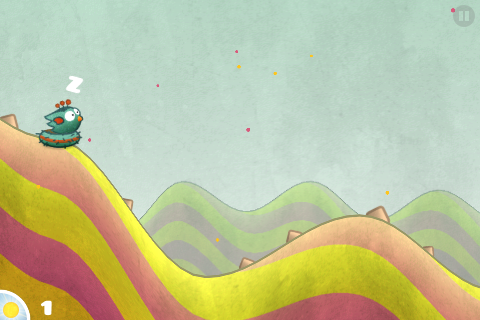
Andreas Illiger's adorable Tiny Wings soared onto the iOS app store this week. Quite suddenly, half my Twitter feed was talking about this charming new Canabalt-esque game (‘Canabalt-esque now being pretty much its own genre). Between downloading the game, playing two rounds, and going back to the app store to give the game a five-star rating, over a hundred new reviews appeared. And what good reviews, too! Players say they love it, that is it beautiful. The compliments are vague and abstract (though, looking back several hours later, the number of reviews has quadrupled and there are more specific comments now, both complimentary and critical), but they mirror my own feeling on the game perfectly: Tiny Wings is lovely, and it makes you feel good.
The premise is that you are a bird who will never be able to fly because your wings are too tiny. But this doesn’t stop our little disproportionate hero from trying anyway. He wants to fly, and he will do it however he can. With a touch on the iPhone’s screen, the bird folds his wings back to plummet towards the ground and speed down hills; when you release, he soars off the incline of the next hill like a stunt jump, flapping frantically. The key is to time your drops to get the most speed and height for the next jump. If you do it right, you might even touch the clouds.
It’s a fun and addictive experience, much like that of Canabalt—as simple as it is complex. But also like Canabalt, the true beauty and depth lies not just in the mechanics, but in the game’s fiction. The character, the visuals, the animations, and the music all come together to make Tiny Wings about a disadvantaged bird who got the arse-end of life but refuses to give up on his dreams. Tiny Wings makes you want to grin and cry at the same time. Ultimately, it just feels good.
‘Good’ in the way the ending of Cool Runnings feels good (at the very least, how Cool Runnings felt good after a few vodkas the last time it was on TV). Just like the Jamaican Bobsled Team, the tiny bird tries so hard and overcomes so many challenges, but can never quite reach his goal—at least not for good. It’s both heart-warmingly uplifting and tear-jerkingly sad to watch your bird launch into the clouds—so happy he has touched his dreams; so sad that it will be so fleeting as he falls back to earth. But the moment he lands he is eager to try again and again and again.
The music, an uplifting twang of guitars and blare of trumpets that wouldn’t be out-of-place on a Polyphonic Spree album, complements the themes beautifully. If the bird’s whimsical cry of joy when he launches into the sky doesn’t make you smile, the music will.
Tiny Wings is a fun game. It is mechanically competent and has an excellent, simple-yet-deep scoring system that tempts you to play over and over again, as all games in the Canabalt genre should. But while these elements alone would make Tiny Wings a great game, it is the emotional investment enabled by the game’s aesthetic design coupled with these mechanics that make it truly remarkable. That little bird never stops trying to reach his dreams, even if he can only realise them for a second at a time.
Subscribe to:
Posts (Atom)