Showing posts with label Braid. Show all posts

Thursday, May 5, 2011

Anti-Game: The Minimalist Style, Elegant Puzzles, and Mindfucked Space of Hazard

Speaking as part of IGDA Brisbane’s Game On lecture series, Melbourne-based independent games developer Alexander Bruce presented a talk on his current project, the mind-boggling, space-twisting, eyeball-burning Hazard: The Journey of Life. He discussed the game’s history, going back to 2006 and the many iterations that led from a failed Snake clone, to a multiplayer arena combat game, to a single player puzzle game, to the space-warping experience it is today. It was an interesting insight into how such a bizarre game comes into being along with many interesting asides into broader design concepts. There was a video camera present so hopefully a video of the entire talk appears somewhere on the internet in the near future for me to link too [EDIT: Here it is]. In the meantime, though, I’ll try to do sections of the talk justice with this post by focusing on the historical section of Bruce’s talk which explored how he settled on the game’s unique aesthetic style, its puzzle design, and its unique depiction of space, and how the three aspects all intertwine.


The Journey of The Journey of Life
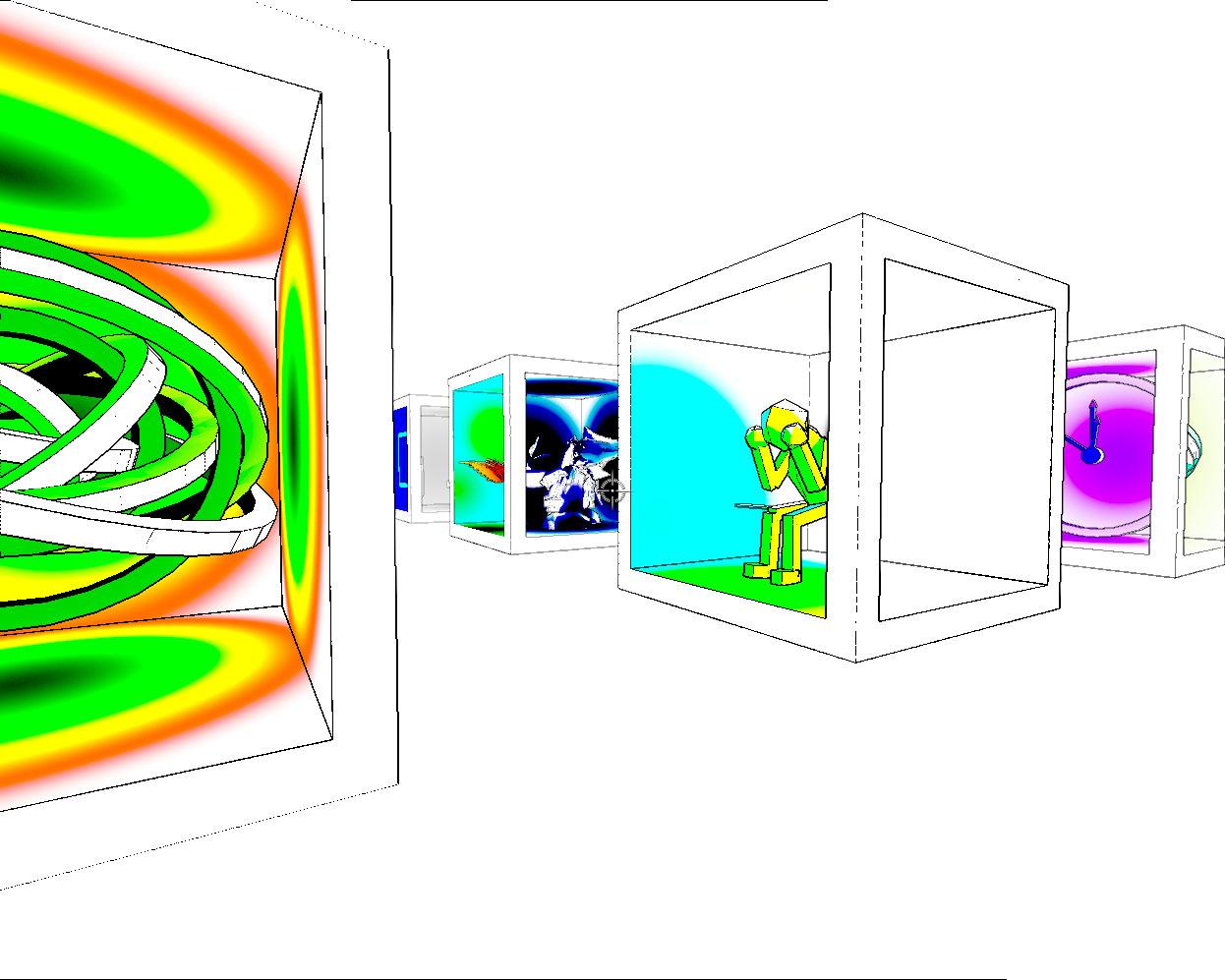
Hazard is a difficult game to describe in words. Even watching a trailer can hardly impress the nauseating sensation that is playing it. Space—or perhaps more specifically how you navigate space—does not work in Hazard like it does in most games or, indeed, like reality. Movement is untrustworthy. You may be standing on the third floor of a tower, looking up and down through a central hole at the other floors above and below you. Meanwhile, in the room to your left is the second floor of the tower, to your right is the fourth floor, simultaneously below you and beside you. Or perhaps you stand before a forked stairwell—red stairs going up, blue stairs going down; take the wrong path and, somehow, you are back before both stairwells again.

The earliest roots of Hazard came into being in 2006 when Bruce started to look at geometry and space. Curiously, this came about when he tried to make a clone of Snake… badly.

“I was trying to create Snake, and I implemented it in a very stupid way.”

Bruce was still learning how to program and didn’t want to have to figure out how to build the game from scratch in Java but neither did he want to “cheat” by using a tutorial. As he had just completed a mod on the Unreal engine, he decided to use the Unreal engine to make his Snake game.

He used what he described as a “brute force method”. He created a floorboard of elevators that would open and close behind the player, leaving a trailing gap in the player's wake. The further the player would get, the longer the trail of depressed elevators would get. “But,” said Bruce. “My game of Snake was fairly flawed as my character could jump and had a gun.”

Rather than remove these elements, Bruce gave up on creating a Snake clone and grew more curious in how these elements would work with his floorboard design. What would happen if he shot the elevators, for instance? “Maybe I could start linking them together so I shoot one and create a rippling effect.”

This led to an abstract combat arena game where players would shoot the tiles that made up levels to cause domino effects that would knock opponents out of the arena. Bruce showed videos of outer-space arenas, constructed out of neon green bathroom tiles shattering in mesmeric displays before binding back together.

Eventually, though, Bruce had to put this project aside as his AI was not performing adequately, and his “brute force” coding made multiplayer next to impossible to run over a network. Instead, he moved on to other prototypes including what he called “recursive space”. Bruce described it as “like Asteroid, where you go off one side and back on the other. I wanted to see what this would look like in 3D.”

The video Bruce showed this time was of an Unreal Tournament-esque map, except with the effect of being enclosed in a cube of mirrors. Copies of the same map stretched ad infinitum above and below the level. The player could fall and land on the roof of the same map, or fire a rocket launcher and be hit in the back by the rocket.

Then, in early 2009, he decided it was time to begin work on something bigger than a prototype. “Of all the things I’d created thus far,” said Bruce. “I was most interesting in trying to do something with my geometry system.” Since multiplayer wasn’t working, he shifted his focus onto a single-player puzzle game.

As with his experimental, abstract prototypes, Bruce explained how “for the most part, all of the good ideas I got for this game came from my mindset of actively working against the grain, because that is what I do best.” This meant trying to create what he described as “the anti-game”, which “flew in the face of whatever anyone else said was good design.” Bruce’s reasoning for this what that he knew that whatever he ended up creating would be different. “If somehow I could make that good enough then I would be onto something special because people hadn’t seen it before.”


Visual Design

The Unfinished Swan

What was to become a key feature of Bruce’s anti-game was the art style. Hazard’s world is predominately a flat white with a thin, black outline, and an occasional flash of bright colour or intricate pattern. It is fairly hard to mistake it for any other game.

Bruce recollected how at E3, 2010, a person observing Hazard said that the distinct, minimalist art direction was “obviously a budget decision.” At E3, where every other game was mapped in high-quality (and predominately grey) textures, Bruce could see how someone could think that. However, “what the person didn’t realise when he made that comment was that despite looking like an unfinished colouring book, he had been standing there watching it for fifteen minutes. Everything around him was louder, in booths that were flashier, on screens that were bigger, by companies that were better, but for fifteen minutes at E3 he couldn’t stop watching this little indie game made of lines and colours.”

For Bruce, the observer’s actions meant more than his words, especially in contrast to other accolades the game received, such as people calling it “the most creative thing at E3. “This kind of thing doesn’t happen by accident,” stated Bruce.

Bruce explained that “in the world of 3D, low budget games stand out as bad because they aren’t keeping up with technical advances. People can tell when something is limited by hardware constraints.” So how was his game able to be compelling? When one can’t compete on technological grounds, one must make up for it with style. “I needed to come up with something that no one else was doing,” Bruce said.

Bruce then showed two games that heavily inspired his own unique visual style. At first, he showed still images of the games as he described them. Curiously, one was simply a blank white screen, and the other was pitch black.

Eventually, he revealed that the white game was Giant Sparrow’s The Unfinished Swan—a first-person game in a pure white world where the player must throw blobs of paint to gauge the shape and depth of the world. Through The Unfinished Swan, Bruce explained “the simplest things we take for granted in games suddenly becomes wonderful again. Simply exploring an environment is magical.”

The black game was Wraughk Audio Design’s Deep Sea—a game that literally has no graphics. The player wears a sense deprivation mask that blinds them, affects their breathing, and works with sound to give the sense of being submerged deep underwater.

Bruce explained that “the design of both these games is interesting, but magnified by the graphical style chosen (or not chosen).” Once Hazard had a similarly extreme graphical style, “it suddenly seemed remarkable again” when compared to other Unreal games.

A side effect of this visual design, Bruce explained, was how it effected the puzzles design of the game—it made the environments readable.


Puzzle Design


Bruce highlighted Portal as a game that uses readable environments well. In Portal, it is clear where you can and can’t put a puzzle. “The minimalist aesthetic got out of the way of the puzzle design and allowed for elegance, not complexity.”

Similarly, Bruce was able to use details and colours to attract the player’s attention in his otherwise white world. “Much like The Unfinished Swan, I could create a game where the emphasis was on discovery.

Bruce contrasted how this was executed perfectly in Portal with how he feels it doesn’t work so well in Portal 2, and in the process managed to find the words to describe the sequel’s shortcomings that I had struggled with myself.

“Every room in Portal 2 feels epic. They contain massive spaces, moving parts, and far more detail than was ever seen in the original game, and as much as all that sounds like a step in the right direction, for me it felt like it flew in the face of their original design. To add all these extra details, they removed the freedom to place portals absolutely anywhere in the game. Many puzzles went from ‘where can I put a portal to solve this puzzle correctly?’ to ‘where can I put a portal at all?’”

While Portal allowed a vast array of choice, Portal 2 restricted freedom: “Every chamber in Portal had room for the original solution, an advanced solution, solving it with the fewest portals, the least number of steps, or the least amount of time. In other words, the rooms were flexible enough to allow many different play styles.” However, in Portal 2, argued Bruce, the only options were success, death, getting stuck, or quitting.

“Limiting the design like this was a real shame as the first game got it all so right.”

(Personally, I wondered if this is why I enjoyed the level design of Portal 2’s co-op campaign far more than the single player, as it more closely resembled the first Portal.)

For Bruce, then, Portal—as shown in the contrast with Portal 2—is a fine example of elegant design, that less is more.

Bruce explained how when he first began designing his puzzles, he too fell in the trap of trying to make everything epic and complex. Though, he soon came to realise that creating a game like that isn’t fun for the player and perhaps not even for the designer.

“The more time I spent thinking about puzzles, the more I realised that truly great design was found when the designer could show you the fewest elements but figuring out how to integrates them all together was the real problem to solve.”

He used Braid to demonstrate this point. Every world in Braid begins with a simple level: obtain the key from the pit and unlock the door. In each world, the player must use the unique ability of that world to get the key, thus learning how that ability worked before moving on to more challenging levels. Bruce explained that, “If I was to give you a single lock and key, but there was something unusual in how they work together, that creates a far better puzzle than me giving you a lock and a hundred keys and saying ‘figure out which one opens it.’”

Bruce stressed that when designing a game that the player isn’t familiar with, “you need to get as much out of the way of the player’s enjoyment as possible.”

To drive the point home, Bruce showed a video of Polytron's upcoming 3D/2D hybrid game, Fez. “Fez is a game that would lend itself to being one of the most frustrating and confusing things ever if executed incorrectly. It would be very easy to overload the design with things like enemies, time pressures, and stress, and lose sight of what makes it special in the first place.”

 
Twisted Space

So Bruce now had his single player puzzle game with elegantly designed puzzles and a minimalist, eye-catching art style, but something was still missing. While playtesting the game, players were regularly getting stuck or lost, suggesting to Bruce that he removed dead-ends, or made the game more linear, or add clealer way pointing. But Bruce was wary of following the feedback too literally. He quoted Team Meat to say, “Players can only tell you what they are used to.” Or, as he put it more bluntly: “Players don’t know what they want.”

For Bruce, that people got stuck on puzzle 40 did not mean there was an issue with puzzle 40, but perhaps there was an issue with how puzzle 38 was communicating the skills that puzzle 40 required.

He boiled down all the negative feedback he was receiving down to the fact that “it wasn’t that people wanted more, or that there were dead ends everywhere, but rather because of the way the game was structured, in a few key points of the game, I was teaching players a piece of information at one point and it was too much of a leap for them to apply that at another point.”

The only way Bruce could solve this would be too significantly reconstruct the game so that some puzzles could be physically linked differently. However, this was impossible without skewing the design that Bruce envisioned for the game. Instead, he tried something else: “Enter Mind Fuck.”

“One of the most important decisions that happened when designing the game happened by not doing what everyone was suggesting,” Bruce said.

“What saved me in this case was doing something that no one ever suggested because it was weird and other games didn’t do it. Something I nearly cut from the game entirely. The answer to making the game special was breaking space. If I could make a maze that keeps throwing players back to the start of it, then it wasn’t too much of a leap to arbitrarily connect one puzzle to another.”

By twisting space, Bruce was able to open up the game to different play styles while also preventing players from getting stuck. Much like Braid, with its reversal of time, failure is never an end in Hazard, but will just send the player somewhere else.

“The game gets out of the player’s way and lets them enjoy the space.”

The feedback from playtesting was instantly different, said Bruce. “Rather than being caught up on guidance, or knowing what they could or could not solve, players just kept running through the game, solving problems in what seemed like a coherent order. It didn’t always make sense, but they didn’t care because the game kept moving.”

Finally, Bruce explained how while Hazard certainly has its thematic content of psychology threaded through its aesthetics and design, it neither has or requires a story. He feels like people miss the point when they ask if it should have a story. “Rather than letting players run around where half of the fun was trying to figure out why it existed, or what it was, if I added a story that explained all of this stuff, they would know they were just going through the motions to get to some contrived plot twist.”

Bruce put it most succinctly, I think, when he said that Hazard is about discovery for discovery’s sake. Just like The Unfinished Swan, exploring and comprehending the world through its aesthetics, its design, and its twisting of space is its own reward.

Tuesday, August 3, 2010

Player Privilege: Why It Is Still Just A Game


This is a follow-up to my previous Death of the Player post where I mused over the idea of de-prioritising the player over other aspects of game design and criticism. It was rough stuff that I was not entirely convinced of, but I wanted to float the ideas to see what opinions people had. Without implying that they in any way endorse these posts, my thanks to Mr AK (who wrote some of his own semi-related thoughts to my post here), Adrian, and Chris for weighing in and challenging some of my points, and ultimately giving me more confidence with what I am actually trying to say.
As all three pointed out, my central argument, which focused on the ‘importance’ of the player was a flawed one. Even in cases such as Limbo where the game often exploits the player, the player’s ability to interact with the game is still central to the experience.
So I have reconsidered my argument and decided that it is not player importance I have an issue with but player privilege. The majority of games hand the player all kinds of privileges that affect how they experience the game. The player has received these privileges for so many years that not only is there a presumption that these privileges are required, but most players are so comfortable in the current environment that they do not even know such privileges exist. I want to abolish the player’s privileges—or at least challenge the player’s dependency on them.
Why? Because over years and decades, like a spoiled child, the videogame player has entered new worlds shielded and smothered by overprotective parents fearful that, if allowed, the child-player will either damage the world or, worse, damage themselves. The player has rarely felt the consequences of their actions, has rarely had to work for a non-quantifiable gratification, has rarely truly regretted or questioned their actions. Thanks to overbearing supervision, the player is tied tandem to the shallow end of the pool—facing no fear of drowning but no prospect of deeper experiences. As the player’s role has grown from simple coin-feeder to active participant, overprotective parents have held them close and refused to let them mature until the player’s sense of self-worth has overinflated to near bursting.
And who are these parents? The greater game industry. Designers, marketers, journalists, and critics smother the player, well-meaning in their intention to protect the player and help them through the game, they instead keep the player from any meaningful experience. In these parents’ eyes, the child-player can do no harm. If anything goes wrong, everything is blamed before the player. Too difficult? Game’s fault. Too easy? Game’s fault. Too complex? Too simple? Game’s fault. Player’s actions render the story pointless or, worse, Player unable to render the story pointless? Game’s fault.
The player is taught (by games, by marketers, by reviewers) that they can do no wrong, that nothing is their fault, that every aspect of the game exists to serve them. The player has grown up believing that nothing will ever affect them negatively and that there will never be consequences to their actions. In our quest to empower players with the agency to do everything, we don’t allow the player to do anything.
Yet, the most acclaimed, most realised game-worlds are those that both react to the player’s actions and, simultaneously but conversely, give the impression that the player’s existence is inconsequential to that of the world’s. That is, Liberty City, The Capital Wasteland, Azeroth, Shadow of the Colossus’s Forbidden Land, and New Austin could exist just as easily without the player’s presence, yet all are affected by the player’s actions.
Such memorable worlds are the minority. Most, due to their pandering of player privileges, are rendered unconvincing and meaningless—mere cushion-covered playgrounds. Player privilege is why videogame stories and characters pale compared to the ranks of film and literature. The current culture where the player presumes a range of privileges is detrimental to all facets of game design and criticism.
This still sounds like I am calling for a stripping of player importance, but this is not the case. The role of the player is crucial to a videogame, central even. Thus, if player privileges are numbing and diluting player experiences, then it is player rights that are crucial and must be safeguarded to keep the player’s experience from being sidelined altogether—to keep the game from becoming not a game. Player rights exist to render a game playable. This is not an all-encompassing list, but some key ones would certainly include:
  • The right to interact. (The player has the right to project actions into the game-world that the game-world then reacts to accordingly).
  • The right to progress. (The player has the right to always be able to progress, to have the means to overcome a challenge, to know when they are going the wrong way).
  • The right to know the rules. (The player has the right to know the rules of the game).
These are player rights. Without them, a game could not be played. Privileges, on the other hand, are things the player is usually allowed to do but by no means must do. Yet, these are so widespread that players have come to presume their right to them, and nearly all games adhere to them out of fear of the tantrum the player (and reviewer) will throw without their precious toys. Again, this list is neither all-inclusive or prescriptive, but some rights the player does not have (i.e. privileges) include:
  • The player does not have the right to act however they desire without fear of consequence.
  • The player does not have the right to immortality.
  • The player does not have the right to omniscience, to have access to every morsel of information about the story, the world, and the characters.
  • The player does not have the right to be rewarded unjustly. (i.e. achievement points for putting a disc in the tray.)
The player does not have the right to instant gratification.
I am not arguing that the player must not have these privileges ever, in any game. Rather, I argue that the player cannot assume entitlement of these privileges and should not dismiss a game for not having them.
Does the presence of these privileges affect the game-ness of a game? No, usually not. If the sole intent of the game is to let the player have a rollicking fun time, then these privileges are fine, if not advantageous. Games that exist just for pure, simple fun (Crackdown, Just Cause 2, the earlier Grand Theft Auto games) are as justified as easy-to-watch action movies and predictable romance novels. Sometimes that is all we want, and that is okay.
However, there also exists movies that are difficult to watch and books that are difficult to read, that are still revered for their aesthetic and thematic (and artistic) merits. I want more games that are difficult to play like Shakespeare is difficult to read and The Godfather is difficult to watch—difficult, but ultimately more meaningful and rewarding. Not like Killzone 2 is difficult on ‘Hard’ for making me put more bullets into an enemy, but like Far Cry 2 is difficult for making me walk for thirty minutes and then have to contemplate the very real punishment of death if I screw up the ambush. Like Half-Life (or the first Halo) is difficult for not giving me an info-dump of story before I am thrown into things. Like Deus Ex is hard for forcing me to act on incomplete information (brought up in Justin's excellent "Groping The Map" series on the game's opening level). Difficult in the sense that the entire game does not revolve around the player’s cushioned empowerment, entertainment, and instant gratification. When we do this, games finally begin to mean something.
Yet, every time a game does push aside some player privileges for loftier goals than instant gratification, there is an uproar by (perhaps a loud minority of) both players and reviewers. Far Cry 2 does not have enough to do; Braid is too ambiguous; Grand Theft Auto IV doesn’t have a jetpack; Limbo kills the player too cheaply. Games such as these are often stamped with the ambiguous ‘literary’ label as though no game could ever be as meaningful as a book. These games tend to keep all of the player’s rights intact while abolishing many privileges in order to focus on other design concerns—namely aesthetic and thematic ones. These games are the ‘difficult’ games that I want to play more of. (Note, though, that when rights are removed along with the privileges, it is to the detriment of the game, such as the sidewards-arrow-gravity-switch in Limbo which removes the player’s right to progress.)
Abolishing player privilege is not something we must start doing in the future. Rather, it is something that games are already attempting right now. Games such as those above (and others, to be sure) are potentially the foundations of a much broader shelf of high-brow games—if we allow them to be.
Such meaningful, artistic, high-brow games will only be more widely accepted if more players realise the satisfaction one can get from giving up their privilege and putting in the extra yards. Thus, it has to start with the players and the reviewers. Designers can craft all the privilege-free games they want, but they will get nowhere if the player refuses to let go voluntarily. This isn’t about changing mechanics but changing culture. Instead of complaining every time a game does not let us do anything we want and demanding the game returns us our privilege, we (players, reviewers, critics) should welcome these games with open arms for potentially allowing us more meaningful experiences.
This is not an elitist aspiration—I have already defended the more ‘easy’ to play games. I just want games that respect my rights as a player without smothering me with privilege, games that present me with a meaningful experience by letting me interact in meaningful ways that might just bite me back. But just as the high-brow player must accept just-for-fun games (and, really, who doesn’t’?), more high-brow titles will only exist if players are willing to give up their privileges.
Players must stop expecting rewards for doing nothing, must stop protesting punishment well-deserved, must stop wanting explosions yesterday. Players have to stop expecting every game to be tailored for their specific needs. It is time the child demands the parents stop pampering them and let them stand, stumble, fall, and eventually learn walk on their own two feet.

Tuesday, July 27, 2010

Imagined Interactions


“Christ, how do I jump!?”
This is the first thought that enters my head as Final Fantasy VII’s opening cut-scene melds seamlessly into the game’s opening level. I mash buttons frantically as the two blue-clad troops attack me on the platform at the Sector One Reactor station, shooting machine guns and throwing uppercuts. Eventually, more by chance than any basic cognitive skill, I manage to press ‘O’ and choose ‘Attack’. EX-SOLDIER runs across the screen, swings his oversized sword, then runs back across to the opposite side. I have no idea if I hit the trooper or not, but some strange white numbers appear before quickly fading. No idea what those are about.
And so, with chaos and confusion, begins what would eventually evolve into a several-year obsession. This game is unlike anything I have experienced before. Enemies appear out of nowhere; I can’t jump; my character just stands there and waits for the enemies to attack him. The menus are a monumental hurdle: while Western Playstation games use ‘X’ as the universal ‘OK’ button and ‘∆’ as ‘CANCEL’, Final Fantasy VII, being Japanese, uses ‘O’ as ‘OK’ and, worst of all, ‘X’ as ‘CANCEL’. Even the physical aspects of the game are wrong. The case is HUGE. Three discs? What on Earth could the other two be for?
It is 1998 and I am twelve-years-old when I first rent it from the local Video Ezy. I choose it over the shelves of generic platform games and shooting games because I have seen a cool TV advertisement showing off all its beautiful cut-scenes. But why do I go back every week and rent it again and again for months until I finally have enough pocket money saved to buy my own copy? At this early stage, I do not think it is a labour of love (that would come later), but just pure bewilderment. I am not so naïve to think Final Fantasy VII was revolutionary in the greater scheme of things, but it was certainly revolutionary for me. I had to re-learn how to play videogames from the ground up. I spent several minutes figuring out how to use the save point (not to mention my new memory card). I died four times on the first boss because of the poorly worded “Attack while its tail is up! It counters with its laser!” (I read this as I should attack while the tail was up). Every hour I played, the game doubled in scope. I stuck with it and sunk more of my time into it than any game previously, but it just kept going… And then we left Midgar.
I cannot say where, exactly, but at some point it just clicked: Final Fantasy VII was not showing me a literal depiction of the game-world, but a representation. My party and the enemies were not really running back and forth, taking turns to hit each other—this was just a representation of the battle that was truly happening. The speed with which my ATB gauge filled represented how fast my characters were. I was not missing targets that were standing still; rather, my accuracy was being compared to the enemy’s evasion to determine my probability of hitting. It would be another twelve years before I had the words, but the game’s rules determine the game’s representative fiction.
Outside battles, too, the game–world represents an actual world that was only ever hinted at. On a meta level, the constant switches in graphic styles—from gameplay, to cut-scene, to full motion video of varying degrees of quality—portray completely different worlds. In more specific circumstances, a character will walk two steps to one side to allow other characters to have a private conversation. Never mind the enemies appearing out of nowhere and the party characters walking into nowhere. 

As a representative system, Final Fantasy VII demanded that I did not just use my controller to engage with the game, but also my mind. If I accepted the world as portrayed by Final Fantasy VII at face value, the game would have made no sense. The world-as-shown works to rules incomprehensibly different to our own world. However, by using my mind to interact with the game, I was able to imagine a ‘real’ game-world lying beneath and dependent on the layers of representation.
Of course, unknown to me at the time, this is something gamers had already been doing for decades on desktop text adventures and tabletop role-plays. But for me, growing up on platform games on the Master System II and Super Nintendo, I had never before been asked to invest more into a game than what I could see on the screen.
Final Fantasy VII was the first videogame story that I actively engaged with because I had to actively engage with it. It was up to my imagination to draw out the story and the world from the rules and mechanics. Once I learnt to do this, Final Fantasy VII stopped being this weird, quirky ungame and became a fully fledged fictional obsession. The world and the characters began to matter to me not because I made important decisions that affected them, but because I was central in crafting them. Not with a character generator like Morrowind or Dragon Age, but with my imagination. Their voices, their movements, their fighting styles—things that the game only ever hints at, I am responsible for forming.
Largely, the reason Final Fantasy VII looks like it does and requires the player’s imagination to fill in so many blanks is due to the technical limitations of the time as well as hangovers from the series’ Super Nintendo iterations. As the years go by and technology allows better visuals, videogames focus more on crafting more ‘realistic’ (or, rather, comprehensible) depictions of their worlds rather than representative ones. In just the Final Fantasy series alone, we see in later games the introduction on voice acting, of enemies walking around outside battles, of more consistent graphic styles and properly-proportioned character models.
While better technology is allowing more interactive narratives in the way the game-world is able to react to the player’s actions, I feel it is also detracting from them by leaving less room for imagined interactions. That is, we can interact more with games and their worlds with our hands, but less and less with our minds. We are able to perform more and more actions; however, these actions are largely meaningless since no room is left for personal interpretation.
The more the game tries to convince us that this is how the world is, the less likely we will be convinced. On the other hand, however, the more the game leaves ambiguous, the more our minds will instinctively fill in the blanks. Take platform games such as Braid and Limbo, for instance. Although arguably more ‘artistically-minded’ (whatever that may mean) than Final Fantasy VII, these games share the same attributes that allow me to invest in the told story. All these games can only be completed in one specific way; none have room for improvisation. Yet, because of their abstract, non-specific styles, there is plenty of space for the player to imbed their own meaning into their actions and the greater narrative.
Over at Above 49, Nels Anderson has been talking about the uncanny valley games enter when they try too hard to depict realism. This, specifically, stood out to me:
"Some might say this is splitting hairs, but what matters is as soon as you start to notice these [slight flaws in games trying to be realistic], it's not possible to stop noticing them. The incongruities can pull the player out of the experience, reminding them they're not seeing a real place, not dealing with real people or real consequences.”
In Final Fantasy VII the characters do not have mouths. This does not matter as you are able to imagine them with mouths. If the characters of a game such as Heavy Rain, for instance, walked around without mouths, that would just be creepy and weird. This is because Heavy Rain (along with most AAA titles of recent times) is telling the player what the world and the characters are like, not asking them to imagine what they may be like.
Anderson uses the example of Puzzle Agent to show a game can evoke how a place feels far more convincingly than a game can ever show how a place looks. For my twelve-year-old self, this is exactly what Final Fantasy VII did. I knew how the Midgar slums, Nibelheim, and the Golden Saucer felt and used my imagination to fill in the blanks that the game did not show me. I became more invested in the world because, in large, that world only existed in my head.
We talk a lot about giving the player agency over the narrative, thinking that the only way to do this is to increase the intricacy of choices and the quantity of paths. These are certainly methods that we should keep exploring, but how about the way readers have been interacting with narratives for centuries: with their imaginations?