Speaking as part of
IGDA Brisbane’s Game On lecture series, Melbourne-based independent games developer
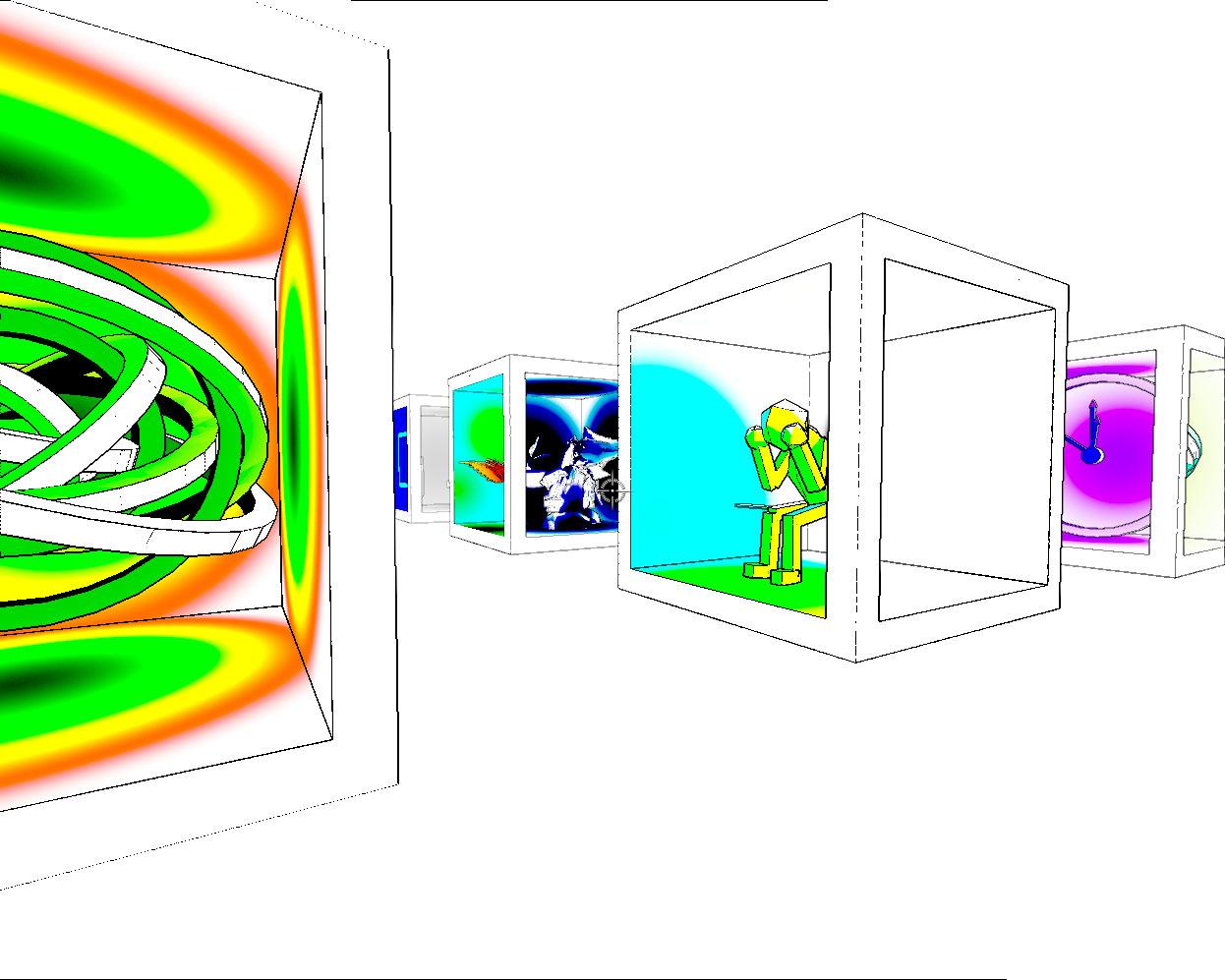
Alexander Bruce presented a talk on his current project, the mind-boggling, space-twisting, eyeball-burning
Hazard: The Journey of Life. He discussed the game’s history, going back to 2006 and the many iterations that led from a failed
Snake clone, to a multiplayer arena combat game, to a single player puzzle game, to the space-warping experience it is today. It was an interesting insight into how such a bizarre game comes into being along with many interesting asides into broader design concepts. There was a video camera present so hopefully a video of the entire talk appears somewhere on the internet in the near future for me to link too [EDIT:
Here it is]. In the meantime, though, I’ll try to do sections of the talk justice with this post by focusing on the historical section of Bruce’s talk which explored how he settled on the game’s unique aesthetic style, its puzzle design, and its unique depiction of space, and how the three aspects all intertwine.
The Journey of The Journey of Life
Hazard is a difficult game to describe in words. Even watching a trailer can hardly impress the nauseating sensation that is playing it. Space—or perhaps more specifically how you navigate space—does not work in
Hazard like it does in most games or, indeed, like reality. Movement is untrustworthy. You may be standing on the third floor of a tower, looking up and down through a central hole at the other floors above and below you. Meanwhile, in the room to your left is the second floor of the tower, to your right is the fourth floor, simultaneously below you and beside you. Or perhaps you stand before a forked stairwell—red stairs going up, blue stairs going down; take the wrong path and, somehow, you are back before both stairwells again.
The earliest roots of
Hazard came into being in 2006 when Bruce started to look at geometry and space. Curiously, this came about when he tried to make a clone of
Snake… badly.
“I was trying to create
Snake, and I implemented it in a very stupid way.”
Bruce was still learning how to program and didn’t want to have to figure out how to build the game from scratch in Java but neither did he want to “cheat” by using a tutorial. As he had just completed a mod on the Unreal engine, he decided to use the Unreal engine to make his
Snake game.
He used what he described as a “brute force method”. He created a floorboard of elevators that would open and close behind the player, leaving a trailing gap in the player's wake. The further the player would get, the longer the trail of depressed elevators would get. “But,” said Bruce. “My game of
Snake was fairly flawed as my character could jump and had a gun.”
Rather than remove these elements, Bruce gave up on creating a
Snake clone and grew more curious in how these elements would work with his floorboard design. What would happen if he shot the elevators, for instance? “Maybe I could start linking them together so I shoot one and create a rippling effect.”
This led to an abstract combat arena game where players would shoot the tiles that made up levels to cause domino effects that would knock opponents out of the arena. Bruce showed videos of outer-space arenas, constructed out of neon green bathroom tiles shattering in mesmeric displays before binding back together.
Eventually, though, Bruce had to put this project aside as his AI was not performing adequately, and his “brute force” coding made multiplayer next to impossible to run over a network. Instead, he moved on to other prototypes including what he called “recursive space”. Bruce described it as “like
Asteroid, where you go off one side and back on the other. I wanted to see what this would look like in 3D.”
The video Bruce showed this time was of an
Unreal Tournament-esque map, except with the effect of being enclosed in a cube of mirrors. Copies of the same map stretched
ad infinitum above and below the level. The player could fall and land on the roof of the same map, or fire a rocket launcher and be hit in the back by the rocket.
Then, in early 2009, he decided it was time to begin work on something bigger than a prototype. “Of all the things I’d created thus far,” said Bruce. “I was most interesting in trying to do something with my geometry system.” Since multiplayer wasn’t working, he shifted his focus onto a single-player puzzle game.
As with his experimental, abstract prototypes, Bruce explained how “for the most part, all of the good ideas I got for this game came from my mindset of actively working against the grain, because that is what I do best.” This meant trying to create what he described as “the anti-game”, which “flew in the face of whatever anyone else said was good design.” Bruce’s reasoning for this what that he knew that whatever he ended up creating would be different. “If somehow I could make that good enough then I would be onto something special because people hadn’t seen it before.”
Visual Design
 |
| The Unfinished Swan |
What was to become a key feature of Bruce’s anti-game was the art style.
Hazard’s world is predominately a flat white with a thin, black outline, and an occasional flash of bright colour or intricate pattern. It is fairly hard to mistake it for any other game.
Bruce recollected how at E3, 2010, a person observing
Hazard said that the distinct, minimalist art direction was “obviously a budget decision.” At E3, where every other game was mapped in high-quality (and predominately grey) textures, Bruce could see how someone could think that. However, “what the person didn’t realise when he made that comment was that despite looking like an unfinished colouring book, he had been standing there watching it for fifteen minutes. Everything around him was louder, in booths that were flashier, on screens that were bigger, by companies that were better, but for fifteen minutes at E3 he couldn’t stop watching this little indie game made of lines and colours.”
For Bruce, the observer’s actions meant more than his words, especially in contrast to other accolades the game received, such as people calling it “the most creative thing at E3. “This kind of thing doesn’t happen by accident,” stated Bruce.
Bruce explained that “in the world of 3D, low budget games stand out as bad because they aren’t keeping up with technical advances. People can tell when something is limited by hardware constraints.” So how was his game able to be compelling? When one can’t compete on technological grounds, one must make up for it with style. “I needed to come up with something that no one else was doing,” Bruce said.
Bruce then showed two games that heavily inspired his own unique visual style. At first, he showed still images of the games as he described them. Curiously, one was simply a blank white screen, and the other was pitch black.
Eventually, he revealed that the white game was Giant Sparrow’s
The Unfinished Swan—a first-person game in a pure white world where the player must throw blobs of paint to gauge the shape and depth of the world. Through
The Unfinished Swan, Bruce explained “the simplest things we take for granted in games suddenly becomes wonderful again. Simply exploring an environment is magical.”
The black game was Wraughk Audio Design’s
Deep Sea—a game that literally has no graphics. The player wears a sense deprivation mask that blinds them, affects their breathing, and works with sound to give the sense of being submerged deep underwater.
Bruce explained that “the design of both these games is interesting, but magnified by the graphical style chosen (or not chosen).” Once
Hazard had a similarly extreme graphical style, “it suddenly seemed remarkable again” when compared to other Unreal games.
A side effect of this visual design, Bruce explained, was how it effected the puzzles design of the game—it made the environments readable.
Puzzle Design
Bruce highlighted
Portal as a game that uses readable environments well. In
Portal, it is clear where you can and can’t put a puzzle. “The minimalist aesthetic got out of the way of the puzzle design and allowed for elegance, not complexity.”
Similarly, Bruce was able to use details and colours to attract the player’s attention in his otherwise white world. “Much like
The Unfinished Swan, I could create a game where the emphasis was on discovery.
Bruce contrasted how this was executed perfectly in
Portal with how he feels it doesn’t work so well in
Portal 2, and in the process managed to find the words to describe the sequel’s shortcomings that I had struggled with myself.
“Every room in
Portal 2 feels epic. They contain massive spaces, moving parts, and far more detail than was ever seen in the original game, and as much as all that sounds like a step in the right direction, for me it felt like it flew in the face of their original design. To add all these extra details, they removed the freedom to place portals absolutely anywhere in the game. Many puzzles went from ‘where can I put a portal to solve this puzzle correctly?’ to ‘where can I put a portal at all?’”
While
Portal allowed a vast array of choice,
Portal 2 restricted freedom: “Every chamber in
Portal had room for the original solution, an advanced solution, solving it with the fewest portals, the least number of steps, or the least amount of time. In other words, the rooms were flexible enough to allow many different play styles.” However, in
Portal 2, argued Bruce, the only options were success, death, getting stuck, or quitting.
“Limiting the design like this was a real shame as the first game got it all so right.”
(Personally, I wondered if this is why I enjoyed the level design of
Portal 2’s co-op campaign far more than the single player, as it more closely resembled the first
Portal.)
For Bruce, then,
Portal—as shown in the contrast with
Portal 2—is a fine example of elegant design, that less is more.
Bruce explained how when he first began designing his puzzles, he too fell in the trap of trying to make everything epic and complex. Though, he soon came to realise that creating a game like that isn’t fun for the player and perhaps not even for the designer.
“The more time I spent thinking about puzzles, the more I realised that truly great design was found when the designer could show you the fewest elements but figuring out how to integrates them all together was the real problem to solve.”
He used
Braid to demonstrate this point. Every world in
Braid begins with a simple level: obtain the key from the pit and unlock the door. In each world, the player must use the unique ability of that world to get the key, thus learning how that ability worked before moving on to more challenging levels. Bruce explained that, “If I was to give you a single lock and key, but there was something unusual in how they work together, that creates a far better puzzle than me giving you a lock and a hundred keys and saying ‘figure out which one opens it.’”
Bruce stressed that when designing a game that the player isn’t familiar with, “you need to get as much out of the way of the player’s enjoyment as possible.”
To drive the point home, Bruce showed a video of Polytron's upcoming
3D/2D hybrid game, Fez. “
Fez is a game that would lend itself to being one of the most frustrating and confusing things ever if executed incorrectly. It would be very easy to overload the design with things like enemies, time pressures, and stress, and lose sight of what makes it special in the first place.”
Twisted Space
So Bruce now had his single player puzzle game with elegantly designed puzzles and a minimalist, eye-catching art style, but something was still missing. While playtesting the game, players were regularly getting stuck or lost, suggesting to Bruce that he removed dead-ends, or made the game more linear, or add clealer way pointing. But Bruce was wary of following the feedback too literally. He quoted Team Meat to say, “Players can only tell you what they are used to.” Or, as he put it more bluntly: “Players don’t know what they want.”
For Bruce, that people got stuck on puzzle 40 did not mean there was an issue with puzzle 40, but perhaps there was an issue with how puzzle 38 was communicating the skills that puzzle 40 required.
He boiled down all the negative feedback he was receiving down to the fact that “it wasn’t that people wanted more, or that there were dead ends everywhere, but rather because of the way the game was structured, in a few key points of the game, I was teaching players a piece of information at one point and it was too much of a leap for them to apply that at another point.”
The only way Bruce could solve this would be too significantly reconstruct the game so that some puzzles could be physically linked differently. However, this was impossible without skewing the design that Bruce envisioned for the game. Instead, he tried something else: “Enter Mind Fuck.”
“One of the most important decisions that happened when designing the game happened by not doing what everyone was suggesting,” Bruce said.
“What saved me in this case was doing something that no one ever suggested because it was weird and other games didn’t do it. Something I nearly cut from the game entirely. The answer to making the game special was breaking space. If I could make a maze that keeps throwing players back to the start of it, then it wasn’t too much of a leap to arbitrarily connect one puzzle to another.”
By twisting space, Bruce was able to open up the game to different play styles while also preventing players from getting stuck. Much like
Braid, with its reversal of time, failure is never an end in
Hazard, but will just send the player somewhere else.
“The game gets out of the player’s way and lets them enjoy the space.”
The feedback from playtesting was instantly different, said Bruce. “Rather than being caught up on guidance, or knowing what they could or could not solve, players just kept running through the game, solving problems in what seemed like a coherent order. It didn’t always make sense, but they didn’t care because the game kept moving.”
Finally, Bruce explained how while
Hazard certainly has its thematic content of psychology threaded through its aesthetics and design, it neither has or requires a story. He feels like people miss the point when they ask if it should have a story. “Rather than letting players run around where half of the fun was trying to figure out why it existed, or what it was, if I added a story that explained all of this stuff, they would know they were just going through the motions to get to some contrived plot twist.”
Bruce put it most succinctly, I think, when he said that
Hazard is about discovery for discovery’s sake. Just like
The Unfinished Swan, exploring and comprehending the world through its aesthetics, its design, and its twisting of space is its own reward.






 Posts
Posts


