The second article I have written for Kill Screen Magazine's website is up now. It looks at LittleBigPlanet and how communication because an intrinsic activity between characters, as opposed to a solely extrinsic activity between players. Please check it out and let me know what you think!
Just like last time, many thanks to Ryan Kuo for the awesome editing job. Without his suggestions, I wouldn't be half as happy with this post as I am.
Today (or possibly yesterday; I am a bit behind on Internet News), Jason Rohrer's entry into this year's GDC's Game Design Contest, Chain World,went up on eBay.
Some quick background information: The theme for this year's contest was 'religion'. That is, the contestants were not to make a game about religion, but a game that could be a religion. Returning champion Jenova Chen created the most disappointing concept, essentially sticking TED talk videos on YouTube with a little bit of gameification. John Romero had an interesting idea for a live-action game that he was able to perform in the room. It was a very western-centric idea of religion, but it worked and was fairly interesting. If I ever get the chance to write up about the actual session, I would like to cover Romero's concept in more detail.
The winning concept, and my personal favourite, however, was Jason Rohrer's. Rohrer's concept was based on his personal feelings of what religion is. In an over-simplified nutshell: religion is the myths we tell ourselves about those that came before us. He used examples such as things his family always say his grandfather used to say (though none of them are actually sure) and the stories and beliefs we form around artifacts such as Stonehenge. Essentially, we craft narratives and reasons around the things we don't know the actual history for.
Rohrer conceptualised this with a modification of Minecraft. One player has one life, and when they die they pass the game on to someone else on a USB stick. Once you play the game, you may never play it again. It was an interesting and inspired concept, and the most grounded in an actual interesting idea of religion. At the talk, Rohrer passed the USB stick onto the second player (himself being the first), and from there the game would continue as player passed it on to player.
Except now, player number two is exploiting it. He is selling the USB on eBay to the highest bidder. I could write a huge rant about how pathetic and despicable I think this is, but as my opinions seem to mirror Darius Kazemi's, I'll just link to his brief thoughts on it. You should read it before carrying on with this piece, just so you know where I stand on the matter.
So yes, the fact that this is happening made me angry. However, unlike several people I have been debating with on Twitter, I don't believe this necessarily implies the game was poorly designed to begin with. On the contrary, I think this exploitation crowns the game an absolute success. Chain World didn't fail. It is we, humans, that failed.
The reasons why others seem to think this exploitation of Chain World implies poor design (and I am not naming these 'others' on the high possibility that I am misquoting them and deforming their arguments, as Twitter is prone to do) can be boiled down to two things: firstly, the game fundamentally relied on players passing the game on, which was a tenuous hope at best; secondly, Rohrer never anticipated the game to be played this way and thus the game fails at achieving the thematic goals intended by its creator.
I agree with both of these statements completely, and I absolutely hate what the current player is doing with the game, yet I still do not believe Chain World failed. Why? Because Chain World is currently being used in the same way religion is used: exploited by the few to obtain money and fame from the many.
No religion starts as an institution. Religion start as faith and belief. It is only when they gather enough popularity that those in charge start exploiting and cashing in on the faith of the many. This isn't a particularly shocking thing to say. You only have to look at the wealth piled up in the Vatican while the preachers of Christianity insist we should give everything to the poor to see it is true. Does this mean religion is essentially 'bad'? No, of course not. Everyone is free to believe in whatever they desire, and nearly all religions are founded on noble, commendable goals. It's the institutionalisation of this faith and the exploitation of the faith of the many by a few that is bad--but also, I would argue, inevitable.
Those who founded Christianity did not do so to gather a huge pile of gold and tell others what to do. They founded it because they thought it was a pretty decent way to live your life and they thought everyone else would gain something from it, too. And then comes the inevitable stage where those in charge find themselves in a position of power over the faith of the many. Sure, it's greedy, but it's human. And I don't mean to pick on Christianity; the same happens in all the world's major religions at some point in history or another.
Now back to Chain World. It started with a belief of Rohrer of what religion 'is' and how that should be conveyed as a game. This belief tapped into similar beliefs of many others, either because he gave a really good presentation (which he did); or because most of those people love Minecraft, or Rohrer's previous work, or both.
And now, those shared beliefs of the many are being exploited by a few. Just like the most popular religions, Chain World is being institutionalised. Chain World is being treated just like a religion.
So was Chain World poorly designed because a) it is no longer conveying the themes Rohrer intended (or arguably it never conveyed those themes as the very first player after Rohrer exploited it), and b) because there was no fail-safe in the game design to prevent this from happening? No. Chain World was exquisitely designed, perhaps even better than Rohrer intended, because it has been able to evolve in the same way major religions tend to evolve: from personal beliefs into the exploitation of many, far beyond the control of the religion's founder.
So while I think what the current player is doing is pathetic, I also think it was inevitable, and perhaps even necessary if Chain World was to succeed at the contests stated thematic goal: make a game that could be a religion. As the bids for Chain World on eBay approach $500, and as Rohrer futilely urges on Twitter that the believers reject this reappropriation and exploitation of his creation*, those currently in power are taking suggestions for a tenth commandment for the game (essentially, putting their own rules over Rohrer's) as they institutionalise Chain World into the religion it had no chance of not becoming.
Chain World succeeded. Humans, on the other hand, have not.
(* Interestingly, I could be reappropriating Rohrer's words in a similar way myself by saying this is what he meant in this tweet, which he quite possibly didn't!)
(** Also, for the sake of full disclosure, and if it wasn't clear from the post, I am an agnostic/athiest (it depends what day you ask me). I apologise if my cynical views on religion offend you and your faith as I mean no disrespect to anyone's personal beliefs.)
After a ridiculous long long trip home (over 30 hours spent on planes, trains, and in airports), I am back in Brisbane after what was easily the most phenomenally insane and overwhelming and outright amazing week of my life attending the Game Developer's Conference in San Francisco. Lectures were attended, reports were written, hotel rooms were partied in, tacos were eaten. It was one hell of a week.
I won't go too far into my experience partly because I am so jetlagged and mostly because that is a piece I am meant to be writing for Pixel Hunt, so I will surely link that when it is done.
Speaking of links, I was planning on linking to all the reports I wrote for Industry Gamers throughout the week, but they are currently migrating to a new server so I can't get to my articles, I am afraid. Instead, here are my favourite three things to come out of last week:
The Many Faces of Tim Schafer, Paste Magazine. Double Fine's Tim Schafer hosted this year's Game Developer Choice Awards and did a stellar job. He was entertaining, funny, and even managed to slam Penny Arcade over the whole Dickwolf thing. It was incredible. Unrelated to all of this, Brian Taylor took a lot of photos of Schafer's head during the ceremony and they turned out awesome.
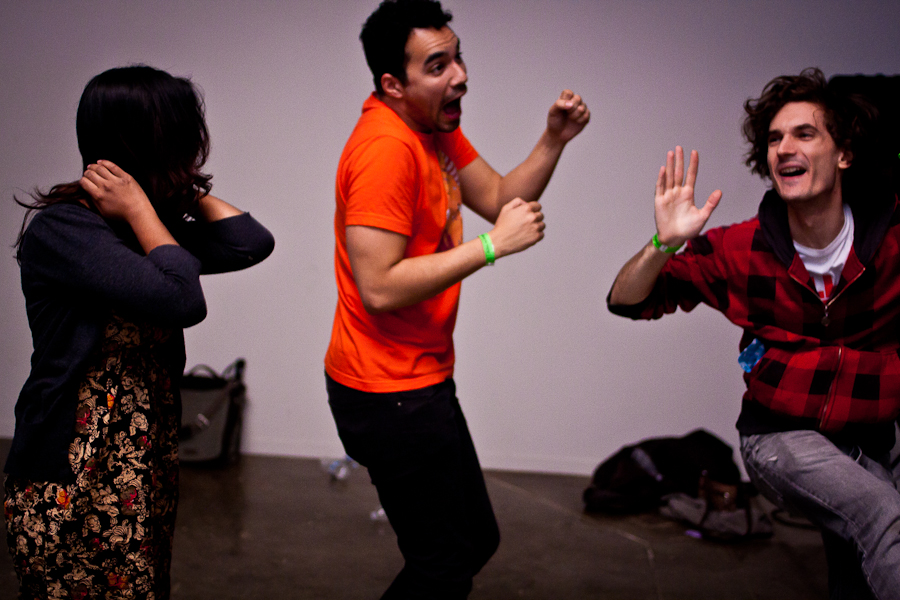
Kill Screen & Copenhagen Gaming Collective Party. The social highlight of the week for me was partying with the amazing writers from Kill Screen Magazine (and a whole bunch of other people!) Games were played, dances were danced, and a certain Sydney-based blogger got a bit drunk and hugged a lot of people. Brian Taylor, once again, grabbed a whole stack of amazing photos worth checking out.
Holding the Bag: How I Gamed GDC's Top Social Game Developers. The Social Game Developer's Rant/Debate was a chaotic highlight of the conference. Strong opinions were thrown back and forward. An experiment/game was run where people had to collect coins to win. One man took things into his own hands and stole the entire bag. He has since written up his own account of the thievery and has drawn some interesting comparisons with social gaming and the gaming industry in general. It is well worth a read.
I am sure there is more incredbile stuff out there that I have not had time to read yet, so please link to whatever you wish in the comments.
I am utterly humbled to have met so many amazing developers and writers this past week and I can't wait to see you all again next year.
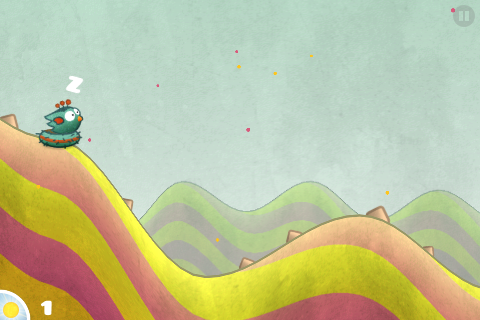
Andreas Illiger's adorable Tiny Wings soared onto the iOS app store this week. Quite suddenly, half my Twitter feed was talking about this charming new Canabalt-esque game (‘Canabalt-esque now being pretty much its own genre). Between downloading the game, playing two rounds, and going back to the app store to give the game a five-star rating, over a hundred new reviews appeared. And what good reviews, too! Players say they love it, that is it beautiful. The compliments are vague and abstract (though, looking back several hours later, the number of reviews has quadrupled and there are more specific comments now, both complimentary and critical), but they mirror my own feeling on the game perfectly: Tiny Wings is lovely, and it makes you feel good.
The premise is that you are a bird who will never be able to fly because your wings are too tiny. But this doesn’t stop our little disproportionate hero from trying anyway. He wants to fly, and he will do it however he can. With a touch on the iPhone’s screen, the bird folds his wings back to plummet towards the ground and speed down hills; when you release, he soars off the incline of the next hill like a stunt jump, flapping frantically. The key is to time your drops to get the most speed and height for the next jump. If you do it right, you might even touch the clouds.
It’s a fun and addictive experience, much like that of Canabalt—as simple as it is complex. But also like Canabalt, the true beauty and depth lies not just in the mechanics, but in the game’s fiction. The character, the visuals, the animations, and the music all come together to make Tiny Wings about a disadvantaged bird who got the arse-end of life but refuses to give up on his dreams. Tiny Wings makes you want to grin and cry at the same time. Ultimately, it just feels good.
‘Good’ in the way the ending of Cool Runnings feels good (at the very least, how Cool Runnings felt good after a few vodkas the last time it was on TV). Just like the Jamaican Bobsled Team, the tiny bird tries so hard and overcomes so many challenges, but can never quite reach his goal—at least not for good. It’s both heart-warmingly uplifting and tear-jerkingly sad to watch your bird launch into the clouds—so happy he has touched his dreams; so sad that it will be so fleeting as he falls back to earth. But the moment he lands he is eager to try again and again and again.
The music, an uplifting twang of guitars and blare of trumpets that wouldn’t be out-of-place on a Polyphonic Spree album, complements the themes beautifully. If the bird’s whimsical cry of joy when he launches into the sky doesn’t make you smile, the music will.
Tiny Wings is a fun game. It is mechanically competent and has an excellent, simple-yet-deep scoring system that tempts you to play over and over again, as all games in the Canabalt genre should. But while these elements alone would make Tiny Wings a great game, it is the emotional investment enabled by the game’s aesthetic design coupled with these mechanics that make it truly remarkable. That little bird never stops trying to reach his dreams, even if he can only realise them for a second at a time.
[A note: I imagine that many of the events I talk about in this post from HeartGold also occurred in Gold and Silver. Though, as I have not played the original Generation II games, this is the first time I have encountered them.]
After battling through half a dozen trainers just south of Violet City, I’m relieved to see the Pokecentre at the entrance to Dark Cave. It seems like a fairly odd, out-of-the-way place for a Pokecentre, but I’m not complaining; I’m only a few hours into my adventure on HeartGold, and my pokemon can hardly survive three consecutive battles in a row without fainting. It would be nice to give my pokemon a rest before venturing on.
A slightly overweight man is standing around outside by himself. I have a quick word to him as I pass.
“Pssst! Wanna buy a Slowpoke tail?”
A Slowpoke… tail? As in, the tail of a Slowpoke? As in, you removed a limb from a pokemon, and now you are trying to sell it to me?
Half-confused, half-shocked, I speak to the man again to make sure I heard correctly. Sure enough, I had. Adding to the absurdity of this interaction, when I tell him that I indeed do not want any Slowpoke tail, he tells me to ‘scram’—a jarringly rude remark in a world as polite and cheerful as that of pokemon. I enter the Pokecentre, still unsure as to what just happened.
Pokemon games, more than the average videogame, have always had to fend off baseless accusations from those trying to protect the defenceless minds of gullible, influential children. Pokemon promotes violence; Pokemon promotes gambling; Pokemon is nothing but an empty marketing scheme that exists solely to separate children from their pocket money. Most of these accusations are hyperbolic or rely on an annecdotal case study of a single child. They also completely disregard the many benefits of Pokemon, such as motivating kids to learn how to read from a young age, basic maths and logic, problem solving skills, and the general themes of cooperation and sharing that permeates the series.
In generally, the population of Pokemon’s worlds reflect all the good things we want children to think about the real-world: people are polite, selfless, and generous; animals are cute, friendly and obedient; everybody lives comfortably and within their means; and, uh, Dad is never home. So being told to ‘scram’ by someone who offered to sell me the limb of a pokemon was nothing short of shocking.
Which leads me to the one accusation often levelled at Pokemon games that seems to have a bit more friction: Pokemon promotes animal cruelty. While still exaggerated beyond all fairness, it is hard to ignore that the supposedly symbiotic relationship between mankind and pokemon seems to be defined as “man forcibly removes pokemon from natural habitat; man imprisons pokemon; man forces pokemon to battle other pokemon and to complete tasks solely for man’s benefit.”
It’s a problem at the core of the series’ design and fiction, yet one the series has gotten away with ignoring for nearly two decades by concealing it in layers of positive themes, cute creatures, and content people. Everybody—man and pokemon alike—is happy, so what’s the problem?
Which made my encounter with the shady man outside the Pokecentre so much more jarring. In a world where international terrorism seems to be equivalent to real-world juvenile delinquency, being offered illegally poached goods and then told to scram was not something I was ever expecting to happen.
More than any previous Pokemon titles I have played, then, HeartGold seems willing to accept that the relationship between man and pokemon is not one of perfectly balanced symbiosis. While man and pokemon are indeed able to live happier lives through cooperation, man is also able to live a far easier and profitable life through taking advantage of pokemon.
(By http://goodcitizen.deviantart.com)
Previous titles have ignored this imbalance or, at the very least, it has been held back by the typically well-natured people that populate the games. But HeartGold tackles it from the very beginning. In the opening sequence where you choose your first pokemon, the typical trope is that you choose pokemon X, and your friend chooses pokemon Y (where X is weak against Y). HeartGold usurps this with a slightly different formula: “You choose X, your friend has already chosen Z, and someone else steals Y.”
Steals! A young pokemon is stolen and forced to battle by an evil-hearted trainer! Professor Elm tells the player directly his concerns for the wellbeing of that pokemon: if the owner is evil, the pokemon will more likely than not grow up to become evil-hearted themselves. What a horrible fate for a living creature, to be raised in such a way that your fundamental outlook on the world is one of evil and corruption.
That someone could steal a pokemon and force it to act a certain way hints, from very early in the game, that the relationship between man and pokemon is not as simple and balanced as previous games would like to think. Rather, mankind has a significant responsibility to the relationship and is just as capable of taking advantage of the creatures as they are of cooperating with them.
Things quieten down for a time and my initial shock at the idea of a pokemon being stolen fades. But then I encountered the rude, obese Slowpoke tail smuggler. The plot thickens in the next town where it becomes apparent that Team Rocket had been rounding up Slowpokes and chopping off their tails to sell on the black market. The tails grow back over time, but how horrid!
And that is as far as my journey into HeartGold has currently progressed. I have a long way to go, but just from these opening hours, I sense a maturity to the series I have not previously encountered (though, I again acknowledge that I have not played the original Gold and Silver versions and the same themes were probably approached in those games, I imagine). In these encounters with the darker members of humanity there is a a heightened self-awareness that challenges not only the player to think in more complicated terms about their relationship to their pokemon, but challenges the series itself to re-evaluate the mechanics at its very core—not so much in the sense that the mechanics are morally questionable, but that they are just more morally complicated than previously assumed.
While the thief steals a pokemon to use for evil, you, on the other hand, now have the option to keep one of your pokemon outside of their pokeball. It isn’t much, but it is a step in the opposite direction to show how man and pokemon can be true companions, rather than the latter being the tool of the former.
My relationship with my pokemon has always been “I tell my pokemon to do something, and they do it; everyone is happy.” However, The pokemon thief, the smuggler, and the poaching of slowpokes by Team Rocket show that this relationship is too simplistic. I must consciously treat my pokemon well or consciously take advantage of them. There is no unconscious middle ground. It is something previous titles have tried to urge in the cutesy, throwaway dialogue, but I’ve never had the imperative to take it seriously. Why put an effort into treating my pokemon well when the alternative is, well, when there is no alternative? But this time, in a iteration of the Pokemon universe where humans exist that intentionally abuse pokemon, my pokemon and their quality of life are completely, utterly my responsibility.
I have a new article up over at Kill Screen's excellent new website. It discusses ideas of progression and difficulty and being 'stuck' in Super Meat Boy and how it helps the player to deal with this in the player's chase for perfection. Or something like that. Thanks to some great editors, I'm really happy with how this has turned out so please head over there and have a read.
And with five more games, so ends my 2010 retrospective. You can check out the games I have already talked about in part one here, part two here, and part three here.
Dragon Quest IX
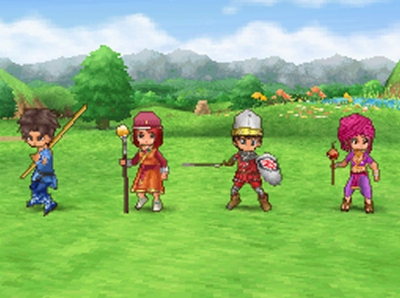
This was my first ever Dragon Quest title, and I had high hopes. I've heard much about the series generally and even more about this game specifically. Certainly, it is the first JRPG I have really enjoyed since Final Fantasy IX, and is also exactly the kind of title I have wanted for my DS for years--namely, a game that is as enjoyable to play for five minutes as it is for fifty.
While the Final Fantasy series seems intent on distancing itself from its roots as much as possible (I have no interest in Final Fantasy XIII whatsoever), Dragon Quest IX is a delightful re-imagining of SNES-era JRPGs with modern sensibilities. The dialogue is alarmingly well-written and full of self-aware humour and bad (i.e. awesome) puns. It takes itself serious enough and constantly throws interesting dilemmas at the player while also constantly lampooning JRPG tropes and cliches.
The story is passable but forgettable, and exists only to prop up the question, yet it does so aptly. Battles are quick and enjoyable and, thankfully, allows you to quickly change between AI settings or switch to full manual control. I hate turn-based games that don't let me control all my people. Dragon Quest IX's AI settings are usually okay, but it is good to be able to switch them off mid boss battle when need be.
Character customisation adds a lot, too. Being able to see every single piece of armour and weaponry on each of your characters adds just enough motivation to buy that new bandanna. I surprised myself by actually considering less-strong shoes for one character just because they matched the rest of her outfit.
I've only just recently tried out the much talked about multiplayer. It is enjoyable enough, though being in another player's world just feels... fruitless. However, pretending you are an AI companion for that player is kind of fun.
I only recall reading one Dragon Quest IX related article this year, and that was a spotlighted blog at Destructoid about how the game deals with the theme of faith.
WarioWare D.I.Y
Contender for best game manual of the year. In the same year that Ubisoft said it would stop supplying printed manuals with games (it was Ubisoft, right?), WarioWare D.I.Y came with a beautiful, thick little book with fold out covers that I sat down to read cover to cover in the vain hope that if I actually read it, game designers would create more manuals like this.
I am not much of a creator of content in games. In LittleBigPlanet, ModNation Racers, Minecraft, I spend very little time actually creating and much more time marveling at the things others create. Yet, in WarioWare D.I.Y, I found it incredibly simple to create fun mini-games of startling variety that just fit into the games existing style without much polish. It takes effort to make a working LittleBigPlanet level to look 'good', but not so in WarioWare D.I.Y.
Similar to the stunning manuals, if you are patient enough to sit through them, the tutorials are practically beginners lessons at object-orientated programming. Even a kid could sit through these and at the end understand the difference between a FOR... DO loop and a WHILE... DO loop. If you have a kid you think would enjoy programming, this is a pretty decent place to start.
Yet I feel it went under the radar a bit. Perhaps if it allowed more complex controls than just tapping, and if it came with more prepackaged games it would have fared better. That said, it has the easiest to use online service of any DS game I've played... but that isn't saying much. If only the DS had a better integrated friend system to help spread games more, I would probably have spent many more hours on this game. At present, it is on the top of my "must return to soon" pile.
BIT.TRIP BEAT
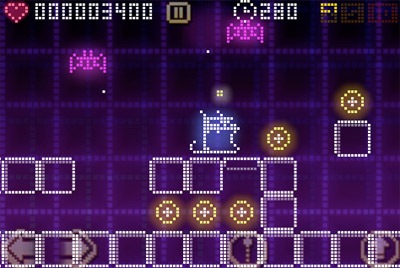
I first grabbed this game on my iphone, but didn't fully appreciate it until I grabbed it for my macbook in the recent Steam sale. BIT.TRIP BEAT (I am under the impression that the capitals are required) is a torturous, indie reinterpretation of ball-and-board games such as Breakout and Pong. It is an entertaining experience, but it is hard to call the game 'fun'. BIT.TRIP BEAT hurts. It makes you dizzy, it makes you motion-sick, it makes your eyes feel like they are bleeding. The visuals are psychedelic and go out of their way to make things difficult for you. Your targets are logic-defying and mindboggling, and the difficulty curve is steeper than the walls of your house.
Yet, I keep returning to it. This game is certainly not for everyone. Hell, this game might not be for anyone. But despite the fact I can't defeat the second level, I still want to keep playing it. Though, I no longer try the iphone version. I almost vomited on the bus one too many times.
Metro 2033
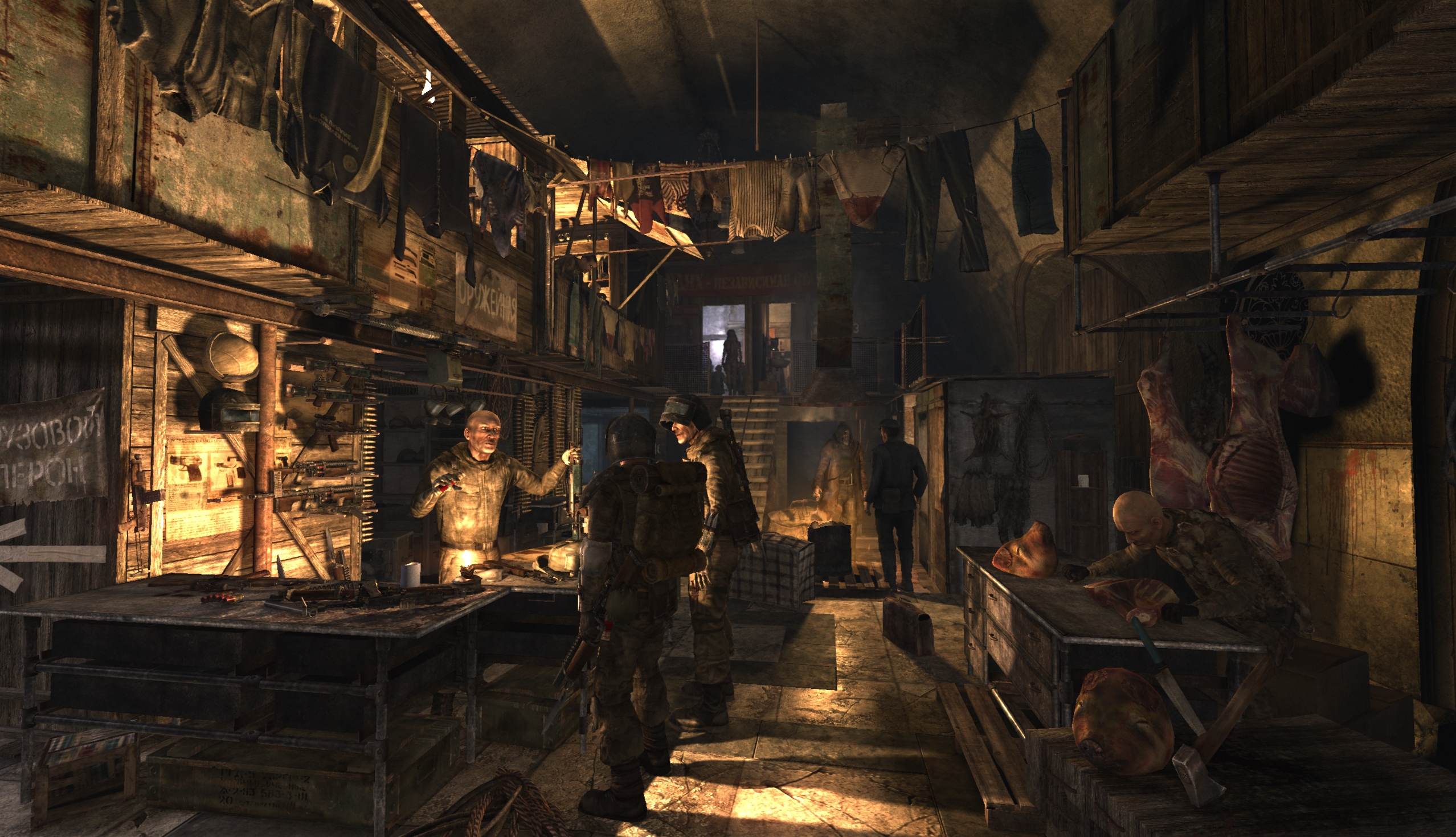
The gunplay in Metro 2033 is nothing special. The mutant enemies are arbitrary and forgettable at best and rage-inducing at worst. Towards the end these green blob... things made me rage quite more than once and nearly prevented me from finishing the game. But the sense of atmosphere the game invokes is unprecedented. Walking around the train stations of Moscow's post-apocalyptic Metro, the world and its people felt real. Their day-to-day problems felt real, and I felt like a part of them. A lot of the worldbuilding is probably owing to the novel, but it pays off excellently. When the gameplay falls through, the fiction keeps you going.
The atmosphere is not just in the towns, however. The sense of cold and the sense of that bare, stubborn struggle of survival are so visceral. From saving individual bullets to wheezing through a spoiled oxygen mask filter instead of wasting a new one, it just felt so... real.
Playing a game in Russian certainly added something, also. It just felt right. I think it is a silly and demeaning analogy to say it felt like playing gaming's version of watching a world movie, but that is what it made me want. Metro 2033 made me hungry for more international games than the typical English and Japanese ones I have access to in this country.
I can't recall reading much about Metro 2033, but I'm sure things were written. Please leave me links to any pieces you remember reading.
iPhone Games
My initial list for these posts had about twenty more games in it, but instead I thought I could put them all under this heading. I stress, though, that that is not because all these games together are only as important to me as one other 'real' game. It is simply because I cannot afford the time to write about twenty more games. I have purchased (or downloaded for free) fifty-two iPhone games since purchasing my iPhone in February 2010. In that time I have played many games that I have thoroughly enjoyed and still often return to at the bus stop, on my lunch break, or just lying in bed. I hold these games largely responsible for the little playtime my DS has received.
Top games include Angry Birds, or course, but also Adam Saltsman's Canabalt and Gravity Hook work perfectly with the touch controls. Solipskier is another great title, requiring you to just keep your finger on the screen. Osmos works beautifully with the touch controls(far better than its PC counterpart), and Spider uses the iPhone's unique abilities superbly to create a very interesting and fresh platformer that also tells a spatial narrative. Meanwhile Tractor Beam is an interesting take on Asteroid which uses physics in some very interesting ways.
All these games are great games because they would not (or do not) work on other platforms. Too many big publishers try to release ports of big console releases on iPhone for $10 that play horribly, yet the indies and the smaller companies have understood that there still exists so much potential in simplistic, minimalist controls, and these are the games that have made the iPhone such a great gaming platform.
That said my most-played and most enjoyed iPhone game was, surprisingly, one using on-screen controls. Pix'n Love Rush is a great little platformer that I have trouble explaining why I enjoy. Each level is mere seconds long, and you complete a five minute game by perfecting as many of these levels as possible, racking up your multiplier as you go. The visuals are delightfully retro (of course) and there are many nods to previous generations of games, as well as a great chiptune soundtrack. Perhaps it is the retro indie platformer obsessive in me, perhaps it is my love of score-chasing, but Pix'n Love Rush just struck a nerve in me and I found it very hard to stop playing. I even wrote a little reader review for Kotaku about it!
And those are the games I played in 2010. How about you? Any particularly interesting ones that tickled your brain that I didn't cover? Any articles I should have linked to but didn't? Let me know! And thanks for actually reading all these. It's been a pleasure to relive all these games, and now I am tempted to start new games on all of them!
The past two days I have posted Part One and Two of my 2010 retrospective where I have just written a few paragraphs on the games that shaped my past year. In Part Three I finally move on to some Playstation 3 games and, shock horror, some 2D indie platformers.
ModNation Racers
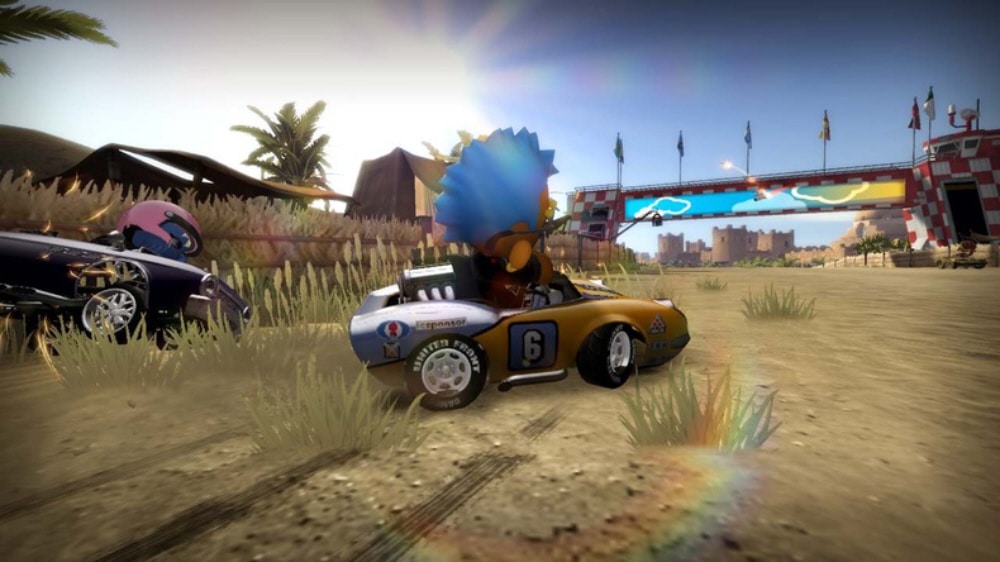
The most frustrating release of 2010. At its core is a devilishly fun kart game with interesting weapons and balanced design that can easily give Mario Kart a run for its money. Yet, around this core are layers upon layers of horrible user-interface design and slow loading times, as though the designers just didn't want anyone to play it.
A patch was released, but it fixed very little. I will probably never play this game again, which would be sad enough if the kart-racing at the game's heart was no so fun. I don't recall reading much about the game, but I did write a rather lengthy rant myself.
Limbo
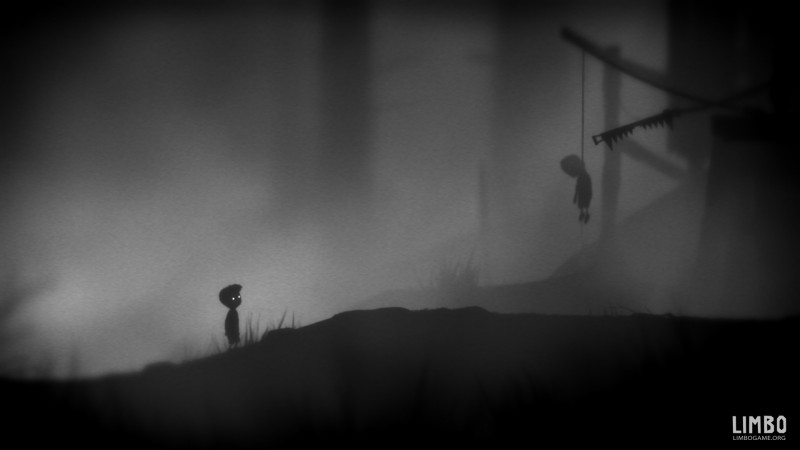
Yet another indie platformer, yet another much-talked-about, opinion-splitting game. I would like to say Limbo transfixed me enough for me to finish it on one sitting, as it did for many others, but one puzzle towards the end had me beat for several days. In fact, I ended up having to ask my brother how to beat it. Many had issues with the game's unforgiving, exploitative design, but I solely blame myself for not being able to defeat this certain level.
Limbo nailed so much perfectly. The mood, the atmosphere, the minimal soundtrack, the puzzles. Underneath, the game could be any physics-based platformer, but the presentation made it so much more. It will be sometime before I forget the sequence with the spider and the lost boys. The transition from the game's ending back to the main menu was also superb and tied in beautifully with the game's overall themes of death and loss.
If anything, its only fault was that it played its cards too early. The woods were far more immersive and memorable than any of the later industrial stages. I understand why the stages progressed in this fashion, but they just weren't as enjoyable. Several puzzles also relied too much on twitch reflexes, that meant some players were stuck long after they knew how to progress.
Limbo also allowed me to first dare put into words ideas I have about a concept I have been calling player privilege. They were very rough ideas, and they have changed much since those two posts (thanks largely to the many comments both posts received), but it was Limbo that first helped me to squeeze the words out.
Super Meat Boy
Yet another indie platformer! One of the things I found most fascinating about Super Meat Boy was the amount of hype surrounding it before it was even released. Hype... for an indie title! So much so that on several occasions, several months apart, I assumed it must have already been released. Team Meat did an excellent job of forming a community and getting them excited about the game in a way few indies have managed.
When it was finally released (I was resetting my 360 constantly to update the Games Marketplace) I was rewarded with the purest, most enjoyable platforming I've experience since Donkey Kong Countr II (possibly an odd comparison, but I was never much of a Mario player). This was not platforming in the same way as Limbo, which used platforming as a vessel for a puzzle game and an atmospheric experience, and not in the same way as VVVVVV which just changed around a few mechanics. Rather, Super Meat Boy took the existing mechanics of run, dash, jump, and wall-jump and polished them to a mirror's sheen until it all just felt so, so, so right.
The game is just a joy to play in every respect; it really is that simple. Some may find the difficulty too high in places, but I never felt like I was 'stuck', even when I was repeating the same level dozens of times. In a similar vein to Nels's post above, Michael Abbott wrote a good post applauding Super Meat Boy and other 2D indie platformers and claims that platformers are the gaming equivalent of jazz music. The development blog at Team Meat's website has many good reads from the development process, such as this one about risk and reward.
Heavy Rain
Ah, Heavy Rain. Despite getting so much wrong, it somehow managed to get so much right. I enjoyed the one time I played the game through, but I have no inkling to go back and try a second time to see what difference outcomes are possible. The story was drab, generic, sometimes illogical, and could have been pulled from any weeknight crime show, but the simple (some would say meager) interactivity really added something for me. I'm not certain just how often my actions actually made a difference, but it always felt like they made a difference, and that was important. It's also why I am reluctant to play it again.
This weight on my decisions and actions largely comes down to the fact the Heavy Rain is continually moving forward. If a character dies, the game continues to progress. Much like I mentioned for One Chance and Minecraft, that my actions were final made them more meaningful to me.
What I also found interesting about Heavy Rain was not just how my conscious decisions affected the narrative, but how the narrative was affected by me stuffing up. Missed quick time events were the difference between life and death for a character is some situations. I'm interested to see other games implement ways for the player to incidentally affect the outcome, not just consciously.
The game's problems can't be ignored, however. The early scene in the shopping mall that sets up the entire story is completely non-nonsensical and ridiculous and has been lampooned quite well in both flash and song form. The treatment of Madison Paige as a constant victim of sexual violence (and not much else) was also problematic. Denis Farr had an excellent post at The Border House blog about that.
This technically isn't a 2010 game, but 2010 was the year that I played it. Many people that I follow on Twitter had been discussing how much they were enjoying Brotherhood, so I decided I should play the original sequel in order to check out the sequel's sequel. Sadly, that looks unlikely to happen anytime soon as it does not look like I will be completing Assassin's Creed II any time soon.
Curtly, I am not enjoying it. The game has some very strong systems at its core, and improves on the gameplay of the first game greatly. However, the writing is consistently terrible, the pacing is non-existent, and the story might as well not-exist. This all combines to create a complete lack of intrinsic motivation--I can do so many cool things in this game, but there is just no point to do it.
Perhaps this is largely because I cannot care for the world and its inhabitants in the same way I care for those of The Capital Wasteland, Panau, or Liberty City. The nuances that most open-world games have are missing; the world around you just doesn't react to your actions. In one mission there is a full-on war being waged on the streets of a city. Among the sword fights, an old lady was sweeping her doorstep. Around the corner, two old men sat casually on a bench. These were not standalone occurrences and completely pulled me out of the experience.
There is a lot of potential here, and perhaps a gamer less-inclined to care about story and fiction than myself could really just enjoy jumping around and fighting guards (which really is quite fun). Much like ModNation Racers, the game-breaking flaws frustrated me so much because what Assassin's Creed II gets right, it gets very right. I would have been interested to explore Ezio's growing up into an assassin, but it all happens too slowly and then too quickly. He is a master of parkour before he has any right to be, and then he is committing cold-blooded murder without a second thought moments later. I would have liked to have seen a steadier progression, perhaps some sign of shock or reluctance at his first murder. Perhaps one day the gameplay will return me to the cities of Italy, but for now the nonsensical story and horrible plotting is keeping me well away.
And so ends Part Three of Thoughts on 2010! One more part and five more games to go!
Yesterday I posted Part One of my 2010 retrospective where I am just writing a few paragraphs about the games I played this past year. Yesterday I covered Bioshock 2, Mass Effect 2, Minecraft, Sleep is Death, and Halo Reach. Part Two continues with games in no particular order.
Red Dead Redemption
Red Dead Redemption was easily my most anticipated game of 2010. No one can suck me in with a series of pre-release trailers like Rockstar. Grand Theft Auto IV is still my favourite game of this generation of consoles and the simple idea of 'GTA on horses' was enough to get me excited--as much as Rockstar urged that Red Dead Redemption was more than that. I was looking forward to the same level of incredible world-building, unforgettable characters, and biting dialogue (and hopefully without the same juvenile, gutter-trash dialogue).
My expectations were not surpassed so much as rendered null. In many ways, Red Dead Redemption is just GTA with horses, but in many other ways it is completely different. The characters are more plausible (if rarely any more likeable). The overall tone is more mature. The world is staggeringly beautiful in a way completely unlike Liberty City. Often I would just pause atop a mountain, mid-mission, just to watch the clouds over the plains.
The game does fall down in many of the same places Grand Theft Auto IV did. While many of the characters were more tolerable, few are likable. Rockstar's obsession with satire has rendered another world of empty, despicable characters. Then there is the notorious trek into Mexico where both the story and pacing go off the rails before the games final part brings things back together for one of my all time favourite game endings.
Red Dead Redemption was also responsible for some stunning pieces of games writing this year, too. Michael Abbott's battle with Armadillo's anti-semite shopkeeper was an early favourite. Another great piece of writing seems to have disappeared from the internet, I am afraid. I distinctly remember reading this piece where a player was playing as a pacifist, walking around a multiplayer free-roam map just tracking wildlife and being murdered by more violently-inclined players. If anyone knows the piece I am talking about, I would greatly appreciate a heads up in the comments. EDIT: If anyone can track down a piece of games writing on the internet, it is Ben Abraham, and he came through for me this time. Here is the piece I was thinking of: "Call of the Wild West" by Brendan Caldwell.
VVVVVV
Another great indie title for 2010, VVVVVV is a straightforward platformer that takes the core mechanic (jumping) and tweaks it to completely change how you approach the game. Instead of jumping, in VVVVVV you flip. When the flip key is pressed, the character falls up until they hit the ceiling, where they will stay until you flip back and fall down to the floor. In the same vein as Portal, this change meant that I had to completely rethink how I approached puzzles that I had already solved a dozen times in previous platformers with a simple jump. The game's presentation is slick, too. I can understand if some people have had enough of the latest retro trend, but VVVVVV's 8-bit graphics and chiptune soundtrack is stunning. It is on Steam these days, too. Strongly recommend you check it out if you are yet to.
One Chance
An interesting and memorable little browser-based game that forces you to make decision and then live with them. In a way, One Chance is a perma-death experiment. Every decision you make is final. You cannot restart; you cannot try again. And when you complete the game, that is it; you cannot start again.
Interesting, that I found a game that I spent little more than a quarter-hour playing memorable enough to including on an end-of-year list. Or perhaps that isn't surprising at all. When games force the player to live with their decisions, the player will have a more meaningful experience, just as Minecraft forces the player to perpetually move forward in time. When faced with permanent consequences, you might be surprised by the decisions you make. It has a few bugs, but generally runs quite smoothly. It will only take about ten minutes to play and is really worth trying out.
Just Cause 2
I almost missed this one. When it first came out, I played the demo, enjoyed it, but not enough to consider buying the full game. This last fortnight, though, I found it on sale and decided it was time. The story is terrible and the voice-acting even worse (what is with that woman in charge of the communist faction?) but the game beneath it is crazy fun. Overall, the game feels like San Andreas combined with the rope tool of Garry's Mod. What makes the game work is its systems. Everything is tweaked in just a way to ensure cool stuff always happens. For instance, when you leap off a car and open your parachute, the car will only need the smallest impact to explode and add some extra drama to your escape. Or, my personal favourite: maybe two missions into the game I was being chased by men in jeeps. I did not expect it would work, but I tried to use my grappling hook to anchor one jeep to the road. Sure enough, the jeep lurched forward to forward-flipped onto its roof. There is little more satisfying in a videogame than when you think "I wonder if..." and then you actually can.
The central play-style of the game is also well-treated by the the fiction. The story of mercenaries and agencies is disposable, but the central concept of having to cause chaos to unlock missions and weapons ties in well with the sandbox 'dicking around' themes of the game.
Not that you need the motivation, just moving is fun. Jumping from a helicopter to land on a motorbike to then leap off just as it explodes into a service station as you leap onto the front of another car and then back up into another helicopter is just pure, rollicking fun. How long it will remain fun without a story worth caring about, however, I can't yet say.
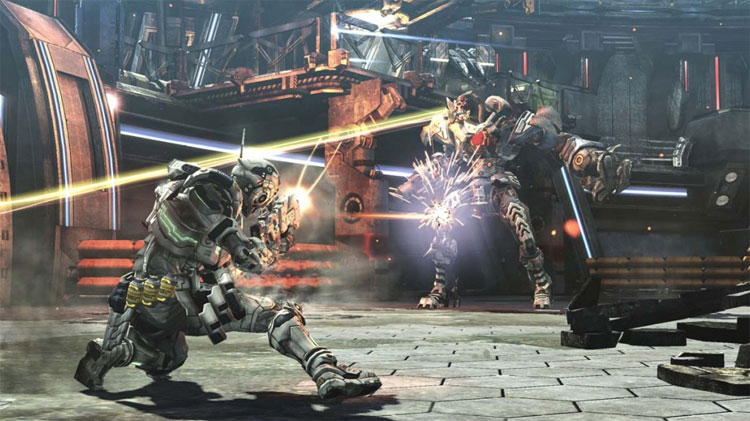
I never enjoyed Devil May Cry or Bayonetta. I don't dislike them, mind you. I can appreciate that both are very slick games, but I just don't enjoy them. So I was very excited when I tried the Vanquish demo and actually enjoyed it. It's a fresh take on the cover shooter in that it punishes you for staying still--an odd move when your central mechanic is taking cover.
The star of the game is not the cover system or the guns or the horribly cliche characters, but the suit that will have you boosting, cartwheeling, sliding, and throwing oversized missiles back at oversized mechs. Interestingly, you do not acquire upgrades for the suit as the game progresses. You finish the game capable of nothing you could not have achieved at the start of the game. Rather, it is your understanding of the suit and what you can do with it that must improve. The stead learning curve complements this nicely and by the end of the game you will be darting around like an expert, ready to begin again on the next difficulty setting.
Similar to Just Cause 2, the story is an absurd throwaway... perhaps. I have a theory that Vanquish's story is not cliche so much as it is a deliberate, tongue-in-cheek parody of western videogame tropes. I have a half-written blog about this that I will hopefully get finished in the new year if I ever get the time to say it. Suffice to say, I'm not sure if Vanquish is the Japanese response to the Western shooter, or the Japanese pointing and laughing at the Western shooter. Perhaps a little of each.
And that is Part Two and five more games down. Unless I think of more that I have forgotten in the next couple of days, I will have ten more games across two more parts in the coming days.
Like most of you, I played quite a few games this year, and I've had one or two interesting thoughts about most of those games. I'm not very good at end-of-year lists or rankings, so instead I thought I might just write a couple of paragraphs about the games that I remember of 2010, something I found interesting about those games, and some good pieces of writing I read about them. This won't be an exhaustive list, nor is it in any order other than the order that the games came to mind. Feel free to add your own thoughts in the comments, or links to any other interesting articles from this year. Suggestions of games I have missed are also welcome, but you might want to wait until I finish the series!
Bioshock 2
Nearly every review of Bioshock 2 that I read called it "the perfect sequel to a game that didn't need a sequel". For my part, it was a delightful return and fleshing out of a world I never expected I would visit again. I was wary the game would ignore the themes of the first game (much as the second half of Bioshock ignores its own themes when you are asked to continue taking orders mindlessly after the encounter with Ryan), but Delta's mental conditioning and the way it affects his decisions is blatant from the start. As you go on your quest for Eleanor, you know exactly why you are doing it: because you have no choice.
Gameplay and mechanics wise, Bioshock 2 improves on the first game's already solid systems nicely. The more open-ended design adds new dimensions to the city of Rapture and combined with the various new weapons and plasmids adds a whole new layer of potential tactics.
Bioshock 2's greatest achievement for me was that I truly felt like a Big Daddy. I felt big and bulky and heavy. My feet clunked on the timber flooring, my drill crushed the skulls of splicers, my rivet gun recoiled as the rivets punched through the air.
Also interesting was how my choices affected gameplay. Instead of the number of little sisters I saved just affecting what cut-scene plays at the end, it instead affected the kind of person Eleanor became and the decisions she made. Towards the end of the game, choices are no longer yours to make and you must stand by helplessly as Eleanor makes up her own mind. Yet, it was your decisions earlier in the game that determined the kind of person she became. You stand by helplessly, knowing that the choices you made allowed this to happen.
Mass Effect 2's cinematic trailer ranks as one of my all time favourite game trailers, just behind practically ever Grand Theft Auto IV trailer. It was good enough for me to finally play through Mass Effect so that I could play Mass Effect 2. Sadly, I found the game only a fraction as enjoyable as the trailer. After all of Mass Effect and more than enough hours of Dragon Age (by which I mean ten very dull hours) I am completely over Bioware's "gather a party and save the universe/middle-earth" plotline.
Which is not to say I couldn't at least appreciate Mass Effect 2 is a good game, just one I didn't enjoy. Unlike Dragon Age, the universe is at least interesting and well thought-out (even if you only get to discover most of it in the 'codex' menu). And the symbiosis between player and character in Commander Shepard is done superbly.
Yet, the gameplay was disappointing, and I couldn't help but feel I had done it all before. I didn't 'quit' Mass Effect 2 so much as just stopped playing one day and never started again. I just didn't see the point.
Minecraft
Rarely will I classify a single game my Game Of The Year, but 2010 has a clear winner in Minecraft. Probably the only release this year that I sunk more than a hundred hours into, and I don't regret a single one. Minecraft means something different to each player. I never built more than a single-room hut, and I was never more than a tourist on the various multiplayer servers. For me, Minecraft was about the lonesome exploration of new worlds. I spent countless nights exploring the deep places of various worlds, filling chests with diamond and redstone, then moving on to another.
The game could evoke emotions unlike any other game. Distress, anger, exuberance, sorrow, disbelief--all from a procedurally generated world with no set goals. That every action is final and irreversible certainly had a say in this. The experiences and memories I have from my all-night sessions of Minecraft easily surpass any other gaming experience I had this year. Surprising, considering I am usually one for the authored narrative.
And then there is Towards Dawn. What started as a simple musing tweet of "I wonder what it would be like to play as a nomad?" has turned into a forty-day-and-counting adventure across strange and beautiful lands. Though, it has stalled the last few weeks over Christmas, I'm afraid.
For the few days after Jason Rohrer's experimental title was released, my brother and I played nothing else. The stories we created were quick, nonsensical, and improvised, written on-the-fly as we hastily found default sprites to further the story. The potential of the game was massive, but sadly I feel few have realised it. I guess the community it required just wasn't there in the way it was for Minecraft. That, or I am just unaware of it.
The greatest element of the game was cooperation. I've seen too many 'player' players play the game as though they were in competition with the 'director' player, a competition where they must break the story that the director has planned. Of course, this is a competition they usually win as breaking the story is easy. This isn't fun for anyone. It's like going left from the start of 1-1 in Super Mario Brothers then complaining when you can't go anywhere. Rather, if you cooperate with the director, the game can be an amazing experience.
In one of my brother's and mine first game, when neither of us really knew what we were doing, I managed to paint an entire scene blue by accident. My brother played along by saying "Ah! Flood!" So we went with this. His family jumped onto the bed and sailed it out to sea, living on a diet of fish until they found an island. It was these experiences that made this game awesome. Sadly actually setting up a game was always difficult and I have thus not been motivated to put much more time into the game in recent months.
Halo Reach
The end of the Halo series, as far as I am concerned, and also the most complete Halo title to date. Bungie has taken the best of the first Halo, added the improvements of the sequels, and removed the ideas that never quit meshed. The story and pacing is adequately tragic, with the helplessness of Noble Team mounting gradually at first then exponentially later.It only suffered from a lack of subtitles informing the player of how much time passes between missions. Some were actually weeks apart, and the missions would have made more sense if I was aware of this at the time.
The juxtaposition between your initial setup of Your Very Own Spartan(TM)'s armour with the customised, individualised helmet of said Spartan smoldering in Reach's rubble was excellent. Many people would have spent many minutes perfecting their ideal Spartan, excited that they would be seeing that Spartan in single-player as well as multiplayer. And then, the second they start campaign, they know that that Spartan, their Spartan, will be dead. It worked stunningly well.
I found matchmaking far more enjoyable than Halo 3, too, but that is mostly because I seem to not such at Reach while I sucked quite incredible at Halo 3. Firefight, however, despite the myriad of new options, I found somewhat lackluster compared to ODST. I can't quite put my finder on why, though. Perhaps it is the map design. Reach firefight is excellent for a short game, but it can't put a light to the multi-hour marathon's I had on the open levels of ODST.
Critical Damage is a blog about videogames—particularly about the meanings we put into them and the meanings we get out of them. I used to update with a new article roughly once a week varying from creative retellings of specific gaming moments to pseudo-academic musings on videogames in general. These days, most of my writing appears elsewhere (check here for a list of the pieces I have worked on) but I still return to Critical Damage from time to time to post some stray, homeless ramblings.
Is a Media and Communications PhD student at RMIT University. Holds a BA in Writing and Japanese with Honors in Communication and Cultural Studies. Is a freelance videogame critic and journalist for the likes of Edge, Polygon, Hyper, Unwinnable, Gamasutra, Pixel Hunt, Ars Technica, and PC Powerplay.
Can be contacted at brendankeogh86 at gmail dot com or on Twitter at BRKeogh.












 Posts
Posts


