Sunday, October 2, 2011

Gears of War 3 Review


I wrote a review of Gears of War 3 over at Pixelhunt. You can read it now, if you want. It doesn't say everything I want to say about Gears of War 3, but Gears of War 3 is a huge game so there is a lot I want to say about it.

One thing my review didn't have space for was the excellent menu and stats system. Gears of Wars 2 was one of those few games on 360 where I wanted to track down and get as many achievements as I wanted, as they were actually enjoyable, additional things to do. Gears of War 3 channels this superbly by tracking your exact progress with every single achievement. Within the menus, you can find out exactly what collectables you are yet to find, exactly which weapon executions you are yet to achieve, exactly which campaign levels you still need to complete on what difficulty, etc. It makes going after the achievements even more enjoyable. The user-interface improvements stretch to multiplayer, too, with dropping in and out of groups and parties immensely easy without having to go to the dashboard.

Story wise, I talk about it a lot in the review, but I only touch on how much I love the Gears characters. Sure, they are all dude-bros, but that doesn't stop them from being characters. Epic has done an excellent job of crafting these personalities and their little nuanced reactions to different scenarios. For me, Gears of War isn't for dude-bros, it's about dude-bros. I find the relationship between Marcus and Dom especially interesting, especially in relation to how I have played through ever Gears of Wars' campaign. Namely, with my own brother on co-op with myself as Marcus and him as Dom. There is a moment later in Gears of War 3 which had a huge affect on this, but I won't spoil it yet and will save that for a later post. Though, the name of the chapter in-game pretty much spoils it anyway. Or maybe it doesn't. Maybe it reflects on its inevitability. Who knows!

I also have many ideas of how Gears of War can be read as a reflection on the futility and contradictory nature of modern masculinity, but that too can wait for a latter post. For now, I find it fascinating that for all their brawn, none of the Gears are equipped with whatever it is they need to save those they love. They are always coming up short and painfully aware of it. Even the cover system reflects this: you are not good enough to face them head-on. I think it captures something really interesting. I could stretch such a post to discuss the Locust as a non-phallic civilization because they don't build towers. You know, just to really annoy those that insist Gears of War is about nothing.

Anyway, there you go. Gears of War 3 is great and you should play it. Also, we should play it. My gamertag should be over there on the side somewhere. If you see me playing, feel free to drop in and help out with a few waves on Horde mode.

Tuesday, September 20, 2011

Ignorance is Bliss. Kill the Scientists.


As I’m writing this, several Italian scientists are going on trial for manslaughter because (if I am understanding the news reports I have read correctly), they failed to predict an earthquake that killed over 300 people. Not because they caused the earthquake; not because they knew there would be an earthquake and didn’t tell anyone; but because they didn’t know there would be an earthquake. Essentially (and again, assuming I am reading this correctly), the scientists are being charged with the deaths of hundreds simply because they were unable to do something they hoped they would be able to do.

Months earlier, Australia’s top climate scientists began receiving abusive phone calls as well as death threats because of the work they have been doing towards better understanding global warming. As opposed to the Italian scientists being crucified for not doing something the general public wanted them to do, these scientists are being threatened for saying something no one wants to hear.

These are two pretty extreme examples of the fall out of what I see as a recent, pervasive trend of wanting to shoot the scientific messenger. Scientists try to understand the world and sometimes that means discovering things we would rather not know, such as how we are responsible for a progressively warming planet and rising sea levels. Instead of dealing with the problems, we move to discredit those delivering it. After all, it is easier to assume the world isn’t warming than it is to actually change our behaviours and societies enough to fix it.

Not helping is a rise in the fundamentalist and conservative right in both the press and politics of many countries that have an interest in not just discrediting climate change but also evolution, stem cell research, and many other strands of science. As such, over the past decades, the authority of scientists on a vast range of subjects has been eroded down to the same level as newspaper editorials, footpath vox pops, and angry bloggers. Many people don't want to hear from the brainy, ivory tower intellectuals about a topic; they want to hear from the average Joe.

Of course, this isn’t an entirely new phenomenon. Scientists have always been scapegoated for telling people what they don’t want to hear and not telling them what they do want to hear. It comes in waves, and at the moment, as we come to terms with just how unsustainable our first-world lives really are, we are certainly at the muddy bottom of the curve.

Personally, I find it all incredibly infuriating when I watch television and see creationism and evolution debated as equal ‘theories’, or when the secret agendas of a climate scientist's peer-reviewed findings are questioned by an oil company, but that is not an area I’m an expert in or tend to write on. What I find interesting, however, is how this general attitude to the sciences permeates and is reflected in our cultural texts. In particularly, two videogames I’ve played and loved in recent months I think could be seen as emerging from this culture that has become obsessed with discrediting and deriding the sciences.


Two caveats. One: There have been stories about well-meaning scientists making dumb mistakes and paying the consequences for them for as long as there has been scientists (Frankenstein, for instance), and I am not trying to say “Look at this entirely unique thing that has never happened before!”. Rather, I’m hoping to just point at what I see as a really interesting, recent emergence of it. Two: These games, I don’t for a minute believe, are intentionally forwarding some secret, anti-science agenda. Rather, they simply reflect the culture they are produced in.

The first game is Halfbrick’s amazing Jetpack Joyride. Jetpack Joyride is the definitive moment where Canabalt stopped referring to a group of games mimicking Saltsman’s game and started referring to an actual genre. Jetpack Joyride has a simple framing narrative set up mostly in the game’s trailer: playable character Barry is a down-and-out blue collar who is sick of his day job and decides to steal a machinegun jetpack from the top secret science lab. After blowing through the wall and sending scientists flying, Barry straps on the backpack and the player must use the jetpack (and a range of other contraptions) to avoid electric zappers and missiles while collecting coins and getting as far as possible. The gameplay is so simple, so intuitive, yet so compelling, so diverse, and so intuitive. It is a phenomenal game and if you own an iOS device and have yet to own it, you are doing yourself a great disservice. But what stands out most in Jetpack Joyride is the insane amount of polish that has gone into the game—something that Halfbrick is already well known for after their successful Fruit Ninja. The shockwaves from explosions, the “thud” of the Little Stomper vehicle’s footsteps, the thrust of the jetpack all feel so good.

One such detail is the little scientists running around beneath you. The little guys are panicking, helpless, and clueless as you destroy their lab and send bullets flying everywhere. It’s as though they have no idea how to react to Barry stealing their device. They run back and forward, they get in the road of rockets, get capped by your bullets, immolated by your flames, and zapped by the zappers. Sometimes, they just slip over.


It’s meant to be funny, watching them run around and get zapped, and it truly is. The scientists also come into play in the games mission structure, with objectives such as high-fiving (i.e. running past) scientists and achievements for avoiding them. But, ultimately, Jetpack Joyride is a product of a culture influenced by politicians and the press determined to discredit and degrade scientists. Everything in the portrayal of the scientists and of Barry in relationship to the scientists is about portraying the supposedly-intelligent scientists as actually dumb and brought down to the same level as the supposedly-yokel blue-collar worker who is actually in charge. It’s a revenge fantasy, really. Look at how dumb the stupid scientists are. Not so smart now, eh? I have your contraption and you don’t have any answers as to what to do about it.

The other game is also an iOS title, but one that is probably far less known. This game is League of Evil, and you play a brawny cyborg who must punch the heads off evil scientists. Again, League of Evil is a great game. Despite the on-screen controls, it is one of the better sidescrollers on iOS and has a real Super Meat Boy Lite kind of feel. But, again, it is possible to read it as emerging from an anti-science culture. Unlike Jetpack Joyride’s scientists, the unquestioningly evil scientists of League of Evil just stand there, waiting for you to punch their heads off. It’s the brawn’s time to shine.


In fairness, this is part and parcel of being a videogame—it is easier to put the player in control of a character whose strength lies in physical abilities than intellectual ones. When you press a button on your controller, you generally want to see something tangible happen in the videogame’s world. It’s something that Half Life 2 comments on when Barney remarks how useful Gordon Freeman’s MIT doctorate was for pulling a lever. So usually, if not the bad guy, the scientist is rarely in a role more noble than sidekick, the one giving the brawny main dude his cool gadgets. Snake has Otakon, Bond has Q, Ezio has de Vinci.

So it is not as though Jetpack Joyride and League of Evil have made scientists the victims/enemies simple because “society hates science nowadays” or anything so reductive. But rather, the way the scientists are presented as dumb, degraded, and helpless offers an interesting lens through which we can see how the prolonged treatment of scientists and science within the media and by our politicians is perhaps starting to drip down into an everyday perception of science as untrustworthy, annoying, and dangerous.

Saturday, September 17, 2011

Split Screen: Freedom in Alcatraz


I have commenced a new column at Kill Screen that is all about playable characters and how they control us. The first, introductory column went up this week and is all about Alcatraz of Crysis 2 and The Shawshank Redemption. It also has an amazing piece of art by Daniel Purvis. If you read it, I'd love to hear what you think about it.

I am Waaaaggghhh


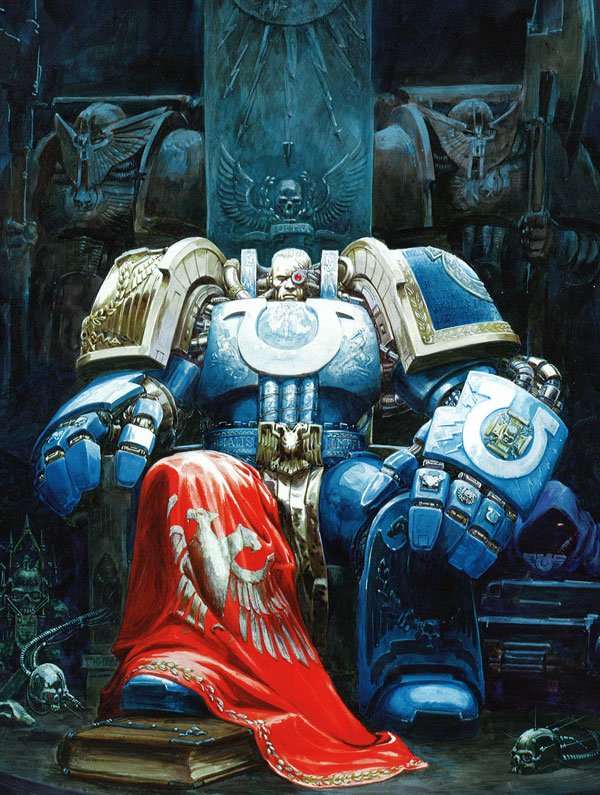
I really like Warhammer 40,000. Not so much the tabletop game (which I suck at) or the miniatures (which I love but, again, suck at) but the fictional universe itself. I love the idea of the Imperium of Man as this futuristic, zealous, fundamentalist movement where humanity itself is the religion. I always found it a fascinating mix of medieval zeal and distopic science-fantasy and continued to devour many novels set among its stars even after I gave up the tabletop game and diverted my funds away from the miniatures to buying more videogames.

Still, despite my love of the fiction, I did not find myself too interested in Space Marine before it came out. I was never too interested in Orks, and as fascinated as I was with the Imperium of Man, I always found Ultramarines to be the drabbest of many drab Space Marine chapters. But then I watched the cinematic trailer (I'm a sucker for cinematic trailers) and had a change of heart when I saw that Chaos would be making an appearance, too. Ultimately, the trailer convinced me that the game successfully captured the feel and vibe of the 40K universe, and that was enough for me.

I'm glad I did because Space Marine is really, really fun. The boltguns feel meaty and the melee is visceral. Shooting and hacking is streamed beautifully so combat slides fluidly from picking off enemy gunners with a scoped rifle to thinning out the hordes with the boltgun before throwing yourself fully into the remainder with chainsword or power axe to pick off those that are left--and there will always be many left. Combat is repetitive and button-mashy, but this quick three-act cycle of distant/mid/close combat gives it a really steady, thumping rhythm that is pleasurable despite its repetition.

The game's feel has been polished well so that the combat is accentuated brilliantly. Orks have this kind of satisfying 'splat' of blood when the fatal bullet impacts them, as though their body expels all the blood remaining in their veins as they die. This offers a vital piece of information to the player, informing them thatone target is dead and they can move onto the next, but it is also, simply, really satisfying to feel your opponents pop like that. It is an odd comparison, perhaps, but the closest game that 'feels' like that to me is Geometry Wars 2. The enemies, when they die, have the same kind of chunk, meaty, splatting nuance to them. This splat is missing from close combat, but that is hardly a problem as it will be a rare occasion that you fell an ork in melee and its body is still in one piece. 

Though, unfortunately, the game is still chunky and clumsy in places. The narrative is rarely convincing and poorly communicated to the player. Often, it feels as though the characters have had a conversation while the player was out of the room, and the player is the only one present who doesn't know something. One example: the space marines see a weird ork contraption in the distance and one of them ponders "What is that?!" Minutes later, you are approaching it and your character says "Quickly! We must destroy the ork ram!" Oh, okay. I guess it is a ram then. I'm glad we figured that out and no one told me. It is always minor things, but it jars with the progression of the story in quite a few places. Also, for a game about space marines, there are precious few space marines present. If not for one vox transmission too far into the game's second chapter, I would have sworn the Emperor only deployed three single space marines to take out an ork infestation. Ultimately, the narrative feels like a condiment to the game and in no way integral to it.

Which is odd as the worldbuilding is excellent. Everything feels like Warhammer 40K. The universe, the species, the imperium are all depicted perfectly so that simply engaging with that fiction makes the game enjoyable. The way the space marines tower over the imperial guardsmen, the humility and zeal, the pride and lack of compassion all feel superb. The ork models are vibrantly coloured as though they were picked right out of the pages of a White Dwarf magazine. Everything looks and feels like 40K and this more than makes up for the clumsy, poorly delivered narrative.


There are also glitches here and there, such as enemies getting stuck on walls or allies teleporting onto lifts or audio diaries playing simultaneously with squadmate chatter. Also, all space marines and orks seem to have come from the same region of England, but none of this gets in the road of the rollicking fun of shooting and chopping through orks. Sadly, though, one thing does: Chaos.

When Chaos rocks up about four chapters into the game, things begin to go downhill insofar as the fundamental fun of combat begins to decline. Significantly, the pleasurable 'splat' of a dead ork is not present with the chaos demons. The demons have a long, drawn out death animation that every single demon plays out exactly the same way when they die as your power axe just keeps swinging through them as though they have already returned to the warp. The few Chaos Space Marines I have fought so far, too, are hardly enjoyable to fight. Your bolts no longer explode in the flesh but ting insignificantly off power armour. The gameplay has been tuned to make fighting orks fun in a 1-vs-1000 kind of style. But Chaos Space Marines are your equal, and this doesn't sit well in the game's framework. Ultimately, fighting Chaos is unsatisfying.

Which is interesting, as it was the presence of Chaos that convinced me to try the game out. But once they appear, it becomes painfully clear that the game was not designed for them. Perhaps a more Gears of War-based cover shooter would be more enjoyable against Chaos Space Marines, as then you could bunker down and fight against them as equals. But Space Marine is designed for you to jump unafraid into a horde of orks and to be confident that you can come out of it on the other side alive and covered in the blood of greenskins.

The game itself seems to realise this. Not long after Chaos arrived, they now seem to have disappeared again as I go back to helping Guardsmen fight the orks. I'm sure they'll appear again soon, though, and hopefully something changes to make them more enjoyable to fight. But for now, Space Marine seems to be a good case study against putting something in a game just because you can. Sure, Chaos fits with the fiction of the 40K universe and they have been as beautifully realised within the game as every other element, but in the style of play that Space Marine demands, they are just no fun to fight. But for now, splatting orks is more than making up for them.

Wednesday, August 24, 2011

Do Videogames Need To Be Fun?


So while I was in Melbourne for Freeplay, I found myself participating in a discussion over at Kotaku Australia about what a videogame 'is' whether videogames have to be fun. Perhaps I said something you will find interesting. If not, the other very intelligent people in the discussion surely did.

Sunday, August 21, 2011

Videogame Criticism, Videogame Journalism, Journalism about Videogames, Videogame Criticism: More a Rant than a Manifesto

So Freeplay is over now. Just as last year’s festival, it was a vibrant and energy-filled few days of great talks, great drinks, and great people. The games ‘industry’ might be in the ashes stage of its phoenix-like life cycle, but the community is as strong and as full of ideas as it ever was.  Just like last year, I am now super excited about the developers, academics, writers, and players in this country and the kinds of things they are able to achieve when given (or, as is most often the case, when they forcibly take) the opportunity.

Yet, despite this, a couple of panels of today, Sunday, the final day of the festival, raised quite a few issues in regards to videogame journalism and videogame criticism. Firstly, in a discussion about supporting and marketing and financing indie projects, I was surprised to sense a kind of underlying tone where it seemed to be implied that the mainstream gaming press doesn’t care about indie games and that they only report on the next Modern Warfare or round of hats for Team Fortress 2. Certainly, go to any major gaming news website and this will be what you predominately see, but only because that is predominately what the gaming websites get sent. If you, as an indie, were to send the editor of a mainstream gaming news site some press pack about your indie title, chances are they will run with it if it is interesting. Game journalists are just as desperate and keen and passionate about new gaming experiences as their readers and players generally are. If you make it, they won’t come. But if you make it and you give it to them, they will almost certainly talk about it.

So this is my first point and it is a lot tidier and self contained than the rest of this inevitable rant will be. The second final panel of the day was called “The Words We Use” and, essentially, was about videogame criticism and journalism. I was pretty excited there was a panel talking about criticism at a primarily developer-focused event. More so, there were actual journalists and critics on the panel. Great! On the panel was Andrew McMillen (a great journalist of many hats), Alison Croggon (a theater critic), Yahtzee (of Zero Punctuation fame), and Drew Taylor, formerly a THQ PR peep and a videogame culture guy who started the magazine JumpButton.

So two things upfront. Firstly, I have a huge amount of respect for each of the individual panelists and their work. Secondly, the panel was the most infuriating thing I have ever witnessed.

My hands were tremblings and my heart was beating erratically every sentence that was said. I tweeted so much I lost 30% of the battery of my phone (but gained about fifty new followers, so hi!).

I don’t want to write here a rundown of the entire presentation, or to pick apart specific things specific people said. I also don’t want to talk about the very problematic gender issues that were brought up (very, very, poorly) by the panel’s chair (who, bafflingly, I don’t believe was a journalist, a critic, or a person who has read anything written about games for the past decade or two). Neither do I want to attack any of the individual panelists. As I said, I highly respect the work of all of them. I can’t stress that enough.

Rather, I want to focus on what most infuriated me about the panel. What ultimately caused the argument and its tone to be so, well, dumb, was due to what I think are much vaster issues in and around videogame writing, and the things that were said at this panel hit it home pretty hard that these things are really quite serious problems for those of us who care about videogame writing. So I think it is more constructive to talk about these problems than to throw harpoons at the speakers themselves. The fact they seem so oblivious to these following things should be a wake-up call to us that we need to do something about these problems. These problems, in list form are:

1. The conflation of videogame journalism, videogame criticism, and journalism about videogames into one interchangeable term.

2. The erroneous idea that videogame journalists should give a shit about developers.

3. The presumption that videogame criticism is ‘too intellectual’ and pretentious and doesn’t actually matter to ‘general players’.

4. The possibility that videogame criticism is, actually, perhaps too pretentious.

So let me hit on these one by one. Themes and arguments will probably overlaps and be out of whack but hear me out and let us see where this goes.

1. The Conflation of Terms

So firstly, the conflation of videogame journalism, videogame criticism, and journalism about videogames. In the panel, these different-but-related things were often used as interchangeable terms for the same thing—namely big, mainstream gaming news sites that just repeat the press releases given to them by a publisher, as though that thin sliver of a fraction is all the writing about videogames that is out there. This could not be further from the truth. These are, in fact, three completely different things. There are gaming news sites whose primary purpose is to tell the consumers of games what games are coming out, when they will be out, and what they will be like. This is, for my purpose, videogame journalism. It is an enthusiast press written for an audience that simply wants to know what is coming out. That such a press might copy press releases word for word is not a problem because it is not attempting to be a critical engagement. It is just telling people who want to know what is coming out, what is coming out.

But that does not mean we can not have great journalism about videogames. The most recent exemplar of this is Andrew McMillen’s “Why Did L.A Noire Take Seven Years To Make?”. Another superb example would be Tracey Lien’s look at “The Rise and Fall of Red Ant”. Yet another would be Leigh Alexander's "No Female Heroes at Activision?" These pieces are great, investigative pieces of journalism written about videogames and the videogame industry. Often (but not always) these pieces are written by the same people who write what I am calling above ‘videogame journalism’ simply because, well, they are journalists who write about videogames. Often, too, they are on the same websites, as the same readership will be interested in it. But they are not the same thing and they are not comparable. Just because one is super investigative and deep and explores things others would want hidden and the other is copy-pasting a press statement, doesn’t mean one is better or worse than the other. They are serving different purposes.

And then there is videogame criticism which is yet another entirely different (though closely related) thing. Those three journalism articles linked in the previous paragraph? Not criticism. I won’t dare try to define here what criticism ‘is’ but, broadly, it is the stuff out there on other blogs. On this blog. Linked to on Critical Distance and written by Tom Bissell in Extra Lives or on Grantland and spoken by Yahtzee in Zero Punctuation and written by Kirk Hamilton at Kill Screen and the list goes on. But it is more than that. It is the Red vs Blue machinima movies. It is every Livejournal about The Sims. Criticism, broadly, is not about what a videogame will be or even what a videogame is. It is about an experience. Generally, that is the experience of playing a game, not of developing a game, as most criticism is (and should be) about playing the videogame and the individual, subjective experience of playing that videogame and what you, personally, felt from that. This doesn't mean a designer cannot write about their own experience of playing that game as a designer (more on that below). If nothing in this paragraph sounds like anything you have ever engaged with, go read “Bow Nigga” and come back here. Seriously. Read it now. The point is criticism isn't about 'story' and it isn't about mechanics; it is about experience.

Games criticism is not about how good or bad a game is but about the experience you had interacting with that game. You might scoff and say “But what is the point? Does it help me design a better videogame? Does it tell me if I should buy this game?” No. Well, it might, but it doesn’t have to. Rather, criticism is about what you experience when you play a videogame. There was a talk the previous day about archiving videogames and hardware, and it bothered me that there was no talk about archiving criticism because that is how we archive how a game was experienced. That Moment in Bioshock or That Moment in Portal matter because of the lived experience of playing that moment and the 20-odd hours of moments beforehand. This is why videogames struggle to permeate broader culture: because if you don’t play that game for 20 hours, you don’t ‘get’ why it was significant. Criticism bridges this gap. Putting a controller into someone’s hand who has never played Bioshock before and making them play the ‘Would You Kindly’ scene will have no impact on them whatsoever other than reinforce ideas of how violent videogames are. Make that same person read any great piece of criticism about that scene and why it was so powerful, and they will get it.

If you want videogames to ‘matter’ to the rest of culture and society, then you need good videogame criticism.

So, again, this criticism is often written by the same people writing the above journalisms. But, again, it is fulfilling a different purpose. I have much, much, much more to say about the significance and proliferation of criticism that already exists but I guess I will get to that. But for now, the three things are not the same. They are closely related; they overlap; but they serve a different purpose and are written in different ways. You can not measure them all with the same yardstick, as this panel was trying to do.

2. The Erroneous Idea

One panel member made the observation about how, when he was in PR for a game publisher, it was so frustrating to see a game get a bad review (a 5!) even though they had told the reviewer that the game was still buggy. This turned into a further rant (partially continued on Twitter) about the ability for a bad review to close studios so, ultimately, reviewers and journalists should be careful about writing bad things about games.

No. They should not.

The videogame journalist is writing for the consumer. If they were to not warn them not to buy a shit product, then they would not be doing their jobs properly. When I write a review, I don’t care if it could mean the difference between you, as a developer, still having a job or not. I care if the game, if my experience of the game (because a review is at least as much criticism as it is consumer advice) is not decent. If it isn’t, I would be a poor writer if I did not tell my readers that.

However! If I was writing an investigative journalism piece into the many, many issues with the industry (as many of the best pieces often are, as the above examples) then, clearly, the developer and the developer’s concerns are mine. But when I write a review, when any reviewer worth her salt writes critically about a game, be it as consumer advice or not, the developer’s career should be the last thing on their mind.

3. The Presumption of Pretentiousness 

So now I am back to ranting about criticism in what perhaps infuriated me more about the panel than any other moment (except, perhaps, the one sentence within which the chair somehow managed to fit a dick joke, a bukkake joke, and a question about gender equality). On the panel was Yahtzee, of Zero Punctuation fame. I want to stress that I love Zero Punctuation. It is crude, yes, but it is funny and consistent and self-effacing and, underneath it all, often hits very close to home about what does and doesn’t work in a game, albeit in very exaggerated terms. Now, Yahtzee was kind of held up on the panel as The Critic while the others were Journalists. Someone (again I think it was the chair) made the observation (if one could call it that) that videogame criticism goes hand-in-hand with humour, non-seriousness, and phallic jokes. Someone else said videogame criticism often tries too hard to be ‘intellectual’ and is only written for a small ‘niche’ of readers.

You are fucking kidding me.

So game conferences generally and Freeplay specifically seem to always be about how videogames are really something worth caring about. They mean something to us, they are art, they matter, they are cultural objects and we need them to seep into broader culture so that the significant, meaningful, artistic contributions that all games and play can make to society can indeed be made. That is the general kind of vibe. Videogames matter and we must move beyond the stereotypes.

In which case, why the hell should our game criticism pander and dwell on the same damn stereotypes? ‘Too intellectual’?! No. Videogames are smart, compelling, meaningful things and the intellectual writing about them is exactly the writing that portrays this fact to a broader culture. You want videogames to matter and be respected as intellectual? Then you fucking well need some intellectual criticism of your games.

And guess what? It is not a small ‘niche’ of readers and writers. There is a whole internet, maybe a whole two internets of thoughtful intelligent games writing. I’m not just talking about its formalised institutions like Kill Screen and the blogs often seen on Critical Distance (but they are a huge part of it and not even they were acknowledged by this panel), but every Dwarf Fortress story illustrated for a forum post. Ever Sim who has its own LiveJournal. There is so much intelligent criticism about what games are, what games mean, and why games matter and to not even mention that at a panel about videogame writing is a huge disservice to everyone associated to the culture and industry of videogame design and play.

And it is not just some anti-developer style of writing, either. Developers, programmers, coders, marketers, everyone has a crucial, unique perspective to bring to videogame criticism. Nels Anderson and Matthew Gallant are two superb examples that come to mind with great blogs full of criticism from a design perspective and well worth the read even if you never want to design a game yourself. Similarly, the criticism about playing games is interesting even if you never want to play a game yourself. I can’t stress this point enough: good criticism is where videogames stop being “lol videogames” and become accepted culture.

But what it all comes down to is that the word ‘intellectual’ should never be said as a negative point of any kind of creative process. Ever. If games are intellectual (which they are), then they deserve intellectual criticism.

4. The Possibility That Pretentiousness Actually Exists

So that was my high horse. Hopefully it inspires you enough to go start your own criticism blog. Because in videogames, everyone should be a critic. Everyone should be writing about their experiences and talking about their experiences and sharing their experiences. But, in reality, a lot of people don’t.

A panel on videogame criticism seemed entirely unaware of the vast blogosphere that exists and even of the more formalised outlets such as Kill Screen or even Extra Lives. And, earlier in the day, as talked about at the start of this rant, a whole bunch of indies thought game writers of any creed didn’t care for them at all.

What if us videogame critics have indeed built an ivory tower for ourselves? Or, rather, what if we have somehow managed to convince everyone on the ‘outside’ that such an ivory tower exists? I for one think it doesn’t exist. I quite literally blogged my way into videogame writing and I believe that if you are a good writer who has something interesting to say about videogames, you will be heard.
But are we more cut off from the world than we (or at least I) believe? Not even just non-gaming culture, but gaming culture, too? No one on this panel seemed to be aware of the broader videogame criticism out there. Is this an actual problem? Are we too self-absorbed. Are we even a we? I hope we aren’t a we, because I think we are just the players. All of them. All the people who have a stake in having real, actual experiences of these games and those experiences are worth recording and worth remembering and worth sharing. So I don’t know. I hope ‘we’ are an open community and that anyone who wants to write about games does write about games and, further, I hope we are reaching or can reach the broader gaming community of players and developers alike.

Developers need criticism, and criticism needs developers. Journalism about videogames is not always videogame journalism. All these things and entities are related and inseparable but they are not all the same thing. To treat them as such is a disservice to all of them.

Most importantly, and the single most crucial thing I want to say in response to the panel is that videogame criticism is out there. So much of it. It is so intelligent and so thoughtful and so well written and all of it is worth reading. Perhaps you have never engaged with it and you are only reading this because you added me to Twitter during Freeplay this year. If that is you, the least you can do is read Ben Abraham’s slide from the (un)Keynote as well as Critical Distance’s weekly blogroll. But there is so much more out there. On the mainstream news sites, in magazines (Edge, Hyper, and PC Powerplay are all incorporating more critically-minded sections of late). Just as crucially: you can write it too. Don’t say what the game is about, say what you experienced. That’s it. And videogames takes one little step closer to being as respected as it should be by the rest of society.


As one last final aside, if you do want to write videogame criticism yourself (please do!) but you have no idea how to, it is simple. Firstly, read Kieron Gillen's manifesto on New Games Journalism. Secondly, write what you feel. That's it. If our Ivory Tower exists, we would love to have you move in with us.


[Update - Katie Williams has also written up a reflection on this year's Freeplay and the role of this panel within the festival that I think is well worth a read. She does a far better job of putting this one panel in perspective to the rest of the festival than I have.

And @SearingScarlet (Sorry, I don't know their real name) has written the best post I have seen so far to deal with the gender-related problems of the panel which you should really read, too. 

And Andrew McMillen, one of the panelists, has uploaded his recording of the panel if you wish to hear it for yourself.

And Ben Abraham has written an opinion piece for Gamasutra about the sexism and gender issues that bubbled over during the panel. You should absolutely read this.  

And two of Australia's (if not the world's) best female videogame journalists have had a discussion on Kotaku Australia about the issues and concerns of being a non-male videogame writer. It is an excellent post and it is great to see two such notable female writers having the guts to speak out on such a topic when doing so is so often a suicide-by-comment-section. Fortunately, the Kotaku Australia commenters seem engaged, polite, and interesting. Read it. Katie Williams then wrote a second post sort of in response to this one that is both personal and heartbreaking and makes me hate all males ever including myself. You should read it as this shit totally isn't cool.

And Freeplay director Paul Callaghan has addressed the panel and the reaction to it on Freeplay's official blog. He also apologised, which I don't believe is fair. Paul is an amazing man who (with others) does a phenomenal job every year pulling Freeplay together to be the awesome festival it is. Still, you can read his thoughts on the reaction to the panel here

And panel chair Leigh Klaver has written a post justifying (I guess) and clarifying the panel. To be completely honest, I don't really think it addresses anything but instead shows how disengaged he is with the broader sphere of critical videogame writers by not including a single link to any of the pieces written about the panel by other writers and a reference to only one of said pieces. This is not necessarily an insult aimed at Klaver, but is perhaps indicative of just how closed off this sphere is. Who knows. I am not satisfied with his responses to the gender issues, either. Still, to be fair, he deserves a chance to explain so give him a read.

If you see any other articles on the panel around the place, please leave a link to them in the comments.]

Wednesday, July 27, 2011

Bastion: A Review and Some Further Thoughts on Choice and Inevitability


Firstly, I wrote a review of Bastion for Paste Magazine. You can read it here, and perhaps you should before you read the rest of this post so I don't have to repeat myself. But if you don't feel like it, here is a run down: Bastion is an utterly beautiful and melancholy game that makes you care for a world that no longer exists. There. That should be all you need for the rest of this post. Also, the rest of this post will contain spoilers for both Bastion and Grand Theft Auto IV so perhaps don't read on if you are yet to complete Bastion at least once.

At the end of Bastion you have to make a couple of choices. The first one is potentially heartbreaking, but not relevant to what I want to say here so I won't go into any details. The second one is what I am concerned with here. At the end of Bastion you can choose to do two things: either rewind time to before the Calamity ripped the world to shreds, or use the Bastion as some kind of airship to fly off and find new lands. However, both have consequences. If you rewind time and 'unbreak' the world, 'you' will cease to exist anymore. The Kid, Rucks, and Zia will have no memory of the post-Calamity world--something that would be hard enough to give up if Zia did not admit right towards the end that she has only ever known happiness since the Calamity. Further, there is no guarantee that people will not make the same mistake and simply cause the Calamity all over again. The consequences of continuing on, of using the Bastion as an airship to fly off into the sunset is two-fold: firstly, obviously, it means the Calamity will never be undone. Ever. Secondly (and more vaguely), the world around you will be irreversibly damaged as you take off. Or something. The game is not overly clear on this point but it seems to me that all the beasts and Ura in the vicinity will be destroyed by you choosing to fly off on the Bastion to find new lands. Perhaps I misread this, though.

It was a hard choice to make and, ultimately, I did not feel as though I had 'completed' the game until I played through it twice and made each choice. The first time I decided to turn back time. At that point, it was the obvious choice. Having heard so many stories about the pre-Calamity world from Rucks's tales, I needed to save it--or rather, to give it a second chance to save itself.

The second time through, when I played "New Game Plus" (which is essentially a new game where you keep you experience and weapons and the enemies get more difficult to reflect this), it was clear that this was not a distinct, 'other' game. The continuation of my character as well as some slight, clever changes in the narration made it clear to me that the Calamity had happened again. So on this playthrough, it made sense to make the other choice, to move forward into the future and not to stagnate in the past. It was bittersweet, of course, as it meant saying goodbye to the world I had wanted to visit for two generations of myself now, but it was filled with a sense of hope and optimism. There was me, Zia, and Rucks, and we were going to explore a brave new world.

The beauty of this was the the utter gravity of my choice to say goodbye to the pre-Calamity world was painfully apparent largely due to my previous playthrough. Because of that playthrough, I knew that turning back time yet again was inevitable. We often say that videogame narratives are about being able to answer the "what if" question. "What if I did this, not that." Bastion answers the question brutally by making you see that what happens is not pretty and then asking you to choose again.

Of course, the flaw of this is that not everyone makes the choice in the order I made them. I feel as though the game is attempting to set up the choices to be made in that order by trying to tie you down to the world with Rucks's sweet, sweet voice, but some players will certainly choose the future their first time through. This, then, destabilises the meta-narrative that, for me, ran through both playthroughs. It's a weakness of the story that i feel Bastion was trying to tell but one that is in no way new to videogames: the player will rarely do what the storyteller wants them to do.

Only one other game felt as incomplete until I played it twice and made the different choice: Grand Theft Auto IV. Rockstar's games always have that inevitability streak, but never has it hit me so hard as it did in Grand Theft Auto IV. Towards the end of the game, Niko makes the choice to either work for a man that previously betrayed him (and make a lot of money) or to kill the man for vengeance (and make no money). His cousin, Roman, wants him to take the money. His girlfriend, Kate... well, she doesn't want him to get revenge, but she doesn't want him to take the money, either. Either way, Niko has promised himself, his cousin, and Kate that this is it, that he will get himself out of this sink-pit of crime once he does this One Last Thing.

So the player makes the choice. Long story short, if you take the money (what Roman wanted you to do), then Roman gets shot dead at his wedding; if you take revenge (what Kate kind of wanted but not really) then Kate gets shot dead at Roman's wedding. The way the narrative progresses, both endings make sense based on the choices you made, and both leave Niko devastated at the end of the game's narrative.

The first time through the game you think "what if". What if you had just taken the money? Kate would still be alive. What if you had walked away? Roman would still be alive. So you play again; you make the other choice; and Niko simply loses someone else he loves. It kind of makes Niko Bellic one of gaming's few tragic characters. The utter helplessness of the situation he gets himself in becomes all the more apparent when you make a different choice and end up at a similarly dark conclusion--if you can call an aimless existence in a foreign city with the specter of a loved one haunting you a conclusion.

Neither of these games do this inevitability-through-choice perfectly. Bastion's hinges on makes choices in a certain order for the full impact to hit the player. Meanwhile, many people had enough trouble getting through one complete game of Grand Theft Auto IV, let alone two. But it is something I would like to see games exploit more often.

Tuesday, July 19, 2011

My Thesis. By Others.


When I uploaded a draft abstract of my thesis back in April, I promised I would continue to write updates about it here. Alas, I have failed to do that. In part this is because I've constantly had other writing obligations and in part it has been because the only times recently that thoughts related to my thesis have been coherent enough to publish is when I am actually writing it. At the moment I am struggling through Chapter One, which I'm hoping will allow me to situate where the player-character relationship sits, stradling the fourth-wall between the actual and virtual worlds (or something like this). Anyway, as I have been failing to write anything coherent about it, I have instead been writing incoherent rambles over at Google+ with which to have conversations with people about my ill-formed ideas.

And conversations I have had! Every post has seen a stack of thoughtful engagement and bouncing of ideas back and fourth and has been really useful for my writing and for forming my ideas. Most surprisingly, these rambles have actually got other people thinking and writing in areas related to the player-character relationship. In particular, Adrian Forest has written a blog post at Three Parts Theory called "Inhabiting Game Spaces" which brings together the relationship between player and character in regards to his primary interest in videogame spaces. Further, Kris Ligman has written a post at Popmatters about videogames, characters, and fourth walls and in doing so has rendered one of my incoherent rambles coherent. Both posts are an excellent read and in a weird, cyclical, nonlinear, new media kinda way, will hopefully end up being cited in my final thesis.

As for my rambles, if you wish to read them yourself, let me know and I will add you to the appropriate circles on Google+.

Thursday, July 7, 2011

Big Concerns about Tiny Towers


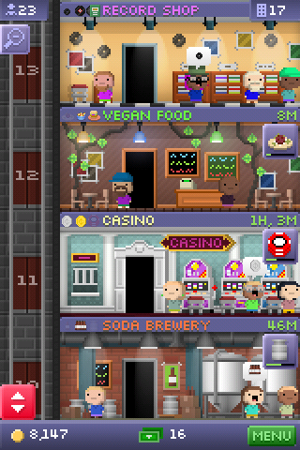
I have been playing the horrifically addictive iOS game Tiny Tower an awful lot lately. To justify the many, many hours the game has taken away from me, I went and wrote a review of it for Paste Magazine that you can read here.

While I was predominately positive in my review and gave the game a good score, the design of the game is potentially problematic and ethically unsound. Jorge Albor wrote a great piece for Popmatters discussing some of the (very valid) criticisms of Tiny Tower that my review just skims over, and follows it up with a few more remarks at Experience Points also worth reading.

Ultimately, Tiny Tower is 'addictive' in the most literal sense of the word, not in the casual 'really fun' sense that we tend to use in writing about videogames. It is designed in such a way that not playing it becomes more and more difficult the more you play it. Truly, it is like a drug: an unarguably enjoyable experience that probably isn't really good for you to do too often.

Anyway, I won't waste more words repeating Jorge or myself here. I find it interesting (and perhaps worrying) that I am enjoying a game so much despite the flaws that I am completely aware of.

Monday, June 27, 2011

Child of Rez


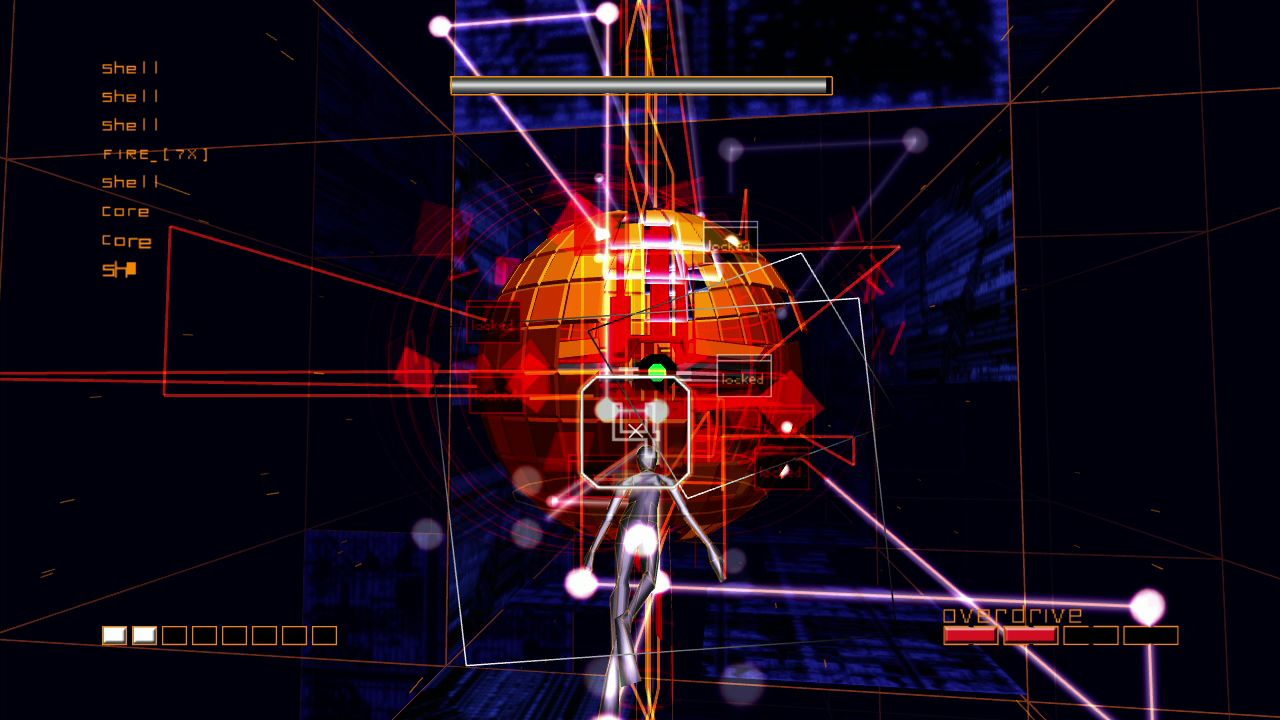
Rez had no right to be a good game. Its level of interactivity is down there with point-and-click adventures, Heavy Rain, and shopping mall directories. You move along on automatic rails, merely moving a crosshair over targets that appear in the same place every time you play. You point at things and they die. This is all there is to it. To get away with such minimal interaction most games would require an extensive narrative, but Rez has about as little story as it does interactivity. There is an artificial intelligence trapped in a computer network and you are trying to free it. That is pretty much it. Yet, despite this lack of interaction and story, Rez manages to be an utterly engaging experience.

So when Twitter assured me I could still enjoy Child of Eden without a Kinect, picking it up was a no-brainer. I tried not to get too excited; I tried not to expect too much, but the very fact that I had no idea what to expect probably, contrarily, made me more excited. When I first played Rez on an Official Playstation Magazine demo disc (that I had purchased for the metal Gear Solid 2 demo) I had no idea what it was I was experiencing. Rez was the most unique gaming experience I had ever encountered when I first played it and, despite knowing better, I was hoping for something just as new this time around.

Sadly, though, the first thing you notice about Child of Eden is that it is not so much a spiritual successor of Rez as it is a direct sequel. Mechanically, very little has changed. You hold down a button while moving a crosshair around the screen, lock onto a maximum of eight targets, then release the button to fire and watch those targets explode into dazzling displays of light and sound. It relies on the same music/visual/haptic synthesis (though, I would argue not synesthesia) with the bass-thud vibrating through the controller, the handclapping of the crosshair when no target it locked, the psychotic and nonsensical worlds pulsing along to the beat. It's all there. The only mechanical difference is the baffling need to hold down a different button to fire the tracer at purple projectiles. I understand that with a Kinect, the tracer and the normal laser can be fired simultaneously, but with a controller you can only fire one or the other, which means many targets will escape as you try to control the fiddly crosshair to destroy the fifty missiles hurtling towards you with all the speed of a drifting continent. It's Child of Eden's only real mechanical innovation and also its weakest element.


Yet, despite the mechanical overlap, Rez and Child of Eden differ greatly in terms of thematic, aesthetic content. Just like Rez, every element of Child of Eden complements and build towards a central, consistent theme, and it is interesting to look at how the two games differ in this regard. Both games explore (in their own very abstract ways) the relationship between humans and technology, between consciousness and artificial intelligence, between the 'real' world and the virtual world. In Rez, you are trying to liberate an artificial intelligence construct from within a computer network (interestingly, the a.i.'s name is Eden). In Child of Eden, you are trying to rescue a real human's consciousness from within the internet (the internet now being known as Eden). Or something like that. The stories are not very coherent--or important, for that matter. Still, the little synopses for each game highlight the intertwined themes both games deal with and the subtly different perspectives and nuances of each.

As Rez's Eden is a fundamentally technological being, so too are Rez's aesthetics. All the game's visuals and sounds reflect themes of technology, science, computers, artificial intelligence, etc. The visuals are all rigid wireframes and flat polygons; the music is all techno beeps and industrial thuds. The playable character's health, too, is portrayed literally in its technological/visual layers. At lowest health, the character's model is a simple sphere, representative perhaps of a single vertices. As the player obtains more health, the character evolves first to a wireframe model before obtaining a mesh, polygons, textures, and, at the final stage, seems to become a living human child. Perhaps, ultimately, Rez is about technology aspiring to become 'actual' life.

Child of Eden's girl-that-requires-saving, on the other hand, is fundamentally human and the game's aesthetics are all about technological invasions on organic life. The jagged wireframe edges and flat polygons  have been replaced with curving, twisting, sparkling tentacles and petals and waves. The robotic, rigid, Tron-like enemies are now bubbles and birds and cells and flowers. The music is less industrial electronic and more trancey pop complete with vocal tracks and chimes. Even the fact that the game is intended to be played with Kinect--with the player's own limbs--rather than the traditional controller shows the emphasis shift from the technological to the organic, with a complete absence of any playable character from the screen.


Yet, despite the emphasis on organic life, Child of Eden just feels stagnant next to Rez. Rez had a sense of motion to it, of constant progression and evolution that Child of Eden failed to instill. In Rez you were always moving forward, moving deeper into the virtual world as you got closer to the central mainframe where the girl was trapped. The music, too, evolved and built as each level progressed from complete silence to a multi-layered harmony. Everything synthesised like clockwork. The visuals and audio always felt like they were working together to the extent that it was often hard to tell if something was a sound effect or part of the music.

In Child of Eden, often that sense of progress is not there. Much of the game plays out like Rez's boss stages: just you floating in one spot as an enemy evolved and unwraps before you. The music doesn't build so much as just shift from one pop cacophony to another. I don't feel like I am moving forward or progressing at all; I am just sitting in the one spot waiting for the pretty lights to appear so I can shoot them. In Rez I was trying to get somewhere; in Child of Eden I was just trying to survive.

But then again, that's life, isn't it? Life is messy, chaotic, unruly, unfair. Rez is uniform, neat, and clockwork like computer systems tend to be, but Child of Eden's messy unfolding is far more indicative of organic life. Things sprawl around you like some crazy collage, not like the well-organised components of a machine.

When I started writing this post, I was planning on examining why I don't think Child of Eden is as good as Rez, but I think now a far more interesting observation is how the two games themselves intertwine and relate in similar ways as technological and organic life do within each game. I undoubtedly enjoyed Child of Eden less than Rez, and one of the first things I did after playing Child of Eden for a few hours was go back and play Rez again. Yet what is more interesting here than just saying Child of Eden is 'not good' is how different each game felt despite being nearly identical as far as mechanics go. Child of Eden is not so much a bad Rez as an anti-Rez. It does not have the same clear progression and tidiness as Rez because organic life is never clear nor tidy. If Child of Eden is a worse game than Rez, it is only because it sticks so determinedly and consistently to its central themes.

Such is life, I guess.