
Tuesday, May 4, 2010

Game Diary 01: 5 May 2010

[So to break up the musty, academic-ish tone that this blog seems to have fallen into, I am going to start breaking it up with this semi-regular column reflecting on the games I am currently playing, articles I have recently read, and work I am currently writing. I'll try to post a new Game Diary once ever seven or so days. Let's see how that goes.]

Four title-colon-subtitle games have dominated my gaming hours for the past week or so: Call of Duty 4: Modern Warfare (360), Grand Theft Auto: Vice City (PS2), The Dishwasher: Dead Samurai (XBLA), and Pixeljunk: Shooter (PSN). I also read three great articles that were made no less great by the fact that I have not played the central game to any of them, and GameCritics.com took my podcast virginity.


Games I Played

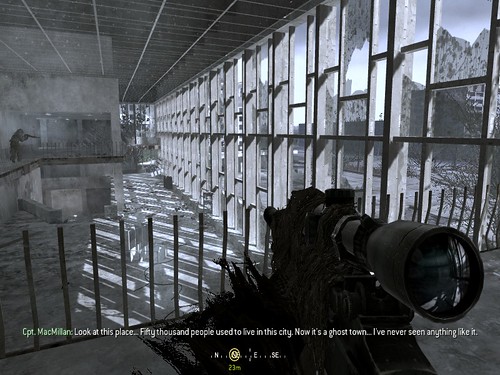
Call of Duty 4: Modern Warfare. Somehow I entirely missed the hype that surrounded Modern Warfare back on 2007. I put off playing it for a long time, ignorantly labelling it as just another brainless, macho, pro-American shooter. Then I had a moment and realised that my disregard was no better than all the people who disregard Halo without playing it. Afraid that I was missing out on something as special as the Halo naysayers are, I picked up a cheap copy from GAME and gave it a go.

By the end of the first level, I remembered why I really enjoyed Call of Duty 2 back in the day. Certainly, Modern Warfare's story is cliche and even a bit crass (Russians and Arabs threatening The West with nukes, oh my!), but it was so excellently executed that not only didn't I particularly mind, I truly felt like I had a responsibility to this fictional world, to see the job done. In the final few levels, particularly, I really felt the urgency. Infinity Ward have done a great job of making you feel like "just another soldier" and, simultaneously and conversely, as thought the fate of the entire world is on your shoulders.

Key Moments: The game probably warrants its own post, but some high points for me were the opening credits, in the back of the jeep; the entire Chernobyl level; and the utterly brilliant final moments of the game. This is how you present a linear story in the first-person mode.


Grand Theft Auto: Vice City. I dusted off my Playstation2 over the weekend and started a new game of Vice City. It took me awhile to get reacquainted with the archaic, auto-aiming controls, but one I did, I remembered why I loved this game so much. The style, the music, the script, all of it is so extravagant. I remember reading an OPS2 preview back before it came out that stated "the jump from GTA3 to Vice City is as big as the jump from GTA2 to GTA3". I couldn't believe this then, but now I must concede it is true. So many elements and mechanics still prolific in Grand Theft Auto IV can be traced back to Vice City, but no further.

Key Moment: Hooning down the beach on a PCJ600 with the sun rising over the water, the wind flapping through my Hawaiian shirt, and A Flock Of Seagulls on Flash FM. The urge to watch The Wedding Singer was almost irresistible.


The Dishwasher: Dead Samurai. XBLA is running some undead promotion at the moment and last week I was able to pick up The Dishwasher at half-price. It is unforgivingly hard, but the style is brilliant (if not a bit flat) and the pace is constant and fast. I am currently stuck on some kind of macho viking boss, but replaying past levels for more swirly currency is keeping me playing.

Key Moment: When my mindless button bashing transformed into frantic, deliberate combos and parrying.


Pixeljunk: Shooter. I have been meaning to play this game for I while. I have never played a Pixeljunk game before, but I have always been intrigued by their art style. Shooter has beautiful physics, beautiful music, beautiful charm. It is refreshing to see a dual-stick shooting game whose key goal is saving lives and puzzle-solving, rather than constant killing. The world reacts organically and predictably to your actions. I would like to find something to criticize about this game, but so far I have nothing.

Key Moment: Realising the ice encroaching from the bottom of the lake was actually forcing the water level to rise.


Articles I Read
"Bow Nigger" at Always Black. I stumbled across this older article thanks to a tweet of a retweet (you know how it is). Not only is it excellently written, but it deals with two things I am currently interested in: shared player/character responsibility to the fictional world, and etiquette between players in online play.

"The Delightful Absurdity of Just Cause 2" at Above 49. Nels Anderson's article went a long way in explaining why I enjoyed the Just Cause 2 demo as much as I did while simultaneously thinking how horrible it was. I found the discussion on 'camp' in videogames particularly interesting as it is something that has come up in my Film Studies at uni recently.

"Toy Soldiers" at The Supercollider. I found this article through Critical Distance's weekly blogroll. Overall, it is just a great read on war as represented in games and journalism. I have never played the XBLA title, but I downloaded the demo halfway through reading this article.


Podcasts I Listened To

GameCritics.com
Podcast Episode 33: Games With Great Storytelling.
The first podcast I have ever listened to! I became "that guy" on the bus who chuckled out loud because of something said in his earphones. After a 15minute rant about Ebert, the episode got into the meat of things about how games do (and more often, don't) tell great stories. I think they shot themselves in the foot more than once by pretty much admitting that the best videogame stories are 'told' through cutscenes and linear-ness and what not. I think they are just opening themselves up to rebuttals claiming that this is why videogames and stories are incompatible. Rather, I think they needed to make a point that videogames shouldn't try to tell stories, but should present stories. That said, they still make some great points about the fact that many game developers neglect the story until it is too late, etc. Worth a listen, if only for argument's sake.

Monday, April 19, 2010

Understanding Musical Films To Exploit Narrative in Adventure Games

I will admit that, as a film genre, I am not the biggest fan of musicals. I found the yearly-ish Disney animations of my youth frustrating. How did all the animals happen to know the lyrics and dance moves of a seemingly spontaneous performance? In live-action musicals like The Sound of Music, why didn't anyone else find it odd when people broke out in song? Because I failed to understand that the rules and conventions of the musical genre as being more important than a coherent fiction for these films, I could not enjoy them.

Reflecting, the frustration my parents expressed the few times they tried to play videogames with me through my childhood are quite similar to those I felt towards musicals: "Why did that item disappear?", "I shot him! Why is he still alive?", "How am I carrying so many weapons?", "Why can't I just use the blue key that I picked up on the last level?", etc. Just as I failed to accept understand the rules and conventions that lie at the heart of the musical film genre, inexperienced gamers will feel frustrated when a game's fiction inevitably breaks coherency and falls back to rules and conventions.

Both musical films and adventure games (by which I broadly mean character-driven games centred around the eventual resolution of an arbitrary plot) present, exploit, and abandon narrative elements in similar and parallel ways. While a musical film consists of song and dance performances generally separated by non-musical scenes, an adventure game consists of playable segments generally separated by non-playable cutscenes.

The performance in a musical film acts in the same fashion as the playable segment of an adventure game. Neither is required to move the narrative towards its conclusion, but that does not meant that it can't. Performances in musical films are split broadly between 'integrated' and 'non-integrated' performances. An integrated piece does move the narrative forward, but a non-integrated performance simply adds to the style and tone of the film without necessarily moving the narrative towards its conclusion. Non-integrated performances are still entirely justified as musicals are primarily about music, not storytelling. The playable segments of the adventure game can also be defined by this binary. An integrated segment will push the narrative forward, while a non-integrated segment could be just another platform level. Non-integrated playable segments are still entirely justified because games are primarily about playing, not storytelling. However, while storytelling is not the primary concern of either musical films or adventure games, both still indeed use stories and narrative in very similar ways.

(It is worth noting that 'integrated' and 'non-integrated' are merely the two extremes, and most playable segments and musical performances will indeed fall somewhere between the two.)

Similarly, the non-musical scenes that separate performances in a musical film act like a game's cutscenes. Non-musical scenes rely on fictional coherency (that is, the social and physical rules of the presented world are consistent) to push the narrative forward at least enough to instigate and justify the next musical performance. In the same way, an adventure game's cutscenes abide by a fictional coherency often ignored during the playable segments to push forward the narrative enough to instigate and justify the next playable segment.

Both musical films and adventure games use rules and conventions to justify breaks in fictional coherency. While the non-musical scene of a musical will be coherent in its application of normality, the moment the characters begin singing and dancing, this coherency is abandoned, justified instead by the convention of the genre that people must sing and dance in choreographed performances. Games, too, fall back on rules and convention to justify a lapse in fictional coherency during playable segments. To a gamer unfamiliar with the conventions of third-person platformers and action games, watching one bullet cripple Nathan Drake in one of Uncharted 2's cutscenes after the last two hundred bullets seemingly had no effect could be very frustrating. While the cutscene relies on the fictional coherency of the presented world that bullets hurt, the playable segments rely on the game's rule that health will recharge over time if the player is not shot again straightaway.

These parallels that adventure games (still a relatively young form of presenting stories) share with musicals (an older, perhaps more confident genre) are worth acknowledging for a variety of reasons. Just as all musical films use a blend of integrated and non-integrated performances, we can learn how games could better integrate some playable segments while also justifying the inclusion of non-integrated segments within the same game. In other words, the story can be progressed during gameplay, but gameplay that doesn't progress the story is no less valid.

For me, playable segments sitting at the non-integrated end of the spectrum would be the long grinds in an RPG like Final Fantasy VII, the repeated corridors of levels like Halo's Library, the jungle-gym climbing sections of Uncharted 2, wandering Fallout 3's wasteland between quests. All of these sections are fun (though, some will disagree with my Halo example), yet none, in my opinion, explicitly move the plot towards completion. More integrated segments would be fighting Sephiroth, blowing up the Pillar of Autumn to destroy the Halo Ring, sneaking into the Turkish Museum, leaving Vault 101 for the first time. These segments are playable and progress the story. These examples are, of course, subjective and open to much debate. It could be argued that every step taken in every game progresses the plot and is an important action to the overall experience, but that does not invalidate the theory--it could also be argued that every song of a musical brings us closer to the end of the film.

I still do not watch musicals often. However, as I am now more appreciative of the genre's rules and conventions as fundamentally more important than fictional coherency, I am able to appreciate the genre. Musicals such as The Sound of Music and Sweeney Todd show that a musical can be constructed on any ration of integrated and non-integrated performances to present a vast variety of themes.
Games too, just like musicals in their own youth, are capable of expanding to present a far a broader variety of themes than they currently do. Certainly, many early musicals conformed to the 'backstage musical' structure of characters putting on a show merely to give an excuse to perform lots of songs and dances, but are the blank-slate space marines of adventure games today any better?

Perhaps by looking at how musicals take advantage of narrative when it is needed but ignore it when it is not needed, games may learn to exploit narrative in a similar fashion to craft more creative integrated playable segments, but also to grow more self-confident to accept non-integrated playable segments that don't forward the plot, but don't have to either. Ultimately, analysing the punctuated story progression of musical films would be more useful for understanding how game stories progress than looking at more traditionally linear genres.

Wednesday, March 24, 2010

The Responsibility of the Player

Over at Experience Points, Scott Juster has two very interesting articles that work with the analogy of the player's role in a game as sharing properties with those of both the actor and director of a theatre. The first article, "Self-directed Play" sets up this analogy, and the second article, "Walk, Don't Run" discusses how a game's rules can be seen as the stage directions and how contradictions within these directions undermine the player's trust. Juster uses Uncharted 2's Tibetan Village scene and its mandatory walking as an example of this contradiction.

A sentence in the opening paragraph of this later article caught my attention as it concerned something I have often mused over, but have had trouble finding words for: the player's responsibility:
"[...] game players are responsible for both a performance's original vision and its subsequent reinterpretations."
The discussion in the comments focuses on when it is suitable for a game designer to force the player into a certain situation or to force the player to conform to unique rules in a certain scene. Without intending to simplify the entire arguments of the commenters (all of whom are totally worth reading, except for mine!): people seemed to agree it is acceptable for the game designer to intervene when the logic and coherency of the narrative is at stake. These comments (again I stress, generally) generally supported game designer decisions such as forcing Drake to walk in the Tibetan Village because if the player decided to run around in circles, the narrative would be rendered nonsensical. However, I think this overlooks the issue of player responsibility

With choice comes responsibility, as some movie character once said (well, I think they actually said 'power', but you get the idea). Just as the actor on stage has a responsibility to the play's overall performance, If a player has an active role in the performance of a game's narrative, he or she has a responsibility to act out the narrative in a coherent way.
Thus, as it is the player's responsibility, it is not something the game designer should force, but something the play should choose. Consequently, if the narrative jars in an inconsistent, illogical way in reaction to how the player acts, the player has only his or herself to blame. For example, it is the player's responsibility to the narrative of Uncharted 2 to walk Drake through the Tibetan Village; it is not the game designer's place to constrain the player by contradicting previous game rules (however, as Juster suggests, forcing Drake to limp as he is recently wounded would allow the game designer to alter the rules without contradicting pre-existing rules).

A disclaimer is now required! I do not mean to imply that the player should ensure the narrative is coherent. Even the most story-driven games are entirely capable of being experienced and (arguably) enjoyed independent of the plot. Rather, if the player wishes to enjoy the game's plot as a coherent narrative, they shoulder the responsibility of ensuring that their own role is acted out in a logical way. If a player wishes to run around the Tibetan Village like a lunatic, they should be able to within the same rules that define the rest of the game; however, that same player can not complain two minutes later that the story makes no sense because of Drake's frivolity. The actor in a theatre cannot complain that the role they just performed was unconvincing without accepting a fair amount of the blame.

A comment on "Walk, Don't Run" brought up Half Life 2:

"Gordon, if he were a character at all and not just a floating gun, would be a complete psychopath and nobody notices. He's busy trying to break the teleporter prototype while Alyx is pouring her heart out. He never looks the actual characters in the eye, he's too busy hopping around impatiently at the exit he knows they're eventually going to lead him to. Valve, in their stubborn but admirable devotion to a particular mode of gamemaking ignore the importance of social rules and it destroys the illusion of believability for both Gordon and the characters in the game."
Valve, I think, do not ignore the importance of social rules; the player does. The player, as an actor in the role of Gordon Freeman, also has the option to stand with the other scientists and listen to the discussion. If the player wishes to enjoy the narrative of Half Life 2, it is his or her responsibility to act in a way that maintains its coherence.

As an aside, years ago, without considering it at all in these terms, I played through Half Life in a way where I pretended I 'was' Gordon Freeman. I acted out my role as a scientist who had no idea what was going to happen. I walked from the train to the test lab (forgetting my HEV suit and being turned around by the security guard on the way); I made eye-contact with people who spoke to me; I ran down the stairs utterly convinced the army was here to help. It was a really interesting way to re-experience the story of a game I had already completed many times before. In hignsight, I was performing as Gordon Freeman.

Back to player responsibility. Another example of player responsibility being ignored that bus me is Clint Hocking's attack on story-driven games in Edge's "Death of the Author" article:
"I'm supposed to feel sad about the death of this character and yet I ran over 17 old ladies to get there. It's really jarring."
It wouldn't be jarring if Hocking, as the player, didn't run over 17 old ladies in the first place. It is not Rockstar's responsibility to make it impossible to hit the old ladies (which, I should note, is not what Hocking was arguing); it is the player's responsibility, if they wish for the narrative to not jar, to not run over 17 old ladies. That said, the player certainly should feel free to drive however they desire if they have no concern for the narrative and only wish to experience the mechanics of the game.

Although I have made clear arguments in this piece, I acknowledge what a tricky thing it is to pin down. Just how much responsibility does the player have? The game designer must surely still have some responsibility towards the narrative, but how much? If not being allowed to run jars in Uncharted 2, is it still acceptable in Modern Warfare 2's "No Russian" mission?

Before these questions can be answered, it must be acknowledge that the play does have responsibilities that a passive audience has never needed to be concerned with. The actor in the theatre cannot sit before the stage to watch the show; neither can they blame the script they refuse to read. Similarly, the player cannot sit back and watch the game unfold without acting in it; neither can they feel mistreated when their own actions shatter the narrative's immersion.

Saturday, March 13, 2010

A Research Argument

[The following is an email that I wrote to the course convener of the research topic I am writing at uni this semester. I explain what I plan on looking at, why I plan on looking at it, and what texts I plan on engaging with. It is a fairly narrow topic as I only have 4000 words and a single semester to write it. If you have any interest at all in what I am planning on writing this semester, read on.

EDIT: I should also note that the essay must in some way tie in to the concept of 'dark play' as described in some random article the convener sent us. I guess the key elements of dark play can be described as a blurring of the frame of play, and a masking of the audience so that they can take part in forms of play that are not socially acceptable without having to fear social repercussions. This isn't too important to this article, though, but when you see the weird reference to dark play, that is why.]


I have been doing quite a bit of reading this week and have found a few texts that I think will be seminal to my essay. As such, I have been able to narrow down my interests into a specific topic… hopefully one specific enough! Now, the tricky part will be describing that topic in this email, which I already suspect may come across quite rambling.

In a sentence, I am going to look at how the real-world player and virtual character share the responsibility of protagonist in Fallout 3.

Over the last two days I have read several chapters of Jesper Juul’s half-real (2005), which is largely focused on, as the name suggests, how video games are 'half-real' in the sense they are played in the real world while simutaneously imagined in a fictional world. The relationship of a video game's ‘rules’ and ‘fiction’ (Juul intentionally avoids using the term ‘narrative’ as much as possible as he believes it has too many definitions and can only be applied to games if you pick and choose which definitions you use) are pivotal to the book. Juul’s defines the two as:


“[…] the fiction of the game cues [the player] into understanding the rules of the game, and, again, the rules can cue the player to imagine the fictional world of the game.” (p163)


This quote in particular made me think about the frame-blurring aspect of dark play. The player must play by the rules of the game, while the character that the player must use to interact with the game’s fictional world must abide by the world’s fictional laws (how gravity works, how non-playable characters to relate to your character, whether or not aliens exist, for example).

The following two quotes about the player and the character in relation to rules and fiction appeal to me as explicitly related to what I hope to look at, as well as clearly linking the topic to dark play’s concepts of masking and hiding the state of play respectively:


“A game is a play with identities, where the player at one moment performs an action considered morally sound, and the next moment tries something he or she considers indefensible. The player chooses one mission or another, tries to complete the mission in one way or another, tries to do “good” or “evil”. Games are playgrounds where players can experiment with doing things they would or would not normally do.” (p193)


And:


“If we assume that the fictional world of the game is a world, it would make sense to assume that the characters in that world are therefore generally unaware of their being fictional characters or being part of a game at all.” (p183) [Not sure why this quote is formatting so weirdly, sorry.]


I understand I can’t base my entire research topic on one book, and I have been reading chapters of other books and articles (including one specifically titled “Moral Decision Making in Fallout”), but I think these quotes sum up quite nicely what I am interested in.

My one problem with Juul’s book is his presumption that the playable character is the protagonist of the game’s story. A game’s narrative revolves around both choices the player makes in relation to the game’s rules, and attributes of the playable character (physical, mental, and moral) within the game’s fiction. Both the player and the character share the role of protagonist.

Fallout 3 will be a good game to exhibit this as the player has much freedom over creating the playable character’s attributes—gender, ethnicity, physical abilities, charm (or lack thereof), morality (based on a quantified measure of ‘karma’ on a sliding scale of -1000 to 1000), etc., and those attributes in turn affects what quests the player is able to attempt, which non-playable characters are friends or enemies, among many other variables. Essentially, the fact that the player may enact either a ‘good’, ‘evil’, or ‘neutral’ character, or even one that swings between the three based on the immediate circumstances, means that Fallout 3 will be a good example to highlight the shared role of player and protagonist, and also to tie that shared role to dark play.

As the essay is so short, I know I will have to apply strict limitations, such as the type of video games this applies to (specifically, coherent-world, adventure games) and so forth. However, and counter-intuitively to the rambling length of this email, I feel this is a topic that I will be able to cover in this essay.

Monday, March 8, 2010

Meaningful Death

(I have tried my best to keep this article free of spoilers. Reading it will not reveal the identity of the Origami Killer, nor will it reveal the consequences of any particular course of action through the game. What it will spoil, however, is the existence of certain scenes in the game. You may find these scenes more rewarding if you read nothing of them before you play them yourself.)

I have only read a fraction of all the Heavy Rain writing out there, but I am surprised that none of the blogs I have read have touched on Heavy Rain's treatment of death. Heavy Rain treats death in a way that I found so much more emotive, so much more immersive, so much more meaningful than near any other game I have ever played, and then it completely stuffs it all up in one scene towards the end of the story. Death in Heavy Rain and its affect on the player has left me simultaneously more impressed and more frustrated than any other aspect of the game, more immersed in and more shut-off from the characters and plot than any game I have recently played.

Narrative-driven games are, more often than not, violent. I am not qualified to justify why this is the case, nor am I well enough read on the matter to link you to someone who is. A story requires conflict of some kind, and a game requires inputs and reactions; violence is a natural solution to this and has been used since one space ship blew up the other in Spacewar. I have no qualms with narratives being violent as long as that violence is used to present a meaningful story, to intentionally evoke a certain emotion from the audience. I want to feel like every death within a story I experience is presented to me like a real person, and that their death is important. I want to be affected by it.

Novels and films arguably have an easier time achieving this than games. The easiest way to make death matter is, simply, to have less deaths. The death of a single character that has been well-rounded over a two hour film is always going to evoke more emotion from the audience than two hours of hundreds of generic mercenaries being thrown from an exploding building.

This is not to say games have not tried to evoke a meaningful, emotive response to death from the player. Call of Duty games highlight that the player is merely "just another soldier" by showing the war from multiple points of view, even killing a few of them to emphasise that you are no more important than any other soldier on the battlefield, and conversely, that every other soldier on the battlefield is just as important as you. Grand Theft Auto 4 forces the player to decide if certain characters are executed or allowed to go free. A friend may easily be injured coming to the player's rescue in Far Cry 2, and the player must make a split-second decision to help their friend in return or to run and save themselves.

However, these attempts at making death meaningful are often diluted by other actions performed in the game.
Games require constant action in order for the player to remain a participant in the narrative's forming. Thus, a typical gaming narrative will often require more constant violence, more constant deaths, and thus, each individual death will carry considerably less meaning. Enemy soldiers in Call of Duty are still treated as hordes of cloned 'bad guys' (though, this criticism could be levelled just as easily at any war film or novel). The play can splatter a dozen old women against the footpath as Nico discusses why he did/did not execute Drako Brevic. Saving your friend in Far Cry 2 will require you to slaughter ten other mercenaries, five of whom look exactly the same, and all of whom look the same as mercenaries at other camps throughout the map. Any attempt to make a single death more meaningful in a game is usually diluted by the two dozen flat characters that died beforehand.

It is worth noting that in each of these games, a large percentage of the basic toolset of actions that the play has available to interact with the gameworld are violent: shoot, hit, throw grenade, reload (to an extent), etc. Consequently, in order to interact with the gameworld, the player must engage in violence for a considerable percentage of the game.

The actions a player may use to interact with Heavy Rain's gameworld, though, are far more numerous and broad than an average action-orientated game. Pick up cup, open fridge, look in glove compartment, lean on balcony, turn on the lights, think, etc. By allowing the player to participate with the gameworld through non-violent actions, Heavy Rain is able to space out violent acts while still remaining sufficiently interactive for the player to progress the narrative. Thus, there are less deaths in the game. Additionally, as the ratio of possible violent actions versus possible non violent actions widens, the impact of a single violent action (pulling a gun, for example) intensifies, and each death is able to have more meaningful consequences for the plot and for the player's overall experience.

I am going to look at three specific types of death in Heavy Rain: two that are more emotive and impactful than nearly any death I have experienced in video games, if not any narrative. The third, towards the end of the game, disappointed me greatly and essentially made a mockery of any meaning the player took out of earlier deaths in the plot and thus destroyed my immersion for the length of the scene, my conviction in the character involved, and almost destroyed my entire game experience.

Type One: Meaningful Murder

In my playthrough, there were two times I was faced with the choice of pulling the trigger of a gun aimed at someones head. If I press R1, the person on the other side of the barrel dies. Their life would continue or end based on the choice I made.

The first was the scene where a suspect pulls a gun on Lieutenant Blake and I, playing as Jayden, in turn pull my gun at the suspect. This scene shook me up quite a lot. I did not want to shoot this character; it was Blake, that pig-headed dolt, who provoked the suspect in the first place. I tried to negotiate; I tried to convince the suspect we could all walk away (an empty gesture after we illegally broke into his apartment, I thought); no one has to be killed here today.

But he grew more edgy. In the end, I panicked and pulled the trigger. My feelings mirrored the dumbfounded look on Jayden's face: I killed him. I was not thinking this coherently at the time, but in the end, it came down to the choice of killing a paranoid man whose house we had entered unlawfully, or allowing a cop to die. I was forced to decide who should live and who should die. I am still unsure if the suspect truly would have pulled the trigger, if I could have talked him out of it. The decision I made stuck with me for days.

The second scene, similar to the first, is when the Origami Killer orders Ethan to murder a man in order to obtain a clue of Sean's whereabouts. When the man opens his door, I understand he is a drug dealer and feel relived that this may make my decision easier. Sure, I am not one to judge a man's life by his drug habits, but it will make it easier to justify it to myself later. However, as one thing leads to another and I am chased through his house, I see his belongings; I see where he lives; I see the artifacts that make this non-playable character into a human being. In the end, standing in his child's bedroom, I simply can't do it. I cannot justify exchanging this man's life for Sean's. I walk away and do not obtain the clue.

In both these situations, the player has to choose (or feel they have to choose, at least) between who lives and who dies: Blake or the suspect, Sean or the drug dealer. Because your character has not just gunned down fifty goons, bandits, gangsters, or aliens, and because both the suspect and drug dealer are fleshed out as living humans by the presence of their homes and belongings, neither choice is easy. These characters are not just faceless non-playable characters that you are fragging. This is murder and your choice will have consequences.

Type Two: Meaningful Suicide

In most games, the most meaningless death of all is that of the player/protagonist. Or, rather, the player/protagonist's life is so meaningful, so utterly integral to the narrative, that the game cannot go on without them and can only continue in a coherent fashion by resetting to a checkpoint situated previously in time and/or space in relation to the point of the player/protagonist's death. In essence, the plot pretends the player never made the choices/actions that lead to their demise.

Having to repeat a section of the game is usually the most meaningful consequence of self-death a player will ever have to face. The in-game protagonist tends to face even less of a consequence as their timeline simply resets and they have no memory or ever actually dying, or they just lose a small amount of money or skill points. (Note: I know I have brought it up several times before, but it is worth noting here again the various perma-death experiments that I am sure you are already familiar with, especially Ben Abraham's Far Cry 2 experiment.)

Heavy Rain has been criticised by some for presenting multiple points-of-view instead of focusing on a single protagonist. Shoinan argues that it made him feel more like a director than a player. This is a fair call. Multiple protagonists do weaken the player's attachment to any one character (namely, Ethan) while not allowing others the time to be properly fleshed out (namely, Madison). However, multiple points-of-view allow Heavy Rain to be one of the first games I have ever played to deal with the consequences of permanent player death, to weave it into the narrative, and to move on. Sure, Mass Effect and Final Fantasy VI may kill off a party member or two, but in Heavy Rain, YOUR decision and/or actions may get YOU killed and the plot will suffer very real consequences because of it, but it will not reset for you.

This knowledge that your death is permanent overshadows every choice and action the player makes through the game
(I distinguish between the two as a missed QTE can just as likely get you killed as a meditated decision). It adds gravitas when determining a path through the power station; it makes what are essentially QTE-scripted fight scenes more tense than any QTE scene formerly had any right to be. Most acutely, the awareness of your own mortality is painfully present in the last task the Origami Killer sets for Ethan: sacrifice your own life to save your son.

In any other game, this choice would have been easy. Obviously you would not die as if you did die, the game would end; it simply isn't possible in the mechanics of most games. In Heavy Rain, however, Ethan's death is very possible, and the water level won't stop rising if it happens before he can free Sean. The fact that Ethan's death would be meaningful, and not just cause me to respawn, made the choice of whether or not to drink the poison a lot harder. I sat Ethan in the chair in the corner for full minutes before I built up the courage to drink it.

Unlike nearly any other game, your death is not only possible in Heavy Rain, is is meaningful and it will have a meaningful effect on the plot.

Type Three: Meaningless Massacre

Only a scene or two after Ethan is faced with the heart-wrenching choice of murdering a man to hopefully save his son, Heavy Rain negates the meaning of this and every death-related choice the player has previously made and, essentially, cheats and betrays the player out of a meaningful experience.

The scene is the one where Shelby barges into a mansion of a millionaire and begins blasting away at faceless goon squads of cloned baddies who, ironically, look like they were taken right out of the original Virtua Cop. I honestly wondered at first if the scene was intended to be some kind of Virtua Cop homage or parody.

This scene is horrible. Horrible! Not twenty minutes after the player sweats over whether or not they should murder a drug dealer in his child's bedroom, they are trapped in an on-rails, QTE, lightgun event and slaughtering dozens of characters. These deaths are worse than meaningless; they are detrimental to the player's entire experience up to this point. The entire gameworld, previously only inhabited with detailed, actualised human beings, is now full of generic-action-game cloned goons needing to be slaughtered. This works in games that have set up cloned goons as consistent with the gameworld. In Heavy Rain, this is inconsistent with the gameworld presented up to this point and completely destroys any immersive zone the player has been able to build up for themselves.

The scene could have been better by, well, being anything other than what it was. Instead of Narnia closets full of guards (a la Virtua Cop), perhaps just two guards at the door could have been overpowered in a quick struggle and ten beg for their lives as Shelby overpowers them. Then the player can decide if he shoots them or not. Perhaps force the player to attempt to sneak in first. Anything but this meaningless QTE trash. I know I keep making the Virtua Cop analogy, but this scene was truly about as enjoyable as trying to play Virtua Cop on my playstation's d-pad before I bought a lightgun. I understand Shelby was pissed at this guy, but this scene was entirely out of character.

Worst of all, and the ultimate insult to the player, after the shootout, the player is forced to decide between letting an old man die of a heart attack or save him. This scene lost all significance for me (and, indeed, I did not mention it under Type One above) because of the events leading up to it. This is no better than Nico running over four pedestrians as he tells Kate he is a new man and is done with crime. In fact, this is worse, as the Grand Theft Auto 4 player can only blame themselves for running over the pedestrians, but the Heavy Rain player has no choice but to play through this ridiculous shootout. (Note: I mean no choice once the scene begins. I do not know if the entire scene is avoidable, but I doubt it is.)

Conclusion

Heavy Rain's characters (both playable and non-playable) are rounder and more fleshed-out prior to any input from the player than the characters of most games--they have more meaningful lives. Because we are able to see Heavy Rain's characters less as flat, empty models and more as fleshed-out people, causing the end of a character's life has a greater impact on the player.

Meaningful lives lead to meaningful deaths which, ultimately, lead to meaningful choices and interactions from the player. Heavy Rain is sometimes predictable, often clumsy, more often awkward, and even more often cliche. However, the player is able to be more emotively immersed in the plot of the game due to the meaningful consequences attached to their choices and actions, and the meaningful lives that those choices and actions may end.

(Final notes:

1. I did not even touch on the fact that the entire game's narrative is framed by deaths. Ie, it both begins and ends with deaths that the characters' every actions are motivated by in some way
.

2. There is a lot wrong with Heavy Rain that I did not touch on in this article. For a good run down on articles looking at Heavy Rain, I would start at Critical Distance's blogroll for last week. And this great article at the Borderhouse Blog.

3. Disagreements and challenges are more that welcomed to this article, they are encouraged. Also, I have spent the better part of this afternoon and evening typing and retyping this and it is surely full of typos that I missed in my half-dazed proof read.. By all means point them out to me.)

Saturday, March 6, 2010

Thought For The Day

If a game requires players and a story requires characters, then the narrative-space of a video game can only be navigated by a hybrid of the two: a player/character with shared, symbiotic agency.

Monday, March 1, 2010

Interactive Tropes

So I started playing Heavy Rain last week and am enjoying it quite a lot more than I expected to. Perhaps it is simply the novelty of playing a game that is more than Just Another Shooter or Just Another Platformer that I find so alluring about it; I'm not sure. It is not without its flaws, but a post addressing those can wait until I complete the game, and that will have to wait until this so called apocalyPS3 passes. For now, I want to look at something which has previously played through my head but which Heavy Rain has caused me to consider from a different perspective: the relationship, or perhaps dichotomy, of interactive-ness and round-ness.

Narrative in linear mediums are more convincing, more believable, if the protagonist is more round. By 'more round' I mean more detailed, more fleshed out. The more we know about the protagonist, the more 'real' they feel, the more likely we are to suspend our disbelief of whatever fantastical plot they find themselves in.

On the other hand, by consequence of being interactive, video game protagonists are generally flatter. That is, they enter the story with very few personal characteristics pre-authored into them. This makes sense as the more attributes pre-ordained unto a character, the less attributes the player is able to endow through interacting with the game. A protagonist of a Grand Theft Auto-like game who has a deep-seeded belief in non-violence would render the crime-ridden story of murder and action illogical and impossible to believe, let alone be an immersive experience.

Interactivity and round-ness are opposite ends of a sliding scale. The more a player is able to interact with and have control over a character, the less round that character is capable of being. Conversely, the player will have more issues interacting with and directing a more rounded, more characterised character.

At the more round/less interactive end of the spectrum are strongly grounded characters like Cloud Strife and Nathan Drake. Characters who are round enough to be convincing in their own right, yet are only interactive in very basic ways (though completely different ways if we were to compare Cloud and Drake) that don't allow much room for the player to add their own attributes to the character. Both Cloud Strife and Nathan Drake are the same characters for nearly every player that plays through their stories.

At the other end of the spectrum, where characters are less round/more interactive, are characters like Gordon Freeman or the Vault Dweller. Characters whose nigh every move can be controlled from picking up a bottle, pulling a trigger, to climbing onto a rooftop, yet are not able to be convincing characters independent of the player's input. Instead, their personalities and moralities are expressed in the player's decision in how an obstruction is confronted, how an objective is obtained.

Somewhere in the middle, in my opinion, would be Commander Shepard and Nico Belic: characters with a relatively strong sense of self but not one that is unmovable by the decisions the player makes throughout the story.

This is why the vast majority of gaming protagonists are tropes, ranging from generic male space marines to generic male mercenaries: to allow the player to paint their own experiences and choices onto an avatar. That, and because many video games are horrible cliche, but that is a different discussion.

Heavy Rain's plot is relatively unique to video games, but is nothing that hasn't been seen before in film or literature. However, its somewhat archetypal (perhaps even stereotypical at times) crime/thriller plotline has me no less immersed than the leaking halls of Rapture or the oppressed streets of City 17. Is it simply that the interactivity of being able to bump the right analog stick to the left to avoid a head-on collision on a freeway makes the scene that much more gripping than watching it passively in a movie?

Well, simply: yes. As Ethan speeds down that freeway, he could die if my reflexes are off by a millisecond. Just as his Shaun's life is in Ethan's hands as he plays the Origami Killer's games, Ethan's life is in my hands as I play Heavy Rain. If I screw up, he is dead.

And that is an experience unique for me in Heavy Rain. I don't die; Ethan does. In Fallout 3, Half-life2, even Grand Theft Auto 4, it's not Qwae, Gordon Freeman, or Nico Belic that dies (at least, not exclusively) but I who dies. Typically, the symbiotic agency between player and protagonist within the gameworld (a symbiosis that strengthens at the less round/more interactive end of the scale) means that the failings of one of us kills us both. But in Heavy Rain, my failings may kill someone else. How far am I willing to go to save someone I love, indeed.

Heavy Rain's characters are about as far across on the less interactive/more round end of thesliding scale as it is possible to go and still be considered interactive. You cannot jump onto the bed; you cannot break and do a u-turn as you drive down the street; you cannot pistol-whip your partner in the police for being a complete douche (which he really, really is). Ethan can sit on the bed, or he can not; Ethan drives down the street whether you adjust the review mirror to look at Shaun on the backseat or not; Norman can futilely shout at the cop to stop beating a suspect, or he can not. Quantic Dream seems to be aware of this in the way Heavy Rain never seems to be referred to as a 'game' and instead as an 'interactive drama'.

By allowing the player less agency over the characters, the characters of Heavy Rain are able to be far better rounded, meaning they are able to be far more convincing characters in their own right before the player makes any form of input.

The environment, though, is another matter entirely. While the characters are less interactive and better rounded than in a typical game, the environment is arguably far flatter and interactive. As many reviews have observed, Ethan's house looks as lifeless and stale as the pages of an Ikea catalogue. The grocery store looks like every grocery store in every city in every country I have visited. The shopping mall looks like... well... okay, shopping malls are pretty lifeless already.

Note that this generic-ness of environment isn't a bad thing. The same scale of round-ness/interactive-ness that applies to characters also applies to environment. While all of Heavy Rain's environments are generic tropes, they are still believable and convincing by being so interactive. Ethan's house feels real; the grocery store feels real; the shopping mall feels as close to real as any shopping mall could hope to feel because the player is able to interact with them so coherently.

Dozens of objects in your house, in the grocer, in the police headquarters can be interacted with and manipulated to potentially affect the direction the narrative takes. It is the player's physical interactions with the environment that are more likely to affect the narrative outcome of Heavy Rai-n-either intentionally by opting to hide the origami shoebox under the motel bed, or accidentally by missing a QTE on the freeway--than the character-motivated conversation interactions like in, say, any BioWare or Bethesda title.

If Gordon Freeman, the Vault Dweller, and The Master Chief are blank canvases on which the player is meant to paint their own choices, the characters of Heavy Rain are portraits as detailed as the close ups of its loading screens--the player just adds chance scars (both physical and mental) haphazardly as they stumble through the story. However, if City 17, The Capital Wasteland, and the Halo Rings are portraits of complex, well rounded worlds within which the game occurs, then the settings of Heavy Rain are blank, minimalist walls and the player can paint on them with whatever damn item they find in the room.

There. Unmix those metaphors!

Monday, February 22, 2010

Ludology, narrative, stalemate.

So it has once again been a very long time since I posted here. Since October, I have been doing quite a lot of academic reading for games. In particular, Hamlet on the Holodeck by Janet H. Murray (a good place to start), and various articles in First Person: New Media as Story, Performance, and Game. Thanks to the dudes who took the time to comment on my last post and give me a place to start reading. There are still a lot of names there I am yet to read, but a lot more of them are beginning to look familiar the more I read.

This semester (commencing next week) I am returning to uni. I am not starting Honours until next year (I will be doing Communication & Cultural Studies), but this semester I am doing a Media Studies research topic as I kind of precursor. I am planning on either looking at Grand Theft Auto IV or Fallout 3 in relation to Jenkins's article, "Game Design as Narrative Architecture". Specifically, his concept of examining games less as stories and more as "spaces ripe with narrative possibility".

I have also forced myself to read some articles in First Person that do not relate specifically to my interest in narrative, as well as those that fight more for ludology (out of those that still frame the issue as a debate between the two). These viewpoints that I do not normally consider have been challenging but very interesting and insightful.

So for this post, I just want to empty my head with a few ideas and things that are running around in there. They are ideas that are related, but in this post they will be presented in separate blobs.I will work on pulling them together as time passes and I get more confident with the texts I am reading. Also, I accept there is the very likely probability that I am going to a) give acknowledgement of concepts and ideas to the wrong people; ie. to the person who wrote the article I first read it in when there may very well be a previous piece that covered it first; feel free to correct me. And b) to have epiphanies and ideas that are either proven wrong already or are better worded by academics I am yet to read; again, please correct me or point me in the right direction.

So here are just a few things running around my head. Firstly:

1. Don't ask what narrative can do for games, but what games can do for narrative.

Okay, that is horribly cliche, but it is the best way I can think to describe simply what I mean. Games don't need narrative. Fact. They are able to "have narratives" (in a very vague sense that I will get to later) but they do not need narratives. Tetris does not need a narrative; Chime does not need a narrative; Geometry Wars does not need a narrative; yet all of these are still able to be amazing games.

In the introduction to "Towards Computer Game Studies", Eskelinen invokes the metaphor of colonisation:

"So if there already is or soon will be a legitimate field for computer game studies, this field is also very open to intrusions and colonisations from the already organised scholarly tribes."

This got me thinking and I kind of got carried away with the metaphor in my head. Narratologists, Cultural Studies Peoples (what do you call people who study Cultural Studies, btw?), English Literature Peoples, etc. are all looking at games and how they can be "improved", so to speak, with narrative. I guess this is similar to a bunch of Europeans riding a boat to [insert Oriental country here] and "improving" the indigenous population by civilising them. In a way, the staunch ludologists are the indigenous tribes refusing to give up their own culture and constantly pestering the advancing colonists instead of just submitting.

Until Eskelinen's article, which I only read a few hours ago, I was one of those colonists, keen to "improve" games with better narrative, whatever that means. But now I realise that I don't want to improve games with narrative, but I want to see in what ways games can make narratives more emotive, more expressive, than any previous medium could beforehand. I want to learn hunting skills and natural medicine from the locals as opposed to converting them all to Christianity, so to speak.

Now back to that thing where I said games "have narrative", which was really just me using a gap filler.

2. Games are not, and can not be narratives. They can be narrative-spaces, or (if I dare coin a term) prenarratives.

Games are not narratives. "Most naive comparisons between narratives and games usually result from too narrow, broad, or feeble definitions of the former," says Eskelinen, and I realised I agree with him. Sure, games are able to have narrative elements, but they do not have ALL the elements. You can not just conveniently forget or add certain properties of what defines 'narrative' just to make it fit. Games are narrative-ish, I suppose.

Sticking with Eskelinen for now. This has got to be one of my favourite ludology-leaning quotes so far:

"[I]f I throw a ball at you, I don't expect you to drop it and wait until it starts telling stories."

Very true! BUT! If you throw a ball at me, and I throw it back, then perhaps later I could tell you the story of how you threw a ball at me and I threw it back. Eskelinen also says this:

"A sequence of events enacted constitutes a drama, a sequence of events taking place [constitutes] a performance, a sequence of events recounted [constitutes] a narrative, and perhaps a sequence of events produced by manipulating equipment and following formal rules constitutes a game." [bold added]

A sequence of events recounted is a narrative. This is very true. I'm sure there are hundreds of academics and theorists who have said this before me, but narratives happened in the past (before they could have been considered 'narratives' and were just events) and are recounted in the present (thus turning the events into narratives). This is why most stories are in the past tense. But games are more immediate due to the unique attribute of being interactive. Games are happenings, not recountings. BUT what about after the game is finished, what then? When that game experience, the events that constituted that playthrough, are connected in the form of a narrative with both plot and story. This is the case whether you are simply talking to your friend about something that happened to your character in Fallout 3, or writing a blog for your Sims, or creating a user video out of Grand Theft Auto IV, or recording your perma-death experiment on Far Cry 2. Games are not narratives, but the events of games can be retold as narratives. My life is not a narrative, but it can be written as a narrative once it is over.

So this leads me to Jenkins's "Game Design as Narrative Architecture" and the idea of "examining games less as stories [and more] as spaces ripe with narrative possibility." Or, more simply, narrative-spaces. To use the biography analogy again, our lives are full of choices and events capable of forming our lives into a compelling narrative if formed in the right way. As are the events and choices we make in any "story-based" video game (another term that will need clearing up).

Open world games like Bethesda titles are probably the best example, but not the only examples. I am going to use Fallout 3 as an example. The Capital Wasteland is littered with compelling narrative elements which, independently, are not narratives in their own right. A comm log here, the corpses of a raided caravan there, a town infested with Death Claws beyond that hill. But as my character threads her way across the Capital Wasteland, discovering her own character and morality by the choices she is forced to make(no different, I believe, to a character "finding herself" in any journey story), these separate elements are stitched together through my interaction with the narrative-space (the game world), and these events can then later be retold as a narrative.

So whether or not games are narratives is irrelevant. Games can be retold as narratives. The choices Qwae, my first Fallout 3 character, had to make in the final chapters of The Pitt have shaped who she is ever since. I can recall this story as clearly as I can recall any story on the bookshelf beside me, it affected me so greatly--more so because I had a role (an interaction) in the decision made.

So games are not narrative.
Games are prenarrative, perhaps. They are the building blocks, the events, that must exist before the narrative does, no less so than the events in a novel or a film or a life exist (even if only in the author's or director's head) before the narrative does. The fact that each person who plays through Fallout 3 will have a slightly different narrative to recall afterwards is what makes games so valuable to narrative (as opposed to narrative being valuable to games).

--

So this is quite long, but I think those are the two key things I needed to get out of my head before I forgot. Any opinions are welcomed. Am I crazy? Am I stating the obvious? Has all this already been stated far better by someone else? Has all this already been proven wrong by someone else? Let me know.


Tuesday, October 20, 2009

Back to Uni

(People on the internet never seem to realise that 'uni' means university. Consider this me telling you that indeed uni does mean university.)


It looks like I will hopefully be returning to university next year to do a Communication and Culturual Studies Honours (ie. "Other", in the English School) to look at narrative in gaming and the such. Particuarly I want to look at the role of the author in games and all that stuff that I rant about (and other people rant about far better). So that should be fun, if my application survives the 6-months of beaurocratic hell to try to enrol.

Technically, though, I am not elligible to enrol as my Writing Major did not have the subjects to prepare me for an English School Honours. So over the summer (southern hemisphere), I will probably be writing a 5000 word research essay to hopefully pave the way into Honours. I applied yesterday for the research essay, and this is what I wrote that my research topic would be:

"The interactive nature of video games allows the presentation of unique narratives that would be impossible in conventional, non-interactive mediums such as film or literature. I wish to identify the devices that video games use to form these interactive marratives and how they affect the audience's (ie. the player's) experience."

So in five thousand words (ha!) that is what I will roughly be looking at. Hopefully looking at gaming narratives' uniqueness will create a kinda vague framework for the authorship stuff I wish to look at next year.

So the question I have to ask you guys is this: Are you aware of any scholarly pieces or academics that already name and identify devices that games use? It would make my essay easier (and make me seem far less arrogant) if I could critique someone elses definitions rather than take it upon myself to make some up myself (and not do them justice in a measly 5000 words).

So now I have to seriously start getting a bibliography together and finding scholarly readings that I can cite and the whatnot. My main issue is that I believe the most interesting discouse about gaming theory is happening in blogs and (the occasional) gaming magazine. So I will need to make a case for citing these types of sources in my essay/thesis. That said, I really haven't looked too hard for scholarly game writing or peer-reviewed journals so I shouldn't jump to conclusions. If anyone can suggest any, that would be tops.

Thursday, October 1, 2009

Who is the narrator?

So between ODST, Scribblenauts, and a family holiday, it has been a while since I last posted. Oops! I attempted to write a massive piece about why Halo is amazing without soundig like a fanboy...but I inevitably sounded like a fanboy so I gave up on that.

Anyway, I have been playing a LOT of ODST lately. The reviews I read were mixed (Edge gave it a 9, Good Game gave it a 5 and a 7, I think) and I think the safe conclusion is if you like Halo you will like ODST, and if you don't like Halo, you won't like ODST.

I am going to resist the urge to go on a rant about how unfortunate it is that so many people disregard Halo as a simple humanist/Americanist alien-shooter (and how unfortunate it is that so many people love it as a simple humanist/Americanist alien-shooter) when the series does so many things right, ad instead talk about some of the really interesting narrative things ODST does (at least, i thought they were interesting). I warn you, though, I am probably oging to pose more questions than I am going to answer. I'm lazy like that.

As you probably already know, ODST's story unfolds as you explore the ruins of New Mobasa and trigger flashbacks where you play a level as anothe rmember of your squad, gaining new perspectives and clues. One of Good Game's criticisms of the game was (and I paraphase) that the Rookie seems to be some mystical, omniscient medium who seems to be able to see the past simply by touching a vaguely related object. I refute this. Never does the game suggest that the Rookie himself viewed/interacted with the same flashbacks the player did. The player did, but not the character the player plays.

But how then does the Rookie know where to go next? Well, the Rookies objectives are never explained in the flashbacks. Rather, they just seem to magically appear as navpoints on his visor. This navpoints, I believe, are set by the AI, Virgil. The Rookie is not merely exploring random areas till he finds the clues needed, he is being points ever-so-subtley by the AI with locked doors, "Keep Right" signs and warning sirens. In a sense, the Rookie is merely the Ai's puppet. It is as subtle in the gameplay as it is blatant in the audio files. I love it. I love how the AI's presence is spread so thin and ghostly but so omnisciently through the story.

Anyway, Good Game's use of the word "omniscient" got me thinking. Perhaps ODST truly does have an omniscient narrator--a narrator that is capable of seeing/hearing anything from any perspective.But who is this narator if not the rookie? I put forth the (not too-well considered) notion that perhaps the AI, Virgil, is the narrator of ODST. The hints are there: the security camera cutscenes, the scanning-esque loading screens, etc. Each member of the ODST unit sees only a fraction of the entire story, but Virgil and the player see it all.

So if Virgil is the games narrator, then does that means that the characters that the player controls (the ODST squad members) are not narrators? Does this is turn mean the player is not a narrator in ODST?

I don't think that is possible. The player is still narrating. The player is still determining what order the scenes play out and the exact, physical actions of the ODST members, so as each ODST member, the player is controlling a Limitied Narrator, while Virgil is somewhat of an omniscient meta-narrator looking over the whole thing, arguably determining how the player views cutscenes.

In fact, I think I may have answered my own question: the player is the narrator(s) from start to finish, but from multiple points-of-view... maybe. I don't know! I am thinking this as I write and now I have a lot to think about.

As a side-note: the Arts student inside me wants to point out that there is no reason the Rookie could not be a female, and I place all the blame squarely on sexist English pronouns for my refering to s/he as 'he' in this post.